
Key Takeaways
01.
VR, 360° tours, 3D and AR are not interchangeable. Each solves a different property-viewing problem.
02.
Browser-first experiences can be the better starting point when reach and low friction matter.
03.
VR is most relevant when distance, uncertainty, complex layouts or the absence of a physical property create friction.
04.
A production solution needs more than 3D graphics: it needs property data, content management, integrations, analytics and reliable delivery.
05.
AI should improve property discovery and assistance without inventing listing facts.
06.
Success should be measured through qualified enquiries, viewing progression, shortlist activity, conversion and sales efficiency, not only tour sessions.
Buying or leasing property online has one obvious limitation: a screen can show information, but it cannot always make a space easy to understand.
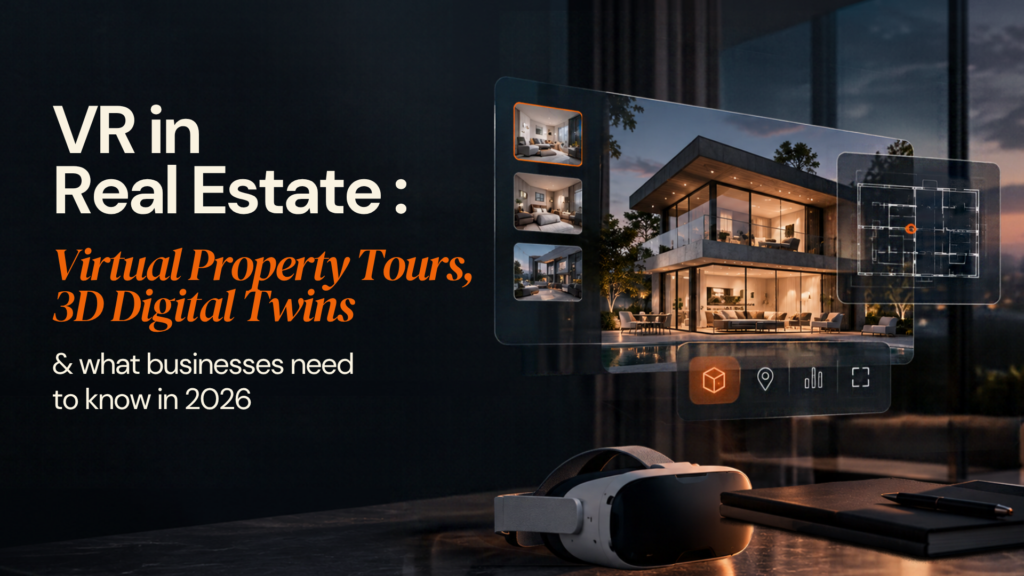
That is where VR in real estate becomes useful. Virtual tours, interactive 3D environments, digital twins and headset-based experiences can help buyers explore properties remotely, understand layouts, compare options and make decisions before an in-person visit.
The opportunity is already visible in buyer behaviour. Zillow's 2025 Consumer Housing Trends Report found that 20% of prospective U.S. buyers ranked 3D/virtual tours as the most important listing feature.
But that does not mean every property business should build a VR app.
At Designoweb, we approach immersive real estate as a product and engineering problem: what decision is difficult today, where does spatial context help, and what is the simplest experience that can improve the outcome?
01
What VR in Real Estate Actually Means
“VR in real estate” covers several levels of immersion.
A buyer might open a 360° tour in a browser, walk through a navigable 3D model, use AR to visualise a renovation, or enter a fully immersive property using a headset. These experiences may share the same spatial assets, but they have different hardware, UX, development and distribution requirements.
360° virtual tours
A 360° tour uses panoramic imagery to let users move between rooms and inspect a property remotely. It works on standard browsers and is often the lowest-friction option.
Research on interactive 360° visits has found benefits over static imagery for the visitor experience, making this format useful when broad access matters more than maximum immersion. Research on interactive virtual tours
Interactive 3D and digital twins
A 3D property experience can go beyond panoramic viewing by representing the space as navigable geometry with room relationships, measurements, floor plans, annotations and interactive content.
That creates a wider product surface:
3D model → floor plan → room navigation → measurements → configurations → enquiry
For commercial property, the same spatial model can support sales, site selection and later operational workflows.
Headset-based VR
Headset VR puts the user inside a computer-generated property or showroom. It is particularly relevant to:
- off-plan developments
- premium or luxury sales
- virtual sales centres
- large commercial spaces
- remote investor presentations
- guided property demonstrations
The trade-off is reach. Headsets add hardware, onboarding, and performance constraints. That makes headset-first VR a strategic choice rather than a default.
AR for real estate
AR is different again. It places digital content into the physical world.
Examples include:
- proposed furniture placement
- renovation previews
- building-scale visualisation
- finish selection
- development models
- site-based experiences
Google's ARCore provides capabilities such as motion tracking, environmental understanding, depth, and geospatial positioning on supported devices. Google ARCore
02
Where VR Creates Real Business Value
The strongest use cases are not the ones that look most futuristic. They are the ones that remove expensive friction from the property journey.
Remote property qualification
Physical viewings consume time for agents and buyers, especially when the buyer is in another city or country.
A virtual experience can help answer an earlier question:
“Is this property worth travelling to see?”
That makes VR and 3D valuable for:
- overseas buyers
- international investors
- relocation programmes
- student accommodation
- premium residential property
- commercial tenants comparing locations
The goal is not to eliminate every physical visit. It is to improve which visits happen and when.
Off-plan property sales
Off-plan developments are one of the clearest applications because customers cannot physically inspect the finished product.
A developer normally asks buyers to combine plans, renders, specifications and verbal explanations into a mental picture. Interactive 3D or VR can make that picture tangible.
Buyers can explore:
- room proportions
- circulation
- sightlines
- finishes
- balconies
- amenities
- alternative layouts
The commercial value comes from reducing uncertainty before a purchase decision.
Listing differentiation
Immersive content is no longer limited to experimental PropTech projects. Zillow's 2025 research found that 3D/virtual tours were ranked as the most important listing feature by 20% of prospective U.S. buyers. Zillow Consumer Housing Trends Report 2025
For property companies, that points to a broader strategy: use immersive media where it strengthens the listing rather than adding VR everywhere.
Commercial real estate and site selection
Commercial properties create a different opportunity because buyers and tenants often need to understand more than appearance.
A digital twin can support:
Explore space → compare layouts → inspect amenities → evaluate fit-out → shortlist → schedule a viewing
This is particularly useful for offices, retail spaces, hospitality, industrial facilities and large developments.
Virtual staging and configuration
Spatial technology becomes more valuable when users can change the property rather than simply look at it.
Examples:
- furniture layouts
- flooring
- wall colours
- kitchens
- bathrooms
- lighting
- partitions
- fit-out options
The strongest implementations connect those options to a real catalogue, development specification or pricing workflow.
03
The Architecture Behind a Production-Ready Real Estate VR Platform
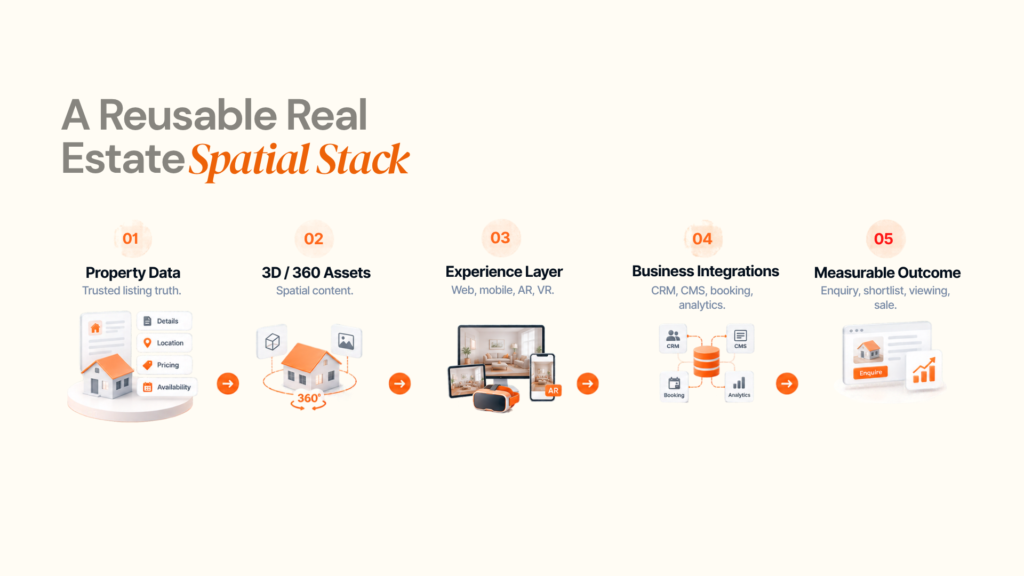
A real estate VR product is not just a Unity scene. It is a software system connecting spatial content to trusted property information.
The core architecture
Property data → 3D/360 asset layer → experience layer → web/mobile/XR delivery → CRM & lead systems → analytics
Property data layer
This should remain the source of truth for:
- property ID
- price
- availability
- dimensions
- floor plans
- amenities
- specifications
- agent details
- development information
Avoid maintaining separate listing data inside the immersive application. Property details change too often.
Spatial content layer
For an existing property, inputs may include 360° capture, depth scanning, LiDAR, or photogrammetry.
For off-plan developments, inputs may include CAD, BIM, architectural models and 3D assets.
The important decision is to create an authoritative, reusable asset pipeline.
A strong model should support more than VR:
3D assets → website → configurator → AR → VR → sales presentation → future spatial products
Experience layer
Unity can manage real-time scenes, interactions, animation, lighting, input, and device integration.
OpenXR provides a common API approach for AR and VR applications across supported devices, helping teams reduce platform-specific fragmentation.
For browser-first delivery, WebXR provides web APIs for supported VR and AR devices. The W3C published a Candidate Recommendation Draft of the WebXR Device API on 9 June 2026.
Integration layer
The immersive experience should connect to systems such as:
- CRM
- MLS/property feeds
- CMS
- property management software
- appointment scheduling
- mapping
- analytics
- customer portals
A useful flow is:
View property → explore → save → enquire → book viewing
That is a business workflow. The immersive experience is one interface inside it.
04
Which Approach Should You Choose: 360°, 3D, AR or VR?
There is no universal best format.
| Business requirement | Practical starting point |
|---|---|
| Broad reach for residential listings | 360° web tour |
| Better spatial understanding | Interactive 3D |
| Fit, staging or renovation | AR |
| Off-plan immersion | 3D + VR |
| Premium sales-centre experience | VR |
| Complex commercial property | Digital twin + 3D |
| Maximum flexibility | Hybrid web + mobile + AR/VR |
A useful rule is:
Use the simplest technology that solves the most expensive source of friction.
For many organisations, the long-term path is:
3D asset foundation → browser 3D → AR → optional headset VR
That protects reach while creating a route toward deeper immersion.
05
Features Worth Building — and What to Leave for Later
A real estate immersive product does not need every possible feature.
High-value features
Interactive floor plans
Let users move between the map and the space. This makes navigation easier and gives the experience a clear spatial structure.
Room and property hotspots
Use them for dimensions, specifications, finishes, amenities, and useful supporting media.
Saved properties and comparisons
These connect immersive exploration with the broader property search journey.
Contextual lead capture
A strong pattern is:
Explore → understand → shortlist → enquire
Analytics
Track room visits, configuration activity, saves, shares, enquiry starts, and viewing bookings.
Add later when the use case supports them
AI assistants, multilingual narration, guided tours, virtual staging, personalised property recommendations, agent-led sessions and multi-user experiences can all add value. They should be justified by a clear workflow rather than added because they are technically possible.
06
Where AI Fits Into Real Estate VR
AI and VR solve different problems.
VR solves spatial understanding.
AI solves information, language, recommendation, and automation problems.
Together, they can make a property experience easier to use.
AI property assistants
A buyer could ask:
“Which units have parking and a larger kitchen?”
A grounded architecture can use:
Approved property data → retrieval layer → LLM → answer
The assistant should not invent:
- price
- availability
- dimensions
- completion dates
- amenities
- specifications
Personalised tours
The same 3D property can surface different information for an investor, family buyer or commercial tenant.
The spatial environment stays consistent; the information layer changes around the user's intent.
AI-assisted staging
Generated staging can help users imagine possible interiors, but proposed or simulated content must be clearly distinguished from the existing property.
The rule is simple:
Use AI to reduce decision friction, not to exaggerate the property.
07
Real Estate VR Cost: What Drives the Budget?
There is no useful single price for “real estate VR.” The budget changes with the number of properties, asset quality, interactivity, supported platforms, integrations, and ongoing content operations.
| Cost driver | Lower complexity | Higher complexity |
|---|---|---|
| Spatial content | Small property set | Large portfolio |
| 3D quality | Basic models | Photorealistic environments |
| Interaction | Explore | Configure, collaborate |
| Platforms | Web | Web + mobile + AR + VR |
| Integrations | Simple listing API | CRM, MLS, CMS, booking |
| AI | None | Assistant, recommendations |
| Analytics | Basic events | Full funnel attribution |
| Infrastructure | Small assets | Large-scale delivery |
| Content operations | Manual updates | Continuous ingestion |
The hidden cost is often content maintenance, not the first application build.
New properties arrive. Prices change. Assets need correction. Finishes change. Old listings disappear.
That is why the budget should be staged:
Foundation → Pilot → Production → Scale
08
Performance, Privacy and Reliability
Immersive property experiences are unforgiving when they perform badly.
Large models, heavy textures and inefficient scenes can increase load time and rendering cost. A production asset pipeline should include:
Create → optimise → validate → profile → deploy
The same property may need different asset versions for desktop, mobile, browser and headset delivery.
Privacy also matters when a system processes location, gaze, hand, body or behavioural data. Data minimisation should be part of the architecture, especially when immersive analytics are connected to customer profiles.
Provide non-VR alternatives such as:
- standard property pages
- accessible floor plans
- captions/transcripts
- browser viewing
- conventional enquiry flows
- non-immersive checkout or booking
An immersive feature should enhance access to the property, not become a barrier to it.
09
Common Real Estate VR Mistakes
Most failures are strategic rather than purely technical.
Starting with the headset
Problem: the technology is selected before the customer journey.
Better: define the user problem and then choose the immersion level.
Optimising for realism instead of performance
Problem: the environment looks excellent but loads slowly or performs poorly.
Better: set asset and frame-performance budgets early.
Creating a disconnected content system
Problem: website, CRM, and immersive experience contain different property information.
Better: keep listing truth in the core business systems and expose it through APIs.
Measuring sessions instead of outcomes
Problem: thousands of tours look impressive but do not explain business value.
Better: connect immersive events to qualified enquiries, viewing progression, shortlist activity, and conversion.
Overusing AI
Problem: the property product becomes an AI demo with a 3D interface around it.
Better: use AI for focused workflows such as Q&A, recommendation, tagging, or multilingual assistance.
10
A Practical Roadmap From Pilot to Production
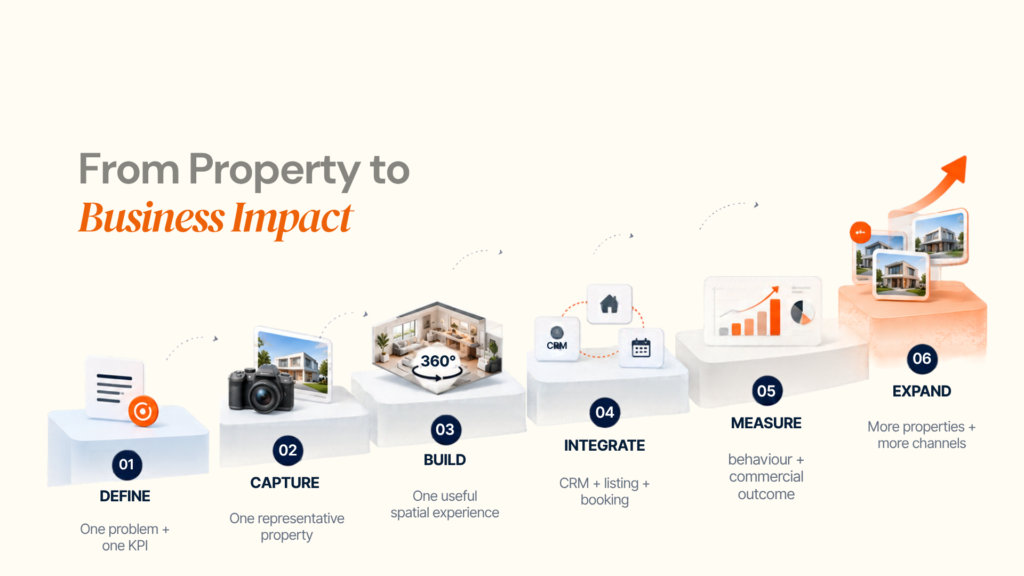
Step 1: Define one business problem
Examples:
Reduce unnecessary physical visits.
Improve off-plan buyer understanding.
Help commercial tenants evaluate spaces remotely.
Define the target user, property type and primary KPI.
Step 2: Build one representative experience
Do not start with thousands of listings.
Use one representative property and test:
- usability
- spatial quality
- loading
- device compatibility
- engagement
- enquiry behaviour
Step 3: Connect the business systems
Once the experience works, integrate listing data, CRM, lead capture, booking, and analytics.
Step 4: Expand only when the pilot proves value
Potential next steps include:
3D floor plans → staging → configuration → AI assistant → guided tours → AR/VR expansion
Step 5: Turn spatial content into reusable infrastructure
The long-term opportunity is larger than virtual viewing.
A mature spatial layer can support:
Marketing → Sales → Architecture → Customer Support → Refurbishment → Property Operations
11
How to Evaluate a Real Estate VR Development Partner
Do not evaluate a partner only on the visual quality of a VR demo. Look for a combination of:
| Area | What to check |
|---|---|
| 3D | Asset creation, optimisation and reuse |
| Immersive engineering | VR, AR, WebXR and device strategy |
| Product engineering | APIs, authentication and scalable applications |
| Integrations | CRM, MLS, CMS and booking systems |
| UX | Navigation, onboarding and fallback states |
| Performance | Asset budgets, loading and frame stability |
| Analytics | Behaviour-to-business measurement |
| AI | Grounded answers and clear data boundaries |
| QA | Device, browser and environment testing |
| Scale | Property ingestion and content operations |
| Support | Post-launch maintenance and optimisation |
At Designoweb, we approach this as a combined product-engineering and immersive-development challenge. Our AR/VR app development services, VR app development capability, Unity Solutions, and Virtual Space Creation can work together when a real estate product needs more than a standalone visual demo.
The goal is to connect:
Strategy → UX → 3D assets → immersive engineering → integrations → analytics → optimisation
12
Build the Right Property Experience — Not Just a VR Demo
The best real estate VR projects start with a business problem.
Maybe international buyers need to shortlist properties before travelling. Maybe a developer needs to sell apartments before completion. Maybe a commercial tenant needs to understand a complex space remotely.
The technology should follow that problem.
Designoweb combines immersive development, product engineering and 3D experience design to help businesses move from use case → prototype → integrated product → measurable platform.
Author

Frequently Asked Questions
01
What is VR in real estate?
VR in real estate refers to immersive digital experiences that help users explore or understand property remotely. The category includes 360° tours, interactive 3D environments, digital twins, and headset-based VR.
02
Are virtual property tours the same as VR?
No. Many virtual tours run in a normal browser without a headset. Headset VR provides deeper immersion but introduces additional hardware and distribution requirements.
03
Is VR useful for off-plan property sales?
Yes. Off-plan developments are a strong use case because customers cannot physically enter the finished property. Interactive 3D and VR can help them understand layout, scale, finishes, and amenities earlier in the buying process.
04
Should I build a VR app or a web-based property tour?
That depends on the audience and objective. Web-based experiences offer broader reach, while headset VR can provide deeper immersion. A hybrid strategy can combine browser access with optional immersive modes.
05
Can real estate VR integrate with CRM and listing systems?
Yes. A production architecture can connect the experience to listing feeds, CRM, CMS, scheduling, property management, and analytics through APIs.
06
How much does real estate VR development cost?
There is no reliable universal price. Cost depends on spatial capture or modelling, number of properties, 3D quality, interactivity, platforms, integrations, AI, infrastructure, QA and ongoing content operations.
07
Can AI be added to a VR property experience?
Yes. AI can support property Q&A, recommendations, guided tours, multilingual assistance, asset tagging and personalisation. Answers should be grounded in approved property data.
08
How should VR success be measured?
Use business metrics tied to the use case, such as qualified enquiries, shortlist rate, physical visits per qualified lead, appointment bookings, configuration completion and downstream conversion.
09
Can VR replace physical property visits?
VR is better treated as a decision-support layer than as a universal replacement. The goal is often to improve which properties buyers choose to visit rather than eliminate every physical viewing.