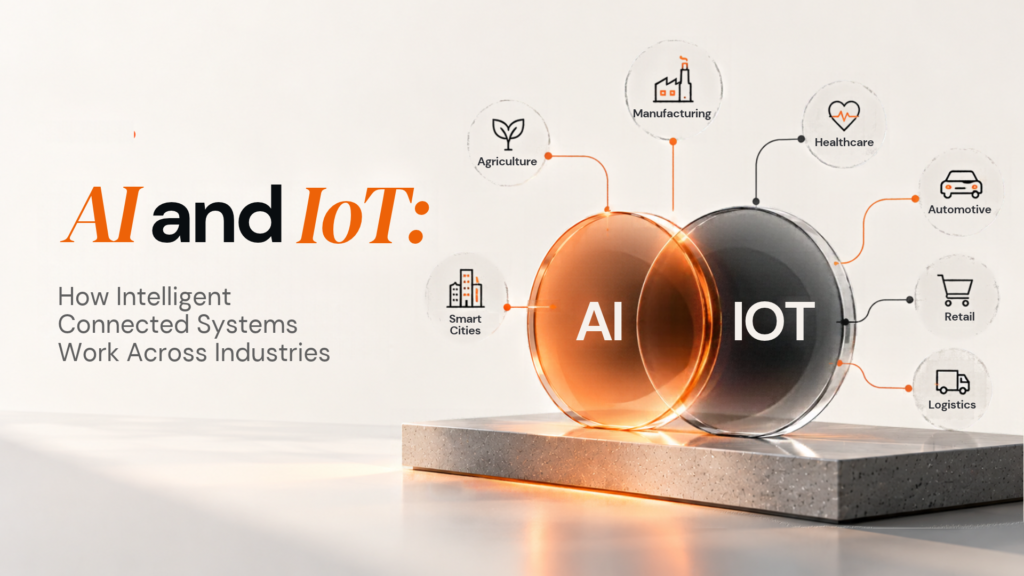
IoT can tell a business what is happening. AI can help determine what it means. That is the practical idea behind AI and IoT integration—combining connected devices, telemetry, and operational data with machine learning, computer vision, generative AI, or optimisation so a system can detect, predict, recommend, or act instead of simply reporting events.
The scale is already significant. IoT Analytics estimates that connected IoT devices will reach 21.1 billion globally by the end of 2025, while its 2026 enterprise IoT research reported a $324 billion enterprise IoT market in 2025.
But connecting more devices does not automatically create a smarter business. A factory may collect vibration and temperature data, a fleet may stream location telemetry, and a building may know occupancy and energy use. Without the right IoT data integration, those signals can remain isolated in dashboards that still depend on people to interpret them manually.
The stronger operating loop is:
-
1
Device
-
2
Data
-
3
AI
-
4
Decision
-
5
Action
-
6
Feedback
In June 2026, the International Telecommunication Union approved Recommendation Y.4618, defining an AIoT reference model across device, edge, and cloud and addressing interoperability, data management, security, privacy, and operational requirements. At Designoweb, we treat AIoT as a product-engineering problem. The device layer, IoT integration, data pipeline, AI workload, application experience, and business systems have to work together. The right implementation may use on-device intelligence, edge processing, cloud AI, or a hybrid architecture depending on the decision being improved.
In this guide, we will explain how AI and IoT integration works, how devices and data connect with AI systems, where AIoT creates value across industries, how to choose device, edge, cloud, or hybrid architectures, what affects cost and ROI, how to secure connected intelligence, and how to move from an IoT pilot to production.
Planning an AIoT or connected-product initiative?
Start by mapping the decision you want to improve, the signals required to support it, and the systems that must act on the result.
01
1. What AI and IoT Integration Actually Means
Connecting a sensor makes a system observable. It does not automatically make it intelligent.
The value appears when the information changes a decision.
Consider a machine that reports increasing vibration. Traditional IoT may display the signal or trigger an alert. An AIoT system can combine vibration with temperature, operating mode, and maintenance history, estimate whether the pattern is abnormal and route the result into a maintenance workflow.
That creates a different loop:
Sense → Understand → Decide → Act → Learn
IoT is the sensing and connectivity layer. AI is the intelligence layer. AIoT connects intelligence back to the physical or operational system.
Why more connected is not enough
Traditional IoT often follows:
Sensor → dashboard → human interpretation → decision → action
An intelligent connected system aims for:
Sensor → contextual data → inference → policy → workflow → feedback
The difference is decision latency. A logistics company may already know where a vehicle is; AI can add ETA prediction or anomaly detection. A factory may already see motor temperature; AI can identify combinations of signals associated with deterioration.
The technology becomes commercially meaningful when the answer to “what happened?” becomes “what should happen next?”
AIoT is a systems problem
Production AIoT spans connected devices, data engineering, edge/cloud infrastructure, machine learning, APIs, applications, cybersecurity, and operations.
A useful sequence is:
Decision → required signal → data → model → compute location → integration → action
This prevents the project from becoming a technology demonstration with no operational owner.
Designoweb works across both sides of this architecture, with IoT app development services for connected products, sensor integration and applications, alongside AI development services covering predictive analytics, computer vision, AI agents and MLOps.
02
2. How an AIoT System Works
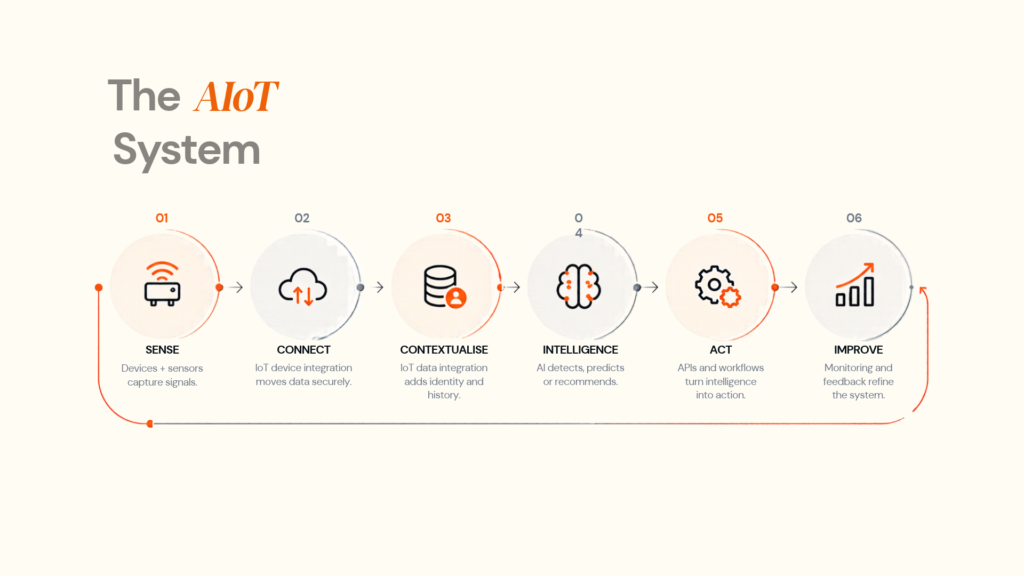
The ITU's 2026 AIoT reference model distributes AI, data, and IoT capabilities across device, edge, and cloud environments and includes requirements for interoperability, security, privacy, and operational management. A practical architecture has seven layers.
Devices and sensors
Cameras, temperature sensors, pressure sensors, vibration sensors, smart meters, wearables, vehicle telemetry and industrial equipment turn physical events into data.
Connectivity and messaging
Data moves through Wi-Fi, cellular networks, low-power networks, gateways, or other communication paths. MQTT is one common lightweight publish-subscribe protocol in IoT environments.
Data ingestion and contextualisation
Raw telemetry needs context. 72°C means very little until the platform knows the asset, operating mode, normal range, ambient conditions, and maintenance history.
This is the foundation of IoT data integration: ingestion, normalisation, timestamps, asset identity, enrichment, storage and access control.
AI and decision intelligence
The intelligence layer may perform anomaly detection, forecasting, computer vision, predictive maintenance, recommendation, optimisation or RAG.
| Business problem | Suitable approach | Typical result |
|---|---|---|
| Unusual equipment behaviour | Anomaly detection | Risk score |
| Future demand | Time-series ML | Forecast |
| Visual defects | Computer vision | Classification/segmentation |
| Equipment failure | Supervised ML/time-series | Failure probability |
| Operational knowledge search | RAG | Grounded answer |
| Schedule optimisation | Optimisation/ML | Recommended action |
| Multi-step execution | Agentic workflow | Controlled action |
Application and workflow
AI output must reach the place where work happens: a mobile app, dashboard, ERP, CRM, maintenance platform, alerting service, or API.
For example:
Anomaly score → policy → maintenance priority → work-order API → technician notification
The anomaly score alone is not the product. The connected workflow is.
03
3. The Role of IoT Integration in AIoT
IoT integration is not just connecting a sensor to an IoT platform. It is the process of moving trusted device data through the system and into the applications and business tools that can use it.
IoT device integration
IoT device integration may involve device provisioning, identity, firmware, Bluetooth or wireless connectivity, gateways, telemetry formats, and health monitoring.
The platform needs to know which device produced the data, whether the device is trusted, and whether the signal is valid enough for downstream processing.
IoT data integration
Device data may need to be combined with customer records, inventory, maintenance history, schedules, location, weather, or operational rules.
That is where IoT integration solutions become strategic. A predictive-maintenance model becomes far more useful when telemetry is joined with asset history and the work-order system.
Enterprise integration
Typical connections include:
IoT platform ↔ CRM
IoT platform ↔ ERP
IoT platform ↔ maintenance system
IoT platform ↔ mobile app
IoT platform ↔ analytics platform
A reusable integration layer prevents every application from building its own device pipeline.
For businesses evaluating IoT integration services, the important question is not only which devices can connect. It is how data will move through the complete product and how the system behaves when one component fails.
Designoweb's product development services are relevant when the integration layer needs to become part of a broader commercial software product.
04
4. AI and IoT Use Cases Across Industries
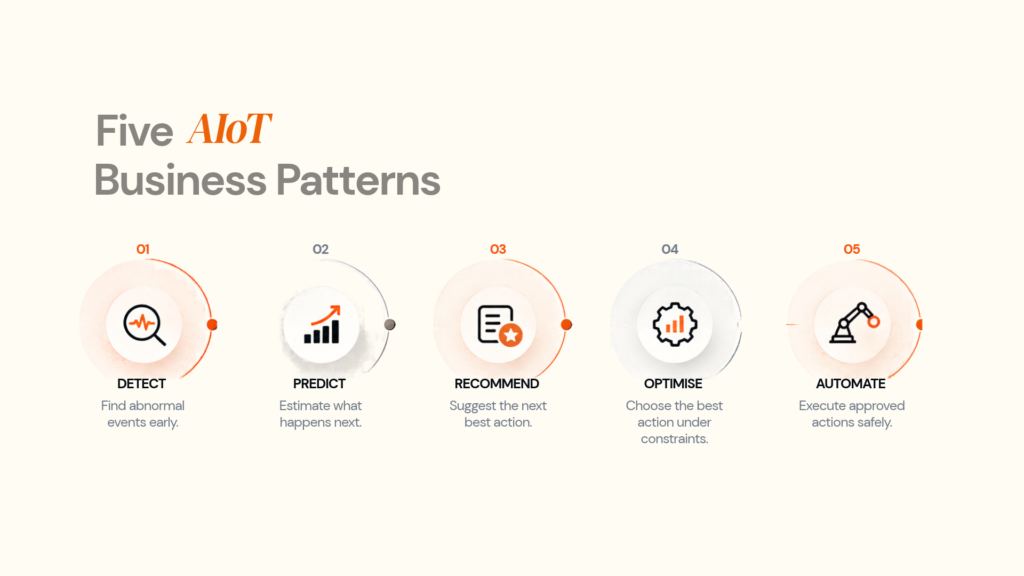
The strongest AIoT use cases share one characteristic: connected data improves a recurring decision.
Manufacturing
Industrial AIoT can combine sensors, cameras, robotics, edge computing and operational systems for predictive maintenance, visual inspection, quality monitoring, energy optimisation and process analytics.
The result may be reduced downtime, better quality or improved asset utilisation.
Healthcare and connected health
AI and IoT integration can support remote monitoring, wearable analytics, connected equipment monitoring and operational forecasting.
The risk profile depends on the use case. Administrative monitoring is different from a system influencing clinical decisions or medical-device operation, so validation and governance need to reflect the actual impact.
Logistics and transportation
Connected vehicles generate location, speed, temperature, utilisation and route data. AI can support ETA prediction, route optimisation, fleet maintenance, anomaly detection and capacity planning.
Real-time decisions may run at the edge while fleet-level planning can remain centralised.
Designoweb's PRO BIKE Sensor App demonstrates a connected-product pattern in which a physical sensor delivers real-time riding metrics such as tilt angles and G-forces to a smartphone alongside post-ride analytics.
Energy and utilities
AIoT can support demand forecasting, condition monitoring, anomaly detection, building optimisation and renewable-energy forecasting. Distributed architectures are useful where operational environments cannot depend entirely on cloud connectivity.
Smart buildings
Connected HVAC, occupancy, lighting, air-quality and energy systems can feed AI models for energy optimisation, maintenance and space planning.
A smart connect app can serve as the user-facing layer, bringing device status, alerts, recommendations and approved controls into one experience.
Retail
Smart shelves, cameras, inventory sensors, kiosks and point-of-sale signals can support stock visibility, demand prediction, queue analysis and personalised experiences. Computer vision deployments should include privacy and security controls appropriate to the jurisdiction.
05
5. Choosing Device, Edge, Cloud or Hybrid AI
Where intelligence runs affects latency, privacy, connectivity, hardware cost, model capability, and operating economics.
On-device AI
Inference happens directly on the device. It suits low-latency, offline or privacy-sensitive workloads, but models must fit CPU/GPU/NPU, memory and energy constraints.
Edge AI
Inference runs on a nearby gateway or edge server. It is useful for local, near-real-time decisions and reduces dependence on continuous cloud connectivity. The trade-off is the operational complexity of managing a distributed estate.
Cloud AI
Cloud infrastructure is useful for large-scale storage, training, fleet analytics and central model management. The trade-offs are network dependency, data transfer and recurring compute costs.
Hybrid AI
For many systems, the practical architecture is:
Device — capture and preprocess
Edge — time-sensitive inference
Cloud — training, storage and cross-site optimisation
Business systems — controlled actions
The ITU's current AIoT reference model explicitly supports distributed placement across device, edge and cloud based on latency, privacy, bandwidth and compute requirements.
The key question is:
Which decisions must keep working when the network is slow, unavailable or unreliable?
That answer determines what belongs locally and what can remain centralised.
06
6. How to Build AIoT Integrated Solutions
Successful IoT integrated solutions are designed around the operational loop, not a technology stack.
Step 1: Define one operational outcome
Examples include reducing unplanned downtime, predicting delivery delays earlier, improving asset utilisation, lowering energy consumption or reducing inspection time.
Step 2: Map the existing decision
Identify who makes the decision, what data they use, how long it takes, what systems are involved and what happens next. This reveals whether the problem is actually AI, integration, data quality or workflow design.
Step 3: Audit device and data readiness
Check sensor coverage, signal quality, timestamps, asset identity, historical depth, missing values, ownership and regulatory restrictions.
Step 4: Choose the smallest useful AI technique
Use anomaly detection for anomaly problems, predictive ML for forecasting, computer vision for inspection, RAG for operational knowledge and agents only when the process genuinely requires multi-step action.
Step 5: Build the integration path
The first technical milestone should demonstrate:
Device → data → inference → API/event → application/workflow → action
A dashboard showing a prediction is not enough if nobody can act on it.
Step 6: Add security and evaluation gates
Before production, define authentication, permissions, encryption, data quality, model thresholds, latency limits, monitoring, rollback and human escalation.
NIST's IoT Product Cybersecurity Guidelines treat the IoT product as a system element whose integration can change the wider security assessment.
Step 7: Operationalise the model
Production requires versioning, monitoring, drift detection, data-quality checks, controlled updates and incident handling. Then expand to more devices, locations and workflows.
This is how IoT integration solutions become a reusable platform instead of a collection of one-off connections.
07
7. AIoT Cost, ROI and Business Case
There is no single price for AIoT because scope can include hardware, device integration, connectivity, data engineering, AI, cloud or edge infrastructure, application development, security and ongoing operations.
What drives cost?
| Cost area | Lower complexity | Higher complexity |
|---|---|---|
| Hardware | Few standard sensors | Cameras, rugged/custom devices |
| Device integration | One device type | Multiple devices/protocols |
| Connectivity | Existing network | Cellular/LPWAN/gateway estate |
| Data | Clean telemetry | Multi-source pipelines |
| AI | Simple model/API | Simple model/API |
| Edge | Limited local processing | Distributed edge fleet |
| Cloud | Basic storage/API | High-scale analytics/ML ops |
| Application | Existing interface | New mobile/web product |
| Enterprise integration | Few APIs | ERP/CRM/maintenance systems |
| Security | Standard controls | Sensitive/regulated environment |
Planning ranges
For early budgeting, a useful framework is:
Connected-device pilot: 25,000–60,000
AI-enabled IoT application: 60,000–150,000
Advanced AIoT platform: 150,000–300,000+
Enterprise/fleet-scale AIoT: $300,000+
These are planning ranges, not fixed quotes. Device count, hardware, infrastructure, integration depth, security and operational requirements can move the budget substantially.
Measure ROI from the decision
Annual AIoT value = avoided losses + operational savings + additional revenue + productivity gains − annual operating cost
For predictive maintenance, consider downtime, failure frequency and maintenance cost. For logistics, consider fuel, utilisation, delivery performance and service penalties. For buildings, consider energy spend, occupancy and maintenance.
Also track false-alert rate, inference cost, latency and human override. A highly accurate model can still produce weak ROI if it creates too many alerts or requires expensive infrastructure.
Building an AIoT business case?
Designoweb can help translate the use case into a pilot scope, architecture, cost model and production roadmap.
08
8. Security, Privacy and Governance
AIoT combines physical devices, networks, data pipelines, AI models and automated actions. Security therefore has to cover the full chain.
Secure the device
Use appropriate identity, protected credentials, controlled permissions, secure software updates and device-health monitoring.
Protect the data path
Think across:
device → gateway → edge → cloud → application → business system
Controls should cover encryption, authentication, authorisation, retention, audit trails and data integrity.
Govern the model
Define what data the model uses, what it can influence, its failure modes, how performance is evaluated, how drift is monitored and when humans must intervene.
NIST's AI Risk Management Framework organises AI risk management around Govern, Map, Measure and Manage.
Control physical actions
There is a major difference between:
AI recommends maintenance
and
AI changes a machine operating parameter.
For higher-impact environments, use:
AI recommendation → validation → policy check → approval → execution → audit
UK and European considerations
For UK businesses, AIoT deployments handling personal data should account for data minimisation, transparency, security and accountability. The ICO's AI and data-protection guidance is a useful reference.
For EU deployments, the EU AI Act applies progressively according to system type and risk category. The actual product, data and use case should determine the assessment.
09
9. When AIoT Is the Wrong Choice
AIoT may be unnecessary when:
A simple rule solves the problem
If business logic is stable and deterministic, a rules engine may be easier to operate and audit.
The data is not ready
Missing signals, unreliable sensors and insufficient historical observations should be fixed before advanced AI is introduced.
There is no action after the prediction
A model has limited value if nobody can act on its output.
The economics do not work
Hardware, connectivity, inference and maintenance can outweigh the expected value.
The consequences are too high for the available controls
High-impact physical decisions require stronger validation and governance than advisory insights.
The goal is not maximum AI. It is the right amount of intelligence for the decision being improved.
10
10. How to Choose an AI and IoT Integration Partner
An AIoT development partner should be evaluated as a systems and product-engineering partner, not only as a device integrator or model provider.
Look for clear answers on business outcomes, device provisioning, protocols and APIs, IoT data integration, model selection, device/edge/cloud placement, security, evaluation, post-launch operations and scale. A credible proposal should explain what happens when data is missing, connectivity fails, the model is uncertain or a business system is unavailable.
Be cautious with proposals that focus heavily on model names but say little about integration, failure handling or operations.
Designoweb brings together IoT integration services, AI development and product engineering, allowing connected-device data, AI and application workflows to be planned as one product.
11
11. Designoweb: From Connected Devices to Intelligent Products
At Designoweb, we do not treat AI and IoT integration as two disconnected projects.
We engineer the connected product around:
Business outcome → device/data strategy → IoT integration → AI architecture → application → workflow → operations
Our work can span connected devices, sensor integration, mobile/web applications, APIs, cloud and edge infrastructure, AI models, operational workflows and production monitoring.
PRO BIKE Sensor App
The PRO BIKE Sensor App connects a physical sensor to a smartphone application and provides real-time riding metrics such as tilt angles and G-forces, plus post-ride analytics. It is a clear example of IoT device integration becoming part of a complete user-facing product.
VASD
The VASD case study combines AI-based image analysis with recommendations, product links, service matching and booking workflows. The lesson is that intelligence creates more value when it connects directly to the user's next action.
Our approach is to build IoT integrated solutions that can evolve from a connected prototype into a production product without forcing every future requirement into the first release.
Ready to turn connected-device data into a working product?
Share the devices, data sources, workflow and target outcome. Designoweb can help define the appropriate AIoT architecture and implementation path.
Build the AI Feature That Has a Business Job to Do
The strongest AI mobile applications are not the ones with the most AI features.
They are the ones where intelligence changes something meaningful: a user finds an answer faster, an employee completes a task with less manual effort, a business identifies risk earlier, or a product adapts to a user's needs.
Designoweb helps businesses build connected and intelligent digital products across AI, IoT integration, application engineering, and scalable product infrastructure.
Author

Frequently Asked Questions
01
What is AI in mobile app development?
AI in mobile app development means integrating technologies such as machine learning, generative AI, computer vision, speech processing, recommendation systems or AI agents into a mobile application to perform intelligent tasks such as prediction, classification, personalisation, search or automation.
02
What are the most common AI features in mobile apps?
Common features include recommendations, personalised content, chat assistants, voice interfaces, image recognition, OCR, predictive analytics, fraud detection, document processing, semantic search and workflow automation.
03
Does every AI mobile app need a large language model?
No. Many mobile AI use cases are better served by traditional machine learning, computer vision or smaller specialised models. LLMs are most useful where language understanding, generation or reasoning is part of the problem.
01
Should AI run on the device or in the cloud?
It depends on the workload. On-device AI is useful for latency-sensitive, offline or privacy-sensitive tasks. Cloud AI is useful for larger models, centralised data and complex processing. Hybrid architecture can combine the two. Apple and Android both currently support on-device AI approaches.
02
What is hybrid AI in mobile app development?
Hybrid AI combines on-device and cloud inference. For example, a mobile application may perform a fast initial classification locally and send uncertain or more complex cases to a cloud model.
03
Should I use RAG or fine-tuning?
Use RAG when the system needs access to private or changing information. Consider fine-tuning when the main requirement is consistent task behaviour, style or output patterns. They can also be combined.
04
When should an AI mobile app use AI agents?
Agents are useful when the product needs AI to plan and execute multiple steps through tools or APIs. They should be introduced when that autonomy solves a real workflow problem.
01
How do I secure an AI-powered mobile app?
Start with standard mobile security controls, then secure the AI layer with authenticated APIs, input validation, rate limits, controlled tool access, output validation, safe data handling, monitoring and evaluation. OWASP MASVS provides a useful mobile security baseline, while OWASP's LLM guidance covers AI-specific risks.
02
Does on-device AI automatically make an app private?
No. On-device inference can reduce the amount of data sent to a remote model, but privacy must be assessed across the full application. Analytics, logs, synchronisation and third-party integrations may still process personal data.
03
What should UK and European businesses consider?
Teams should assess the applicable data-protection and AI governance requirements before production deployment. The ICO provides AI and data-protection guidance for UK organisations, while the EU AI Act applies according to system type and risk category.
01
How much does AI mobile app development cost?
There is no reliable universal price. Cost depends on AI capability, data readiness, mobile platform coverage, model usage, integrations, security requirements, scale and ongoing AI operations. A proper estimate should follow discovery and architecture rather than a feature-count estimate alone.
02
How long does it take to build an AI-powered mobile app?
The timeline depends on whether the team is adding an AI feature to an existing application or building an AI-native product. Feasibility, data preparation, model evaluation, mobile development, backend integration, security, and testing all affect the schedule.
03
How should I start an AI mobile app project?
Start by defining one business outcome, identifying the AI workload, checking data readiness, selecting an appropriate architecture, and validating the highest-risk assumption through a proof of concept.