
Key Takeaways
01
VR is not automatically the best immersive-commerce investment; for many retailers, 3D product experiences or AR create less customer friction than a headset-first experience.
02
The strongest VR use cases are usually products with high consideration, complex configurations, expensive physical showrooms, or a strong experiential component.
03
A production-grade VR commerce experience is not just a Unity scene. It needs a commerce integration layer connecting catalogue, inventory, pricing, cart, checkout, customer data and analytics.
04
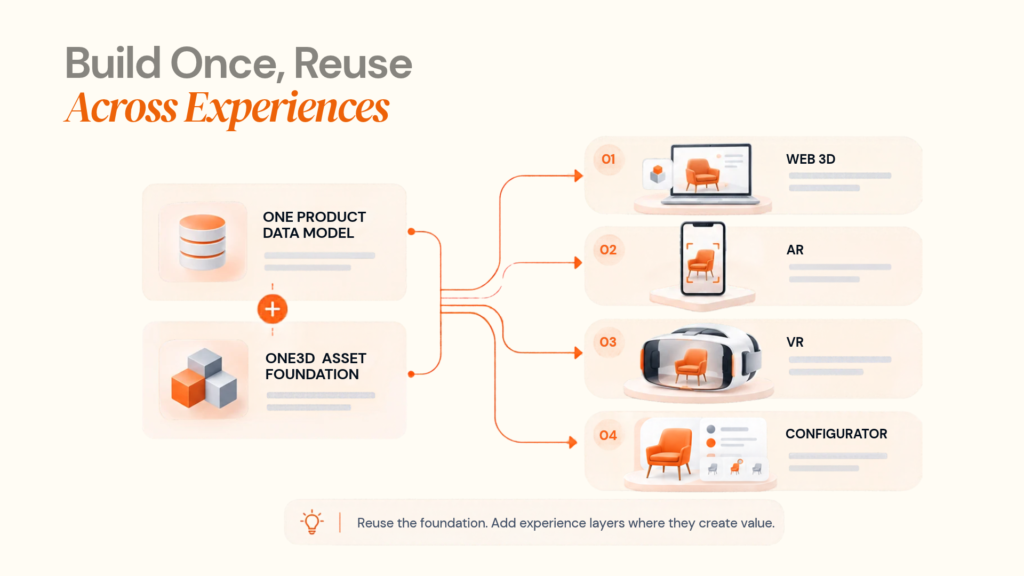
3D assets are the foundational investment. A well-built asset pipeline can support web 3D, AR, VR, configurators, marketing and future spatial experiences.
05
VR should normally be treated as one experience layer over the existing commerce stack, not as a replacement for the e-commerce site.
06
WebXR and OpenXR provide standards and APIs for immersive web and cross-device development, but device capabilities and performance still need to be validated against the actual experience.
07
Success should be measured through commercial behaviour, not simply headset sessions or time spent inside a virtual environment.
08
Privacy becomes more important when experiences use gaze, hand, body, spatial or behavioural data.
09
The best first project is often a narrow, measurable pilot rather than a fully virtualised department store.
Virtual reality in e-commerce sounds like the obvious next step: put customers inside a virtual store, let them explore products in 3D and make the buying journey more immersive.
In practice, the business case is more specific.
VR can be valuable when a shopper needs to understand a product, space, or configuration that is difficult to communicate through photographs and standard product pages. It can also help brands recreate showroom experiences, demonstrate complex products remotely, or turn product storytelling into an experience. But a headset is still a higher-friction interface than a normal website or phone, so the technology has to solve a real buying problem.
That is why the smarter question is not “How do we build a VR store?” It is “Where does spatial interaction improve the buying decision enough to justify the extra product, engineering and operational complexity?”
There is already evidence that richer product experiences can influence commerce behaviour. In Shopify's July 2026 guide to 3D ecommerce, the company cites Rebecca Minkoff's finding that shoppers who viewed a product in AR were 65% more likely to purchase than shoppers who did not. That is an AR example, not a universal VR benchmark, but it reinforces an important point: immersive technology creates commercial value when it gives shoppers information or confidence they were missing. Shopify's 2026 3D ecommerce guide provides the underlying case context.
At Designoweb, we treat VR as part of a broader immersive-commerce and product-engineering strategy. The right solution may be VR, AR, web 3D, a configurator, or a combination of these layers. The starting point is always the customer decision, the business KPI, and the systems that already run the commerce operation.
01
What VR in E-commerce Actually Means
Virtual reality in e-commerce means using an immersive digital environment to help people discover, understand, configure, or interact with products before purchasing.
That definition is broad enough to be useful, but it needs one important clarification:
VR is not the same thing as every 3D shopping experience.
A customer rotating a chair on a product page is using a 3D product viewer. A shopper placing that chair in their living room through a phone camera is using augmented reality. A customer entering a computer-generated showroom through a headset is using virtual reality.
All three can sit inside the same immersive commerce strategy, but they solve different problems and create different levels of friction.
The practical difference
| Experience | Typical device | What the shopper does | Best suited to | Main friction |
|---|---|---|---|---|
| 3D product viewer | Phone, tablet, desktop | Rotate, zoom, inspect | Everyday product discovery | Low |
| AR shopping | Phone/tablet camera or supported glasses | Place, try, preview in context | Furniture, beauty, fashion, eyewear | Low to medium |
| VR shopping | Headset | Enter, explore and interact with a virtual space | High-value products, showrooms, experiential retail | Higher |
| Virtual showroom | Web, mobile, tablet or headset | Navigate a branded environment | Retail environments, launches, B2B sales | Medium |
| 3D configurator | Web, mobile or headset | Change options and inspect outcomes | Bespoke products, vehicles, interiors, luxury goods | Medium |
The key question is therefore not:
“Should we build a VR store?”
It is:
“Which part of the buying decision is currently difficult to make online, and what is the least-friction technology capable of improving it?”
That change in framing can materially reduce wasted investment.
At Designoweb, our AR/VR app development services sit alongside product engineering, mobile development, and 3D capabilities because an immersive experience rarely exists in isolation.
VR is an experience layer, not the commerce system
A headset experience still depends on ordinary commerce functions:
- Product catalogue
- SKU and variant data
- Pricing
- Inventory
- Customer accounts
- Promotions
- Cart
- Checkout
- Orders
- Analytics
- Customer support
The immersive interface changes how the shopper experiences the product. It does not remove the need for the business systems behind the transaction.
02
Where VR Creates Real Commercial Value
VR is most compelling when the product or buying journey is difficult to understand through conventional e-commerce interfaces.
The strongest use cases are not necessarily the most visually impressive ones. They are the ones where spatial context changes what the customer can understand, compare, configure, or decide.
1. High-consideration purchases
A product becomes a stronger candidate for immersive commerce when the customer needs more confidence before committing.
Examples include:
- Luxury goods
- Premium furniture
- Automotive
- High-end sporting equipment
- Consumer electronics
- Bespoke products
- Complex equipment
- Architectural or interior products
- Specialist B2B products
Customers in these categories may need to understand scale, configuration, craftsmanship, environment, materials, or use before purchasing.
That is where immersive interaction can have a job to do.
For a premium furniture retailer, for example, the experience could move from:
Photo → product detail → questions
to:
Inspect → configure → enter the environment → compare → decide
The technology matters because it changes the information available to the buyer.
2. Complex products with many configurations
Consider a product with:
- 12 colours
- 6 materials
- 4 trims
- Multiple dimensions
- Interchangeable components
- Optional accessories
A traditional product page can represent those choices through dropdowns, swatches and images.
A 3D configurator can show the consequences of those choices.
VR goes further when the customer benefits from seeing the configured product inside a larger environment.
This can be particularly useful for:
- Kitchens
- Luxury interiors
- Vehicles
- Boats
- Commercial spaces
- High-value equipment
- Modular products
The commercial value comes from reducing uncertainty around a complicated purchase, not from making the interface look futuristic.
Designoweb's 3D product design services can support the reusable asset layer behind these experiences, including interactive visualisation and 3D product work.
3. Virtual showrooms
A virtual showroom recreates some of the discovery logic of a physical retail environment.
A shopper might:
- Enter the environment.
- Explore product collections.
- Select a product.
- Inspect it in 3D.
- View configurations.
- Access product information.
- Add a product to a shortlist or cart.
- Continue to the familiar web checkout or speak with a sales specialist.
This approach is particularly interesting for brands with expensive physical retail environments, specialist products, or international audiences.
The virtual experience can also extend a physical showroom rather than replace it:
Physical store → virtual twin → online exploration → commerce
That creates an omnichannel journey instead of an isolated VR application.
4. Experiential product storytelling
Some products are purchased partly because of the story around them.
A conventional product page might rely on text, photography, and video. A VR environment can put the shopper inside the story.
A premium brand could let a customer:
- Explore the workshop
- See materials being produced
- Understand craftsmanship
- Interact with design elements
- Move through an origin story
- Configure the final product
This can make VR valuable for premium positioning, launches, and branded environments.
But storytelling still needs a commercial job.
A beautiful virtual environment with no useful product interaction may generate attention without generating sales.
5. Assisted selling and B2B commerce
VR is also relevant outside direct-to-consumer retail.
Manufacturers, wholesalers, and specialist sellers can use immersive experiences as a sales-enablement layer.
Consider a buyer evaluating:
- Industrial machinery
- Commercial interiors
- Medical equipment
- Large-scale furniture
- Construction products
- Vehicles
- Specialist equipment
Instead of flying a prospect to a showroom or carrying every physical configuration, a sales team can demonstrate the product in a controlled digital environment.
The experience can include:
Product selection → configuration → guided demonstration → specification → quote request
In this context, VR is not just marketing.
It becomes part of the sales process.
High consideration + high complexity + high visual dependency = strong candidate for immersive commerce
Low consideration + simple product + high headset friction = stronger candidate for web 3D or conventional commerce
6. Product education before purchase
Some products require understanding before they can be confidently evaluated.
VR can help customers learn:
- How a product works
- How components fit together
- How a system is installed
- How a premium product is manufactured
- What different configurations look like
- What ownership or usage will involve
This is especially relevant when product education reduces sales friction.
The experience can bridge the gap between “I like it” and “I understand what I am buying.”
03
When VR Is Probably the Wrong Choice
There are many e-commerce cases where VR adds more friction than value.
VR should be questioned when:
- The average transaction is low value.
- The product is simple to understand.
- Customers buy frequently and habitually.
- Most traffic comes from mobile users who are unlikely to enter a headset experience.
- Product selection matters more than product immersion.
- Customers primarily need price, availability and delivery information.
- A well-designed AR preview would solve the real problem more simply.
- A 3D viewer would provide enough additional product information.
- The business has no measurable KPI beyond engagement.
- The product data or 3D assets are not reliable enough to support a production experience.
The correct strategic response may therefore be:
Do not build VR yet. Build the 3D foundation first.
That is not a technology downgrade. It can be a more reusable architecture.
A useful rule for product leaders
Ask three questions before approving a headset-led project:
- What customer uncertainty are we removing?
- Why does that require an immersive environment rather than 3D or AR?
- What commercial metric should change if we are successful?
When the answers are weak, the product should probably start with a lower-friction experience.
04
VR vs AR vs 3D Commerce: What Should You Build?
The easiest way to decide is to start with the customer task.
| Customer problem | Most suitable starting point | Why |
|---|---|---|
| “I want to inspect this product.” | 3D viewer | Low-friction interaction |
| “Will this fit in my home?” | AR | Uses the customer's real environment |
| “Will this suit me?” | AR / virtual try-on | Adds contextual visualisation |
| “I want to customise this product.” | 3D configurator | Makes options visible |
| “I want to experience your store.” | Virtual showroom / VR | Recreates spatial discovery |
| “I want to understand this premium product.” | 3D + AR or VR | Adds depth to product storytelling |
| “I want my sales team to demonstrate complex products.” | VR / interactive 3D | Supports guided selling |
| “I want maximum reach with minimum friction.” | Web 3D / AR | Avoids headset adoption |
For many retailers, the strongest architecture is not:
VR instead of AR
It is:
3D asset foundation → web 3D → AR → optional VR
The same underlying product assets can support several customer experiences.
Shopify's July 2026 guidance on 3D ecommerce describes 3D product experiences and AR as practical ways to bring richer product information into online commerce, while noting that VR creates a more immersive environment and generally requires dedicated hardware.
This leads to an important architecture principle:.
For a brand already investing in e-commerce product content, this approach can make immersive commerce a progression rather than a separate technology programme.
05
The Technical Architecture Behind VR Commerce
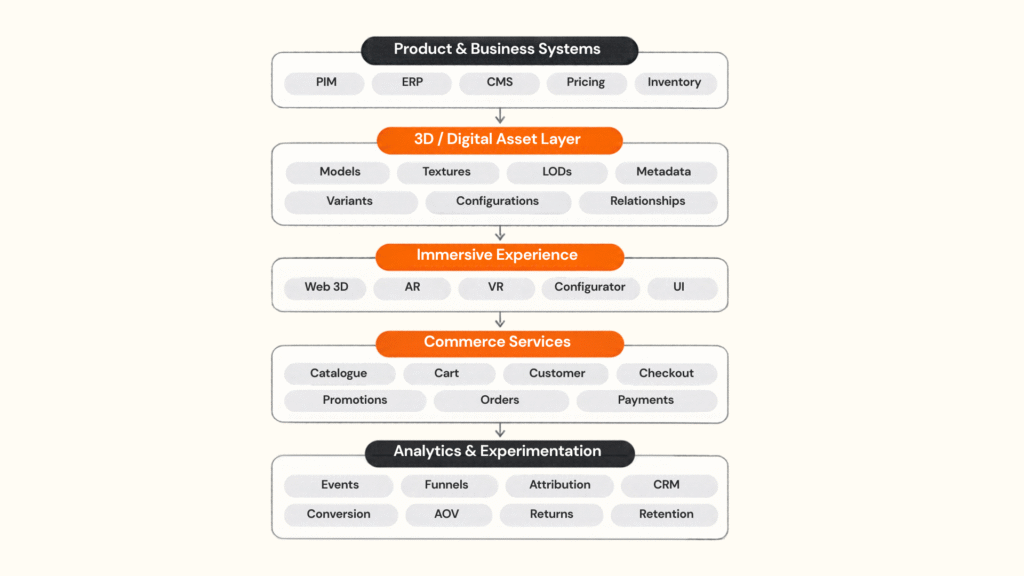
A production VR commerce experience is closer to a distributed product system than a standalone 3D scene.
A useful high-level architecture is:
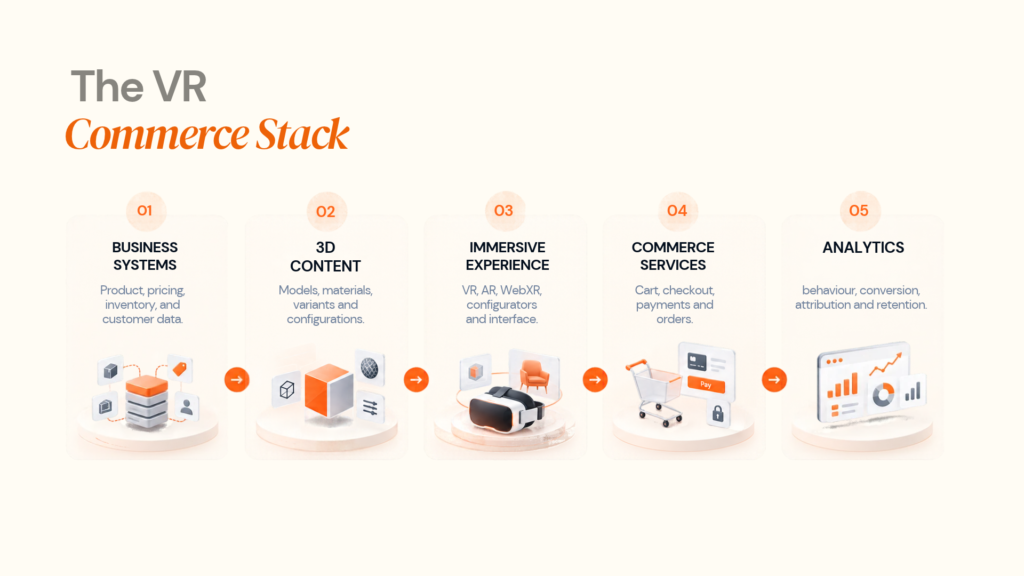
This separation keeps the immersive experience flexible while preserving the business systems that already run the operation.
1. Product data layer
VR cannot compensate for bad catalogue data.
The experience still needs:
- Product IDs
- Variants
- Pricing
- Inventory
- Dimensions
- Product descriptions
- Materials
- Availability
- Configuration rules
- Images
- Product relationships
The immersive interface should consume the same trusted business data that powers the rest of the commerce ecosystem.
That prevents a serious production problem:
A beautiful virtual product that is disconnected from the actual catalogue.
2. 3D asset pipeline
The 3D layer is one of the biggest investments in immersive commerce.
Assets may begin as:
- CAD files
- Photographs
- Scans
- Existing 3D models
- Photogrammetry
- Artist-built models
They then need to be prepared for the target experience.
Typical tasks include:
- Mesh optimisation
- Texture optimisation
- Level-of-detail generation
- Lighting optimisation
- Material authoring
- Collision setup
- Interaction points
- Animation
- Variant management
- Asset compression
The objective is not merely visual quality.
The asset needs to be:
Accurate + performant + reusable + maintainable
This is why the 3D asset pipeline should be treated as a product capability rather than a one-off creative task.
3. Experience layer
This is where Unity, Unreal, native XR development, WebXR or other immersive technologies may enter the architecture.
Khronos OpenXR provides a royalty-free, cross-platform standard API for XR applications, while the W3C WebXR Device API defines web access to VR and AR devices. The current WebXR specification was published as a Candidate Recommendation Draft on June 9, 2026, so browser-based immersive support should still be validated against the exact device and browser matrix required by the project.
A headset-first native application may be appropriate when:
- Immersive interaction is central.
- Graphics requirements are high.
- Device control matters.
- Custom interaction is important.
- The business has a defined headset audience.
A WebXR or browser-led approach may be better when:
- Reach matters.
- Sharing a link matters.
- Customers should not install an application.
- The experience needs to sit close to the web storefront.
- The use case can work within browser capability constraints.
The target hardware should be defined before choosing the rendering architecture.
4. Commerce layer
A virtual shop still needs normal commerce infrastructure.
The experience may need APIs for:
- Catalogue retrieval
- Search
- Product details
- Pricing
- Promotions
- Inventory
- Customer accounts
- Cart
- Checkout
- Orders
- Recommendations
The immersive layer should not become a second source of truth.
Instead:
Commerce platform = source of commerce truth
Immersive experience = new interface to that truth
This reduces duplication and makes future changes easier.
5. Analytics layer
Every meaningful interaction should be measurable.
Useful event categories include:
- Showroom entry
- Product view
- Product interaction
- Configuration started
- Configuration completed
- Product added to shortlist
- Add to cart
- Checkout started
- Purchase
- Assisted conversion
- Exit point
The analytics model should be designed before development, not retrofitted afterwards.
06
How to Integrate VR With an Existing E-commerce Stack
The safest model is usually integration, not replacement.
Instead of rebuilding the store inside VR, preserve the existing commerce infrastructure and add a new immersive interface.
Integration pattern
Existing Storefront
│
├── Product Pages
├── Search
├── Cart
└── Checkout
│
▼
Shared Commerce APIs
│
┌──────┼─────────┐
│ │ │
Product Pricing Inventory
│ │ │
└──────┼─────────┘
│
▼
Immersive Experience
├── Web 3D
├── AR
└── VR
This architecture has an important commercial advantage.
A shopper can discover a product in VR and still finish the purchase through the familiar web checkout.
That lowers the risk of forcing every part of the transaction into an unfamiliar interface.
Shopify and immersive commerce
Shopify supports 3D models as product media. Its 2026 guide to 3D ecommerce also positions 3D and AR as practical ways to add richer product information to online shopping.
For a Shopify-based business, the question is therefore not necessarily:
“Do we need a separate VR store?”
It can be:
“How should the 3D and immersive experience consume our Shopify product and commerce data?”
For brands already using Shopify, Designoweb's Shopify development capability can be part of the technical foundation rather than a separate project.
Headless and API-first commerce
An API-first approach becomes especially valuable when the brand wants several experiences over time.
The same backend can support:
- Website
- Mobile app
- AR experience
- VR experience
- Sales showroom
- Configurator
- Partner portal
This is one reason Designoweb's product development services are relevant to immersive commerce.
The goal is to create a new experience layer without creating a second commerce operation behind it.
Customer identity and account continuity
Customers should not feel like they have entered a completely different system when they switch from the immersive experience back to the main store.
A connected implementation can preserve:
- Sign-in state
- Saved products
- Configuration choices
- Cart contents
- Loyalty information
- Personalisation preferences
- Sales-assistance context
This can make the transition from immersive discovery to transaction feel much more natural.
Checkout should remain familiar
There is little strategic value in recreating complex payment flows inside an immersive environment unless the business has a compelling reason to do so.
For many projects, a better approach is:
Discover in VR → configure → add to cart → open familiar checkout
That keeps payment infrastructure isolated from the rendering environment and avoids unnecessary duplication.
07
How to Build a VR E-commerce Experience
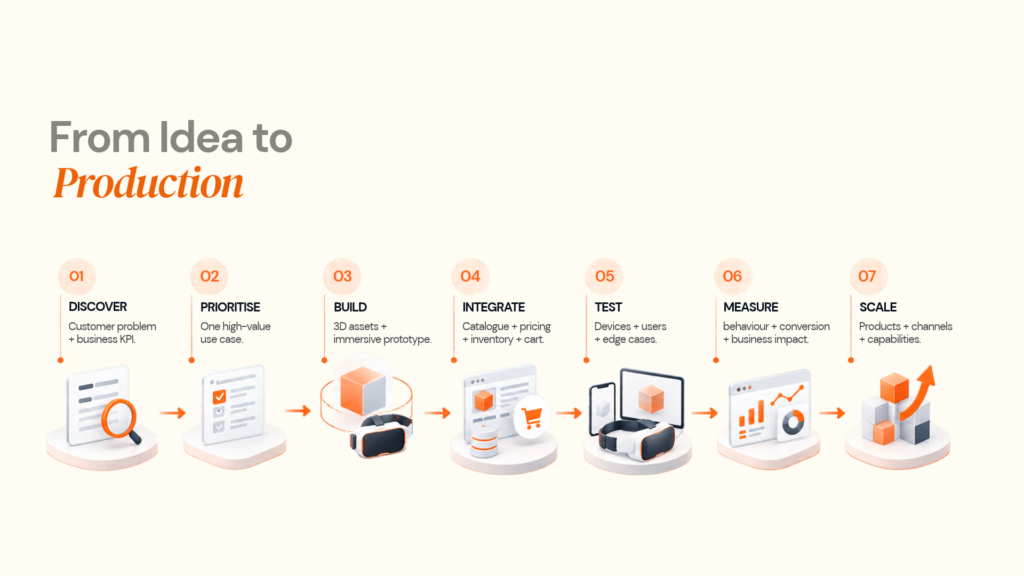
A strong VR commerce project should move through defined decision gates.
Phase 1: Discovery
Start with:
- Customer journey analysis
- Product selection
- Commercial objective
- Audience definition
- Platform constraints
- Target hardware
- Existing commerce architecture
- Asset availability
- Analytics requirements
- Accessibility requirements
- Privacy requirements
The output should be a business and technical brief.
Designoweb's product development process follows a discovery-first approach that moves from product goals and definition into architecture, design, development, testing and launch.
Phase 2: Choose one high-value use case
Do not start by virtualising the entire catalogue.
Choose one focused use case such as:
- One premium product category
- One virtual showroom
- One configurator
- One assisted-sales workflow
- One seasonal campaign
- One product demonstration
The purpose is to prove whether immersive interaction changes customer behaviour.
Phase 3: Build the 3D asset pilot
Create a representative group of products and test:
- Visual accuracy
- File size
- Texture quality
- Performance
- Loading behaviour
- Device compatibility
- Interaction model
- Variant handling
This stage often reveals whether the original asset strategy is realistic.
Phase 4: Prototype the experience
Focus on:
- Navigation
- Discovery
- Product inspection
- Configuration
- Interaction
- Information hierarchy
- Transitions
- Accessibility
- Fallback paths
- Commerce handoff
The prototype should be tested with actual users.
Not every interaction that looks impressive is useful.
Phase 5: Connect commerce
Connect the experience to production systems.
A practical pattern might be:
PIM / ERP → Product Service → Immersive Experience → Cart → Existing Checkout
The important thing is that product, inventory, and transactional logic remain authoritative in existing business systems.
Phase 6: Test aggressively
Immersive applications have failure modes that ordinary e-commerce interfaces do not.
Test:
- Frame performance
- Loading time
- Tracking
- Input accuracy
- Device differences
- Network interruption
- Session recovery
- Unexpected user movement
- Incorrect configurations
- Expired products
- Out-of-stock products
- Checkout failure
- Accessibility
- Privacy controls
Designoweb's Unity solutions can support interactive simulations and immersive product experiences where a real-time 3D engine is the right fit.
Phase 7: Launch as an experiment
Do not define launch as:
“The VR store is live.”
Define it as:
“We can now measure whether this experience improves a defined commercial outcome.”
That distinction changes what gets measured, optimised, and funded next.
Phase 8: Expand only after the core use case proves itself
Once the experience demonstrates value, the roadmap can expand into:
- More products
- More configurations
- More locations
- More devices
- Personalisation
- Social interaction
- AI assistance
- Sales workflows
- New immersive channels
08
VR E-commerce Cost: What Actually Drives the Investment
There is no useful single price for “a VR e-commerce app.”
Two projects can both be described as VR commerce while having completely different engineering requirements.
The important question is therefore not:
“What is the average VR e-commerce development cost?”
It is:
“Which product, content and technical decisions are driving our investment?”
The major VR e-commerce cost drivers
| Cost driver | Lower complexity | Higher complexity |
|---|---|---|
| Product assets | Small product set | Hundreds or thousands of assets |
| 3D quality | Basic visualisation | Photorealistic real-time rendering |
| Environment | Simple showroom | Detailed interactive digital twin |
| Platforms | One target | Multiple headsets + web |
| Interaction | Browse and inspect | Configure, interact, collaborate |
| Commerce | Product links | Live cart, customer and order integration |
| Personalisation | Basic | Dynamic recommendations and configurations |
| Analytics | Standard events | Advanced behavioural analysis |
| Data | Minimal | Spatial, gaze, gesture or profile data |
| QA | Limited device set | Multi-device and multi-network testing |
| Support | Static launch | Continuous content and product updates |
The hidden cost most brands underestimate: 3D assets
A VR environment may be expensive to build once.
A product catalogue is expensive to keep accurate.
Products change.
Colours change.
Packaging changes.
Variants change.
Discontinued products disappear.
New SKUs arrive.
That means the right question is not only:
“How much will the VR application cost?”
It is:
“How will we create, manage, update, and reuse the 3D product content over time?”
A reusable asset foundation is often more valuable than a highly detailed one-off showroom.
Designoweb's 3D product design capability can support the content layer behind product visualisation, interactive presentations and immersive experiences.
Other cost areas buyers often underestimate
Commerce integration
Connecting the immersive experience to live product and order systems can require more engineering than the initial 3D prototype.
Device and environment testing
A headset build that looks perfect on one target configuration may behave differently elsewhere.
Performance engineering
Visual quality, loading time, frame stability and memory usage need dedicated optimisation.
Analytics
If the team cannot measure product interaction, configuration completion and conversion pathways, the commercial impact becomes difficult to prove.
Post-launch content
If products are frequently updated, the organisation needs an operating model for 3D content refreshes.
A more useful investment model
Instead of budgeting for one large VR application, consider three stages:
| Stage | Objective | Typical output |
|---|---|---|
| Foundation | Validate assets and customer problem | 3D product/content pilot |
| Pilot | Validate behaviour | Focused immersive experience |
| Scale | Expand validated use case | Production commerce experience |
This helps avoid spending the majority of the budget before the most important product assumption has been tested.
09
How to Measure ROI and Commercial Impact
Time spent in VR is not automatically a business result.
A shopper could spend ten minutes exploring a showroom and still buy nothing.
Measure the full journey.
Experience metrics
- Experience starts
- Product interactions
- Configuration completion
- Product views
- Exit points
- Repeat sessions
These metrics tell you whether customers are actually using the experience.
Commerce metrics
- Add-to-cart rate
- Checkout initiation
- Conversion rate
- Average order value
- Assisted conversion
- Product attachment rate
These metrics connect immersive engagement to commercial behaviour.
Operational metrics
- Return rate
- Return reasons
- Sales-assistance time
- Physical showroom dependency
- Demonstration costs
- Content production reuse
For high-value products, operational impact can be as important as direct online conversion.
Compare exposed and non-exposed customers
The most useful comparison is often:
Users exposed to the immersive experience vs comparable users who were not
Depending on traffic volume and the maturity of the experiment, the business can use:
- A/B testing
- Holdout groups
- Cohort analysis
- Assisted-conversion attribution
- Product-level comparisons
- Sales-team assisted attribution
The measurement approach should be selected before the pilot launches.
A practical commercial model
For direct-to-consumer retail:
Incremental gross profit
= incremental orders × contribution margin
− experience operating cost
For B2B or high-consideration products:
Sales value influenced
= qualified opportunities × average deal value × immersive-assisted conversion rate
These are not universal ROI formulas. They are simple structures for making the business case explicit.
Measure the effect of the experience, not just the excitement
A useful dashboard might connect:
Exposure → Interaction → Configuration → Cart → Purchase → Return
That makes it easier to identify where immersive technology is actually helping and where it is simply creating activity.
Wondering whether your VR idea can be measured as a real business experiment?
Designoweb can help define the KPI model alongside the product architecture so the pilot is built to produce evidence, not just a demo.
10
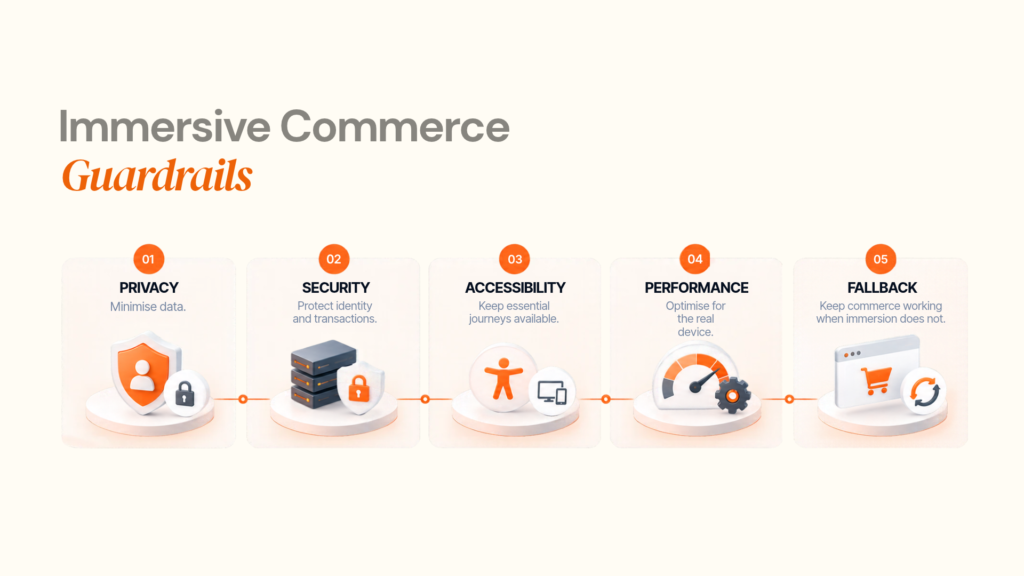
Privacy, Security, Accessibility and Performance
Immersive commerce introduces data and UX considerations that do not always exist in conventional e-commerce.
Privacy
Immersive systems can process spatial and body-related data, including gaze, movement or behavioural signals.
NIST's IR 8557 on usable cybersecurity and privacy for immersive technologies discusses the privacy and cybersecurity considerations created by immersive technologies and the importance of usability when communicating privacy and security information.
The architecture should therefore start with data minimisation.
Ask:
- Do we really need this sensor data?
- Can we process it locally?
- Do we need to retain raw data?
- How long should derived data remain available?
- Can the feature work without identifying the user?
- Is consent required?
- Is the data being combined with other customer information?
For UK-facing businesses, the ICO's guidance on personal data confirms that personal data can include identifiers such as location data and online identifiers, depending on context.
The practical rule is simple:
Collect only what the experience needs, explain why it is needed, and minimise retention wherever possible.
Security
At minimum, the architecture should consider:
- API authentication
- Encrypted communications
- Role-based access
- Secure customer sessions
- Payment isolation
- Least-privilege access
- Logging
- Vulnerability testing
- Dependency management
- Secure analytics
- Secrets management
Payments should not become tightly coupled to the rendering environment.
Where external services are involved, credentials and customer account linking need dedicated protection.
Accessibility
A virtual store should not become an accessibility dead end.
Provide alternatives such as:
- Normal web product pages
- Accessible product information
- Captions and transcripts where audio is used
- Seated interaction modes where appropriate
- Motion-comfort options
- Readable information layers
- Non-VR checkout paths
- Clear exit controls
- Keyboard or standard interaction equivalents where appropriate
The immersive experience should enhance shopping rather than make essential product information available only to headset users.
Performance
Immersive interfaces are less forgiving of poor performance.
The W3C WebXR Device API is designed for access to immersive devices and associated input and sensor capabilities on the web, which makes browser/device compatibility an important part of the implementation decision.
Important performance considerations include:
- Asset size
- Draw calls
- Polygon counts
- Texture resolution
- Level-of-detail
- Loading strategy
- GPU usage
- CPU usage
- Frame stability
- Network latency
- Caching
- Content delivery
A high-fidelity product that takes too long to load is not a premium commerce experience.
Capability and fallback strategy
The architecture should explicitly model capability.
For example:
This enables graceful degradation instead of hard failure.
Capability
- Headset support
- Browser immersive mode
- Controller/input
- Graphics profile
- Network
- Product asset
- Commerce API
Possible states
- Supported / unsupported
- Available/unavailable
- Available/limited
- Full / reduced
- Strong/weak/offline
- Full/simplified/unavailable
- Available / degraded / unavailable
11
Examples of Immersive Commerce in Practice
Real-world examples show that immersive commerce does not have one fixed format.
Alo: virtual retail environment
Shopify's 2026 3D ecommerce guidance highlights Alo's virtual retail experience as an example of brand-led immersive shopping.
The important lesson is that the experience is not simply a 3D product viewer.
It recreates some of the spatial logic of a retail environment:
Enter → explore → discover → interact → shop
That model is especially relevant to brands where the environment is part of the product story.
Walmart: commerce connected to immersive experiences
Walmart and Unity announced an immersive-commerce initiative in 2024 that allowed developers to integrate Walmart's commerce APIs into games and apps, including experiences created with Unity. Walmart's own developer platform still documents an Immersive Commerce API for integrating commerce into digital experiences.
The lesson is broader than Walmart itself:
Commerce can become an infrastructure layer inside an experience rather than requiring every transaction to begin on a traditional product page.
The example is useful because it shows how product discovery, immersive interaction, and physical commerce can be connected through APIs.
Globe-Trotter: 3D configuration without requiring VR
Unity's retail case material highlights Globe-Trotter's custom luggage experience as an example of interactive product configuration.
That matters because not every useful immersive-commerce experience needs a headset.
A customer may receive most of the product-value benefit from:
3D model + configuration + live visualisation
without entering a virtual store.
Designoweb's adjacent immersive proof
Designoweb's portfolio includes an EGL Modular Kitchen AR experience, where customers can visualise and customise a kitchen using augmented reality.
That is not a VR commerce case study, and it should not be presented as one.
It is relevant adjacent proof for the product-visualisation side of immersive commerce.
Designoweb's portfolio also includes immersive work such as Eye Anatomy and Metaverse Interior Configuration, demonstrating experience with real-time 3D and spatial product experiences.
The broader technical lesson is:
3D experience + interaction + business systems
A commerce product needs all three.
Why the examples matter
The common thread across these experiences is not the headset.
It is the ability to make something easier to:
- See
- Understand
- Configure
- Compare
- Demonstrate
- Experience
- Buy
That is the actual opportunity in immersive commerce.
12
How to Decide Whether Your Brand Needs VR
Before commissioning a VR application, answer these questions.
The VR readiness test
- Is the purchase difficult to understand through a normal product page?
If no, start with conventional commerce or 3D.
- Does the product benefit from spatial context?
Furniture, interiors, vehicles, and complex products often do.
- Is the purchase high consideration or high value?
If customer uncertainty is low, immersion may not materially change the decision.
- Does the target customer have a reason to use VR?
A technically impressive experience with no behavioural demand will struggle.
- Can the same 3D assets support other channels?
If yes, the investment becomes more reusable.
- Can you measure a commercial outcome?
If the only KPI is “engagement”, the business case is incomplete.
A simple decision framework
| Situation | Recommended approach |
|---|---|
| Product understanding is weak | 3D product experience |
| Size, fit or context is the main issue | AR |
| Configuration is the main issue | 3D configurator |
| Brand storytelling is the main objective | Virtual showroom / VR |
| Physical showroom is expensive to replicate | VR showroom |
| Sales team needs remote demonstrations | VR or interactive 3D |
| Product is simple and low value | Traditional e-commerce |
| Customer adoption is uncertain | Start with web 3D or AR |
| Long-term spatial strategy is planned | Build shared 3D and API foundations |
This approach keeps the investment tied to the buying problem.
13
How to Evaluate a VR E-commerce Development Partner
A VR development partner should be evaluated as a product engineering partner, not only as a 3D studio. A team may be excellent at building a visual demo and still struggle with catalogue integration, real-world commerce flows, analytics or post-launch maintenance.
Vendor evaluation checklist
| Area | What to ask |
|---|---|
| Product strategy | Can the team challenge the use case and define measurable outcomes? |
| 3D | Can the team create, optimise and maintain production-ready assets? |
| Immersive development | Which VR, AR, WebXR and real-time 3D environments can they support? |
| Commerce | Can they integrate catalogue, pricing, inventory, cart and order systems? |
| Architecture | Can the immersive layer reuse existing business APIs? |
| Performance | How are frame rate, loading, and asset optimisation handled? |
| Analytics | How will user and commercial events be measured? |
| Security | How are customer and sensor-related data protected? |
| Privacy | How is data minimised and governed? |
| Accessibility | What alternatives exist for customers who cannot use VR? |
| QA | How are different devices, browsers and interaction models tested? |
| Scalability | Can the architecture support new products, platforms and channels? |
| Post-launch | Who maintains content, integrations and production systems? |
The partner should be able to say “not VR”
This is one of the most useful procurement signals.
A good partner should be willing to say:
“The customer problem is real, but VR is not the right first solution.”
That shows the conversation is about product value rather than technology adoption.
At Designoweb, we combine AR/VR app development, VR development, 3D product design, product engineering, and commerce-oriented software development.
The relevant capability chain is:
Strategy → Product design → 3D assets → Immersive engineering → Commerce integration → Analytics → Optimisation
That is the level at which immersive commerce projects need to be evaluated.
14
What a Sensible First VR Commerce Project Looks Like
For most brands, the first release should be small enough to learn from.
A practical pilot might contain:
- 5–20 priority products
- One immersive environment
- One core interaction
- Existing catalogue integration
- Existing web checkout
- Analytics instrumentation
- A non-VR fallback
- A defined commercial hypothesis
For example:
“Customers buying premium modular kitchens need more confidence in configuration and spatial layout. We will test whether an immersive product experience increases configuration completion and qualified enquiries.”
That is a measurable product hypothesis.
Compare it with:
“We want to build a VR store because immersive commerce is the future.”
The first can be tested.
The second is simply a technology project.
A strong pilot should answer five questions
- Do customers use it?
Measure activation and completion.
- Do they understand the product better?
Measure configuration and interaction behaviour.
- Does behaviour change?
Compare conversion or qualified enquiry outcomes.
- Does the experience work reliably?
Measure performance and failure states.
- Can the foundation be reused?
Check whether the 3D assets and APIs can support web 3D, AR, or future VR experiences.
The goal of a pilot is not to prove that VR looks impressive.
The goal is to prove that immersive interaction improves a measurable part of the commerce journey.
15
Where Designoweb Fits
At Designoweb, we engineer immersive commerce experiences as part of a connected product system.
We do not start with “Which headset should we build for?”
We start with:
What is the customer trying to understand, configure, experience, or buy?
From there, we design the right combination of 3D, AR, VR, mobile, web, and commerce infrastructure.
Our approach
What we build around the immersive layer
We can help structure:
Product strategy
Define the use case, audience, business KPI, and pilot scope before technology selection.
3D foundation
Create or optimise the product assets required for 3D, AR, VR and configurator experiences.
Immersive UX
Design navigation, interaction, onboarding, accessibility and fallback states around real customer behaviour.
Commerce integration
Connect product data, pricing, inventory, account and checkout flows through the existing commerce architecture.
Engineering
Build the web, mobile, Unity or immersive application layer based on the chosen experience.
Analytics
Instrument customer and commercial events so the business can evaluate the result.
Post-launch optimisation
Improve content, compatibility, performance, and product flows using real usage data.
Why this matters for e-commerce teams
A VR experience can fail even when the graphics are excellent.
It can fail because:
- The product catalogue is outdated.
- Configurations do not match inventory.
- Checkout is disconnected.
- The experience is too slow.
- Customers cannot access it.
- There is no fallback.
- The business cannot measure impact.
- The content becomes expensive to maintain.
That is why we approach immersive commerce as product engineering with a spatial interface, not a standalone visual build.
Frequently Asked Questions
01
What is VR in e-commerce?
VR in e-commerce uses virtual reality to place shoppers inside an interactive digital environment where they can explore products, stores, configurations or branded experiences before buying.
It differs from AR, which overlays digital content onto the real world.
02
Is VR in e-commerce the same as virtual try-on?
No.
Virtual try-on is frequently an AR experience because it uses a camera or live view to place a product on the shopper or into their environment.
VR instead places the user inside a computer-generated environment.
The two can still belong to the same immersive-commerce strategy.
03
Does e-commerce VR require a headset?
Not every immersive commerce experience does.
Web 3D and AR can work through ordinary phones, tablets and browsers, while fully immersive VR generally requires compatible XR hardware.
The WebXR Device API is designed to provide web access to VR and AR devices, while OpenXR provides an API ecosystem for immersive applications.
04
Can VR connect to an existing Shopify store?
Yes, but the architecture should be designed carefully.
Shopify can provide product and commerce infrastructure while a custom immersive layer consumes the relevant product, catalogue and commerce data. Shopify currently supports 3D models as product media.
A VR front end should generally not become a second source of truth for products, prices or inventory.
05
What technology is used to build VR e-commerce applications?
The stack depends on the experience.
A project may use:
Unity
Unreal Engine
OpenXR
WebXR
3D asset tools
cloud APIs
e-commerce APIs
analytics systems
content-management systems
The right stack is determined by target devices, interaction requirements, performance, deployment model and commerce integration.
06
Should an e-commerce brand build VR, AR or 3D first?
Start with the customer problem.
Use 3D when shoppers mainly need better product inspection.
Use AR when shoppers need to see products in their own environment.
Use VR when spatial immersion, virtual showrooms, guided selling or experiential storytelling is central to the buying journey.
A hybrid roadmap often makes more sense than a single-technology decision.
07
How much does a VR e-commerce app cost?
There is no useful standard price.
The biggest factors include the number and complexity of 3D assets, environment fidelity, supported devices, interaction depth, e-commerce integrations, analytics, privacy requirements, QA and ongoing content maintenance.
A discovery and pilot phase is usually the more useful way to establish scope than pricing an entire VR commerce ecosystem upfront.
08
Is VR more expensive than AR or 3D commerce?
It can be.
VR commonly introduces additional hardware considerations, immersive interaction design, environment development and device-specific performance requirements.
That does not mean it is a poor investment.
It means the expected commercial value needs to justify the additional friction and engineering effort.
09
What customer data can a VR shopping experience collect?
Depending on the technology and implementation, an immersive experience can process information related to movement, gestures, spatial surroundings, gaze or other behavioural signals.
Not all of this needs to be stored.
The implementation should use data minimisation, define retention policies and avoid collecting data that is not necessary for the experience.
NIST has specifically identified privacy and security considerations around immersive technologies and spatial/body-related data.
10
Does VR create GDPR or UK GDPR considerations?
Potentially, yes.
GDPR applies to personal data regardless of whether it is processed through a website, app or immersive system. In the UK, the ICO provides specific guidance on biometric information and notes that some behavioural signals, including gaze analysis, can fall within biometric data considerations depending on how they are processed and used.
Legal requirements depend on the exact data, purpose, lawful basis and implementation, so privacy should be addressed during solution design rather than after launch.
11
How should a company start a VR e-commerce project?
Start with one product category and one measurable customer problem.
Then:
Define the commercial objective.
Select the experience.
Audit existing 3D assets and commerce APIs.
Build a small prototype.
Connect production data.
Test performance and usability.
Launch with analytics.
Expand only when the pilot demonstrates value.
This approach reduces both technical and commercial risk.
12
Can existing 3D product assets be reused across VR, AR and the website?
Yes, and that is one of the most important reasons to treat the 3D asset pipeline as a reusable platform.
A well-designed asset system can support:
web 3D
AR
VR
product configurators
marketing content
sales tools
future spatial experiences
The exact asset format and optimisation requirements still depend on the target platform.
13
What should I look for in a VR e-commerce development company?
Look beyond headset development.
The partner should be able to handle:
3D assets
immersive UX
VR/AR engineering
commerce APIs
product data
analytics
security
privacy
device testing
cloud infrastructure
long-term product maintenance
The strongest technical partner should also be willing to say when VR is not the right first investment.