
Key Takeaways
01.
The strongest healthcare AI applications are tied to a specific workflow rather than a broad “AI for healthcare” ambition.
02.
Documentation, patient access and administrative automation can be more controlled starting points than autonomous clinical decision-making.
03.
Imaging, risk prediction and other high-impact clinical use cases require stronger validation, evidence and lifecycle controls.
04.
Generative AI works best when surrounded by retrieval, structured healthcare data, APIs, business rules and human review.
05.
HL7 FHIR supports healthcare information exchange, but it does not solve data quality, identity or workflow problems by itself.
06.
AI agents can coordinate bounded workflows, but every additional action increases the need for permissions, auditability, escalation and monitoring.
07.
Healthcare AI cost is driven by integration, validation, security, infrastructure, model usage and ongoing operations—not just initial development.
08.
Regulatory obligations depend on intended use. A scheduling assistant and an AI-enabled diagnostic device do not carry the same requirements.
Healthcare AI has moved beyond the question of whether the technology works in a lab. The more important question now is where it can fit into a real healthcare workflow without creating more risk, complexity or administrative overhead.
The adoption signal is already strong. In March 2026, the American Medical Association reported that 81% of physicians surveyed use AI professionally, with common applications including research summaries, documentation, discharge instructions and other clinical or administrative tasks. In England, NHS England announced access to AI tools for 505,000 clinicians and support staff following a trial involving more than 30,000 NHS workers. AMA physician AI survey · NHS England AI rollout
But adoption is not the same as successful implementation.
A model that summarises a consultation is one thing. A production healthcare AI system must retrieve the right information, respect permissions, fit existing workflows, handle uncertainty, record what happened and remain measurable after deployment.
That is why the strongest AI healthcare use cases are not simply the most impressive demonstrations. They are the ones where intelligence improves a defined decision, reduces a measurable burden or helps a healthcare professional or patient complete a meaningful task.
At Designoweb, we approach healthcare AI as product engineering rather than model integration. The starting point is the workflow, the data, the risk level, and the outcome the system needs to improve.
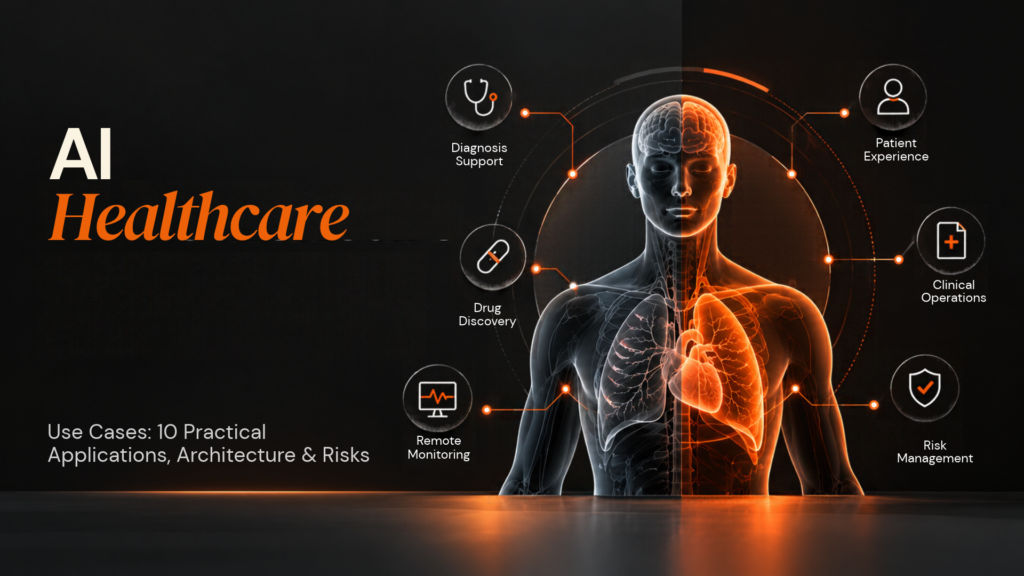
In this guide, we will explore 10 practical AI healthcare use cases, how to decide which one to build first, what the underlying architecture looks like, how much healthcare AI development can cost, what security and regulatory controls matter, and how to move from an AI pilot to a production-ready healthcare product.
01
Why AI Healthcare Use Cases Are Moving From Experiments to Workflows
The healthcare AI conversation used to focus heavily on what a model could theoretically do.
Could AI read an X-ray? Could machine learning predict deterioration? Could a chatbot answer medical questions?
Those questions still matter, but healthcare buyers now have a harder set of questions:
Can the system fit the workflow? Can it access the right data? Can its output be reviewed? Can the organisation measure the result? What happens when the model is wrong?
Healthcare rarely runs from one clean database. Information may sit across EHRs, laboratory systems, imaging platforms, scheduling, pharmacy, claims, wearables, and internal applications.
The model is therefore only one component.
A useful healthcare AI workflow is closer to:
Data → context → AI inference → validation → decision → action → audit → feedback
Before selecting an LLM, computer vision model, or predictive algorithm, define:
| Question | Example |
|---|---|
| What problem exists? | Clinicians spend too much time documenting visits |
| What data is required? | Conversation audio + approved patient context |
| What should AI do? | Draft a structured note |
| Who approves it? | Clinician |
| What happens when confidence is low? | Manual review |
| What proves value? | Documentation time + correction rate |
This prevents a common mistake: building an impressive AI feature with no owner, no KPI and no clear place in the user's workflow.
Designoweb's AI development services cover custom AI, predictive analytics, computer vision, autonomous agents, operational AI and MLOps, supporting projects that need to move from model experimentation into production software.
02
10 AI Healthcare Use Cases Worth Evaluating
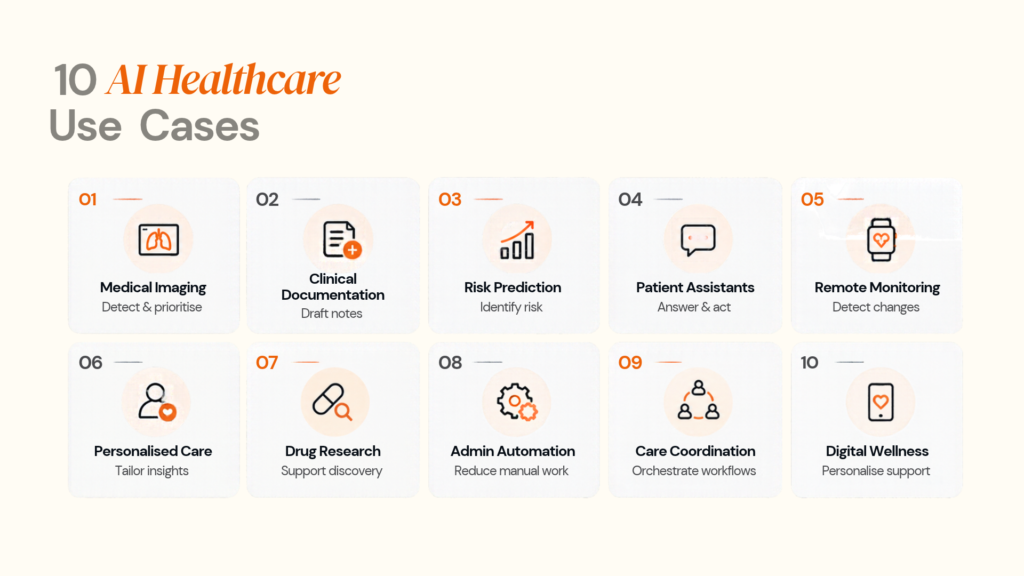
From data to decision. From decision to better care.
Not every healthcare AI application has the same clinical sensitivity, data requirement, or regulatory burden.
1. Medical Imaging and AI-Assisted Diagnostics
Computer vision can analyse X-rays, CT, MRI, mammography, pathology and other medical images to identify patterns, highlight areas for review or prioritise cases.
The US FDA maintains an active list of AI-enabled medical devices authorised for marketing. Its current database includes products across radiology, neurology, cardiovascular care and other specialties. FDA AI-enabled medical devices
A production workflow is closer to:
Image → preprocessing → AI inference → detection → quality checks → clinician review → report → audit
The important questions are how the system handles uncertainty, how model updates are controlled, and how performance is monitored after launch.
Designoweb's AI development services include computer-vision capabilities for image-driven workflows.
2. Clinical Documentation and Ambient AI
Ambient AI can capture a clinician-patient conversation, transcribe it, identify relevant information, and prepare a structured draft note. The clinician reviews and approves the final record.
| Step | AI role | Human role |
|---|---|---|
| Conversation | Capture/transcribe | Conduct consultation |
| Understanding | Extract information | Add context |
| Drafting | Generate note | Review/correct |
| Record update | Prepare output | Approve final record |
NHS England is expanding AI-supported administration, while the MHRA published July 2026 guidance on the qualification and classification of ambient voice technology-enabled medical-device products in Great Britain. NHS England · MHRA
The opportunity goes beyond transcription into draft discharge instructions, correspondence and specialty-specific documentation—while keeping clinician approval explicit.
3. Predictive Analytics and Patient Risk Stratification
Predictive AI can estimate readmission risk, deterioration, no-show risk, medication-adherence risk, disease progression, or operational demand.
A typical flow is:
Clinical data → feature pipeline → predictive model → risk score → workflow trigger → human review
A risk score has limited value if it simply sits in a dashboard. It becomes more useful when it triggers a defined action, such as routing a cohort to care-management staff.
Production monitoring should cover calibration, false positives, false negatives, missing data, subgroup performance, and model drift.
4. Patient Engagement and Conversational AI
Patients need help with many small tasks: appointments, preparation instructions, documents, contacts, and scheduling.
A stronger healthcare assistant connects conversation to action:
Patient request → intent detection → identity verification → approved context retrieval → API action → confirmation → audit
A general information assistant should not have the same permissions as a system that can change appointments or initiate other healthcare workflows.
5. Remote Patient Monitoring and Wearable Health Data
Wearables and connected devices can generate heart rate, sleep, activity, glucose, temperature, movement, and other signals.
AI can help identify patterns worth reviewing without turning every abnormal reading into an alert.
Device → mobile/edge ingestion → secure pipeline → AI analysis → threshold/policy → clinical review
The useful KPI is not the number of alerts. It may be the percentage of alerts that lead to meaningful action.
Designoweb's IoT app development services support connected-device and wearable applications that can form the data layer for AI-enabled health products.
6. Precision Medicine and Personalised Care
AI can help analyse combinations of clinical history, laboratory results, imaging, medications, genetics, lifestyle information and longitudinal outcomes.
The technical challenge is often data harmonisation rather than the model itself.
Inconsistent identifiers, incomplete histories and incompatible data sources can undermine an otherwise capable AI system. A strong data foundation therefore comes before the AI layer.
7. Drug Discovery and AI-Enabled Clinical Research
In life sciences, AI can support candidate prioritisation, literature analysis, molecular property prediction, therapeutic-target research, trial recruitment and trial-data processing.
A research platform might follow:
Research sources → data harmonisation → retrieval/model pipeline → experiment tracking → researcher interface → evidence layer
For startups, a focused research-intelligence workflow can be a more practical first product than an attempt to automate an entire drug-discovery lifecycle.
8. Administrative Automation, Coding and Revenue Cycle
Some of the most measurable AI healthcare applications sit outside diagnosis.
Use cases include medical coding support, claims preparation, prior authorisation, scheduling, eligibility checks, referral management, document classification and patient communications.
The workflow can combine AI with deterministic automation:
Document → AI classification/extraction → validation rules → business workflow → human exception handling
This is often easier to measure using turnaround time, correction rate, acceptance rate or staff minutes per transaction.
9. Care Coordination and Agentic AI
AI agents become relevant when healthcare workflows require multiple steps and system interactions.
For example:
Identify referral need → check existing referral → retrieve information → identify missing documents → update workflow → track status → notify staff → escalate exception
The value comes from orchestration, but so does the risk.
Agents need explicit permissions, audit trails, action boundaries, and human approval for higher-impact actions.
Designoweb's AI development services include autonomous-agent development for bounded workflows.
10. Mental Health and Digital Wellness
AI can support personalised content, journaling, mood tracking, behavioural prompts, educational resources and progress tracking.
The distinction between wellness and clinical care matters. A self-care product has a different risk profile from software that claims to diagnose or treat a psychiatric condition.
Designoweb's Mental Healthy case study documents AI-driven personalisation, mood tracking, educational resources and personalised programmes.
03
Which AI Healthcare Use Case Should You Build First?
The ten categories are not a universal priority list.
Evaluate each opportunity across:
Business impact + data readiness + workflow fit + clinical/regulatory risk + implementation complexity
A practical framework:
| Use case | Value | Data complexity | Clinical sensitivity | First milestone |
|---|---|---|---|---|
| Documentation | High | Medium | Medium | Draft for clinician review |
| Patient self-service | High | Low–Medium | Medium | Controlled FAQ + scheduling |
| Admin automation | High | Medium | Low–Medium | One measurable workflow |
| Predictive analytics | High | High | High | Retrospective validation |
| Remote monitoring | High | High | High | Alert + review workflow |
| Imaging AI | High | High | High | Narrow specialty validation |
| Agentic workflow | High | High | Medium–High | One bounded workflow |
A strong first project usually has three characteristics:
The problem is costly. The workflow is measurable. The AI output can be reviewed.
For startups, this often means starting with one focused workflow instead of attempting to build a complete AI hospital platform.
04
How Healthcare AI Software Actually Works
A healthcare AI product is more than a model connected to an app. A practical architecture is: Data sources → ingestion → normalisation → data foundation → AI/retrieval → orchestration → application → monitoring Data layer Sources can include EHR/EMR systems, labs, imaging, claims, scheduling, mobile apps, wearables, research databases, and enterprise documents. Interoperability layer HL7 FHIR is a standard for exchanging healthcare information electronically and is widely used for healthcare APIs. It helps systems exchange structured information, but it does not automatically solve data quality, identity resolution, terminology mapping, or consent. HL7 FHIR Model layer Use the model class that fits the job:
Problem
- Image analysis
- Risk scoring
- Document extraction
- Clinical summarisation
- Knowledge retrieval
- Sensor anomaly detection
- Multi-step workflows
Likely approach
- Computer vision
- Machine learning
- NLP / LLM
- Generative AI
- Embeddings + search
- Time-series / ML
- Agent + orchestration
RAG
RAG can connect a healthcare assistant to approved documents, procedures and organisational knowledge at runtime.
Question → retrieval → relevant sources → model response → validation
RAG does not make the model automatically correct. Retrieval quality, source freshness and permission checks still matter.
Agents
When AI performs actions, the control layer matters:
LLM → policy check → context retrieval → tool call → validation → approval → action → audit
The model should not be the only mechanism deciding whether an action is permitted.
05
Healthcare AI Architecture: From Patient Data to Action
A production healthcare AI system can be viewed through seven layers:
| Layer | Responsibility | Key question |
|---|---|---|
| Data | EHR, devices, imaging, documents | Can we access the right data? |
| Integration | FHIR, APIs, ETL, events | Can systems exchange it reliably? |
| Data foundation | Storage, metadata, lineage | Is it usable and traceable? |
| Intelligence | ML, vision, LLMs | Which model fits? |
| Orchestration | Rules, workflows, agents | What can AI actually do? |
| Product | Mobile, web, clinician UI | Can users act on it? |
| Governance | Security, audit, evaluation | Can it remain trustworthy? |
For many healthcare projects, the hardest layer is integration.
A model cannot repair a broken data pipeline. A chatbot cannot reliably book appointments if scheduling APIs are inconsistent. A risk model cannot remain dependable if the production data distribution changes without detection.
Designoweb's product engineering process connects product definition, architecture, development, testing, launch and post-launch support—important when the AI layer is deeply connected to the product.
06
Security, Privacy and Regulatory Considerations
Healthcare AI combines valuable data with high-impact decisions. Security needs to cover:
-
1
User/device
-
2
application
-
3
API
-
4
data
-
5
model/provider
-
6
logs
-
7
downstream systems
Important controls include:
- encryption in transit and at rest
- identity and access management
- least-privilege permissions
- secure secrets management
- audit logging
- retention controls
- tenant isolation where relevant
- incident response
Medical-device considerations
Not every healthcare application is a medical device. Intended purpose matters.
The FDA maintains a public list of AI-enabled medical devices authorised for marketing in the US and reported more than 1,600 authorised AI-enabled medical devices as of September 2026. FDA
In Great Britain, the MHRA's 2026 ambient-voice guidance addresses the qualification and classification of certain medical-device products. MHRA
EU requirements
For organisations serving the EU, AI Act obligations depend on the system and its risk category. Article 50 transparency obligations apply from 2 August 2026, while other high-risk provisions have later application dates. European Commission · AI Act Service Desk
Risk management
NIST's AI Risk Management Framework uses four functions:
-
1
Govern
-
2
Map
-
3
Measure
-
4
Manage
07
Healthcare AI Development Cost
There is no useful universal price for healthcare AI.
An educational assistant, remote-monitoring platform and imaging product may all use AI while having completely different engineering and validation requirements.
Main cost drivers
| Cost driver | What increases complexity |
|---|---|
| Data integration | Multiple EHRs, labs, imaging systems |
| Data preparation | Cleaning, mapping and validation |
| Model strategy | Specialised models or custom training |
| RAG | Indexing, retrieval, permissions |
| Agents | Tools, orchestration, approvals |
| UI/UX | Specialist patient or clinician workflows |
| Security | Identity, encryption and auditability |
| Clinical validation | Evidence and performance testing |
| Infrastructure | Inference, storage and latency |
| MLOps | Monitoring, drift and model lifecycle |
| Compliance | Jurisdiction-specific documentation |
| Adoption | Training and workflow redesign |
Indicative planning ranges
These are planning ranges, not fixed quotations:
| Project scope | Indicative investment |
|---|---|
| AI-assisted admin/document workflow | 30,000–70,000 |
| Patient-facing conversational AI | 50,000–100,000 |
| Healthcare RAG knowledge platform | 60,000–120,000 |
| Predictive analytics platform | 80,000–150,000+ |
| Computer vision workflow | 100,000–200,000+ |
| Remote-monitoring platform | 100,000–200,000+ |
| Complex regulated healthcare AI | $200,000+ |
Actual cost depends on the scope, data maturity, integrations, clinical validation and deployment environment.
A better budgeting path is:
Discovery → risk assessment → data audit → architecture → proof of concept → pilot → production → optimisation
08
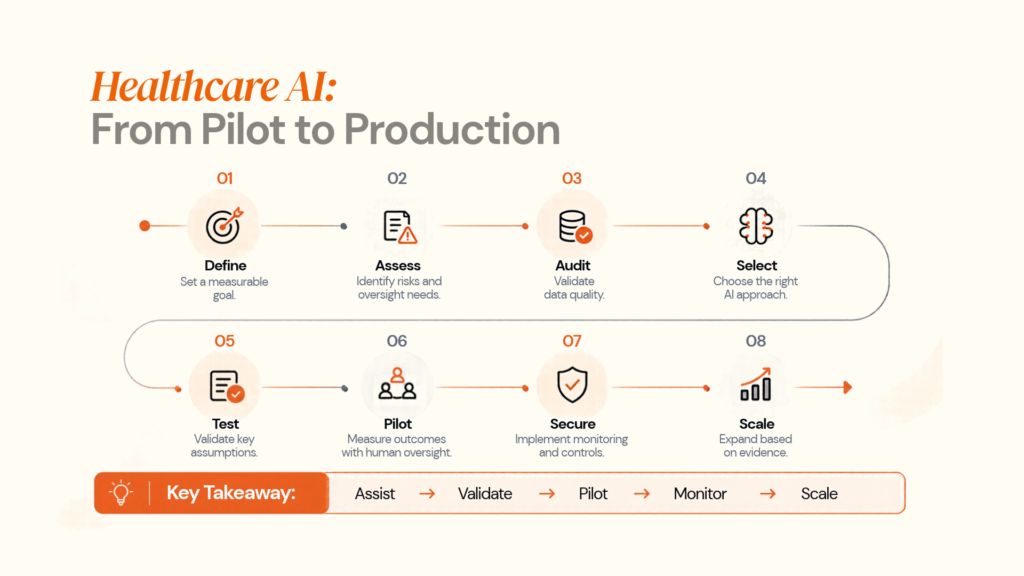
How to Implement Healthcare AI Without Getting Stuck in a Pilot
09
How to Evaluate a Healthcare AI Development Partner
A healthcare AI development company should be evaluated as a product-engineering partner, not just a model builder.
| Area | What to ask |
|---|---|
| Workflow | Do they understand the actual healthcare process? |
| Data | Can they integrate the required data sources? |
| Interoperability | How will EHR, FHIR and APIs connect? |
| Model strategy | Why this model? |
| Validation | How will quality be measured? |
| Human oversight | Where does authorised review happen? |
| Security | How is healthcare data protected? |
| Monitoring | What happens after launch? |
| Scalability | What changes at 10x usage? |
| Cost | What creates recurring infrastructure/model spend? |
| Ownership | Who owns software, data and evaluation assets? |
| Exit strategy | Can the organisation change model/provider? |
One question matters especially:
What happens when the AI is wrong?
A strong vendor should be able to explain the fallback path, escalation process and system boundaries.
Designoweb's product development services are relevant when AI needs to become part of a wider production product rather than remain a standalone experiment.
10
How Designoweb Fits Into Healthcare AI Development
At Designoweb, we build healthcare AI products around the workflow, the user and the technical system—not around a model alone.
Our current AI capabilities include:
- custom AI development
- predictive analytics
- computer vision
- generative AI
- NLP
- autonomous agents
- operational AI
- MLOps
- AI governance
We apply those capabilities differently based on the problem.
Predictive healthcare AI can use machine-learning pipelines for risk scoring, forecasting or decision support.
Conversational healthcare AI can combine LLMs with approved knowledge, APIs, identity and permission controls.
Connected health products can combine mobile applications, wearable or device data and AI.
Agentic healthcare workflows can coordinate bounded administrative processes with explicit tool permissions.
Designoweb also has adjacent healthcare product experience:
- PharmaTop — healthcare education platform with medical courses, enrolment, payments and progress tracking.
- Kayzen — appointment and session-management platform for psychologists and patients.
- Mental Healthy — mental-wellness platform with AI-driven personalisation and mood tracking.
- VASD — AI-powered image analysis, recommendations and service workflows.
These projects reinforce one principle:
Healthcare AI becomes useful when it is engineered into a complete workflow.
Author

Frequently asked questions
01
What are AI healthcare use cases?
AI healthcare use cases are practical applications of artificial intelligence across clinical, operational, research, and patient-facing workflows. Examples include medical imaging, clinical documentation, predictive analytics, remote patient monitoring, patient assistants, precision medicine, drug research and administrative automation.
02
What are the most common uses of AI in healthcare?
Current applications include clinical documentation, medical research summarisation, medical imaging, predictive analytics, patient communication, administrative automation and assistive diagnosis. An AMA survey in 2026 found that 81% of surveyed physicians reported professional AI use, with research summarisation and clinical documentation among the most frequently reported applications.
03
How is artificial intelligence changing healthcare?
AI is helping healthcare organisations analyse large datasets, automate repetitive work, support clinical workflows, personalise services and coordinate information across systems. The impact depends on how well the technology is integrated into actual workflows rather than on model capability alone.
04
What technology is used in healthcare AI?
The technology depends on the use case. Common building blocks include machine learning, deep learning, natural language processing, computer vision, generative AI, embeddings, vector search, RAG, APIs, FHIR, cloud infrastructure, MLOps and workflow orchestration.
01
Does healthcare AI need a large language model?
No. LLMs are useful for language-heavy workflows such as summarisation, conversational interfaces and document generation, but predictive analytics, imaging and sensor applications may use other types of machine learning instead.
02
What is RAG in healthcare?
Retrieval-augmented generation combines a language model with a retrieval layer that finds relevant information from approved sources before the model generates a response. It can be useful for healthcare knowledge assistants, internal documentation and policy-based workflows where source material changes regularly.
RAG should still be evaluated for retrieval quality, source freshness, access control and response accuracy.
03
How does AI integrate with EHR systems?
Integration can use APIs, interoperability standards such as FHIR, event pipelines or other mechanisms supported by the existing systems. The implementation must also handle identity, permissions, data mapping, validation, logging and error handling. FHIR is a standard for electronic healthcare information exchange published by HL7.
01
Is AI in healthcare subject to HIPAA?
It can be, depending on the data, organisation and use case. HHS specifically recognises third-party AI chatbots that handle PHI on behalf of healthcare providers as examples of business associates in relevant circumstances.
02
Is AI healthcare software regulated as a medical device?
Some healthcare AI products are medical devices, depending on their intended purpose and functionality. The FDA and MHRA both maintain regulatory frameworks for software and AI used as medical devices.
03
Does healthcare AI require human oversight?
For many clinically sensitive use cases, human oversight is an important part of safe deployment. Recent research on clinical AI implementation emphasises safety, effectiveness, monitoring and human oversight as recurring requirements.
01
How much does it cost to build healthcare AI software?
There is no meaningful single price because requirements vary significantly. The main cost drivers are data integration, security, UI/UX, AI model selection, infrastructure, clinical validation, monitoring, compliance and ongoing maintenance.
02
How long does it take to build an AI healthcare solution?
The timeline depends on scope and regulatory requirements. A focused administrative AI feature can be substantially simpler than an AI-enabled medical device requiring clinical validation, integrations and regulatory work. A realistic estimate should be produced after the workflow, data, architecture and compliance scope are assessed.
01
What should I look for in a healthcare AI development company?
Look for experience across product engineering, healthcare workflows, data integration, AI architecture, security, validation, MLOps and post-launch support. The vendor should be able to explain what happens when the model is uncertain, incorrect or unavailable.
02
Can an AI development company integrate AI into an existing healthcare product?
Yes. In many cases, integrating AI into an existing platform is more practical than rebuilding the product. The implementation can include APIs, data pipelines, RAG, predictive models, AI agents or other AI capabilities depending on the existing product architecture.
Designoweb currently supports AI integration across existing products and technology environments through AI development, generative AI, RAG, agents, machine learning and AI infrastructure capabilities.