
Key Takeaways
01.
Generative AI is expanding from code generation into the full software delivery lifecycle.
02.
Copilots, coding agents and AI-native products need different levels of autonomy and control.
03.
Strong use cases are pattern-heavy, context-rich, and verifiable.
04.
RAG is useful for private or changing knowledge; agents become relevant when systems need multi-step reasoning and tool use.
05.
Production AI needs evaluation, observability, permissions, security, and human approval where risk requires it.
06.
Measure AI using cycle time, defects, review effort, throughput, and cost—not lines of code.
Software development is changing faster than the tools inside the IDE.
Generative AI has moved from a chatbot that helps developers write snippets to a technology layer that can support planning, coding, testing, documentation, debugging, refactoring, and even multi-step engineering tasks. Coding agents can now work with tools, modify files, and execute commands in controlled environments.
Google's 2025 DORA research, based on nearly 5,000 technology professionals, reported 90% AI adoption among software-development professionals, while more than 80% said AI improved their productivity. DORA also describes AI as an amplifier: it can strengthen good engineering systems, but it can also accelerate weak feedback loops and delivery practices.
The evidence is not one universal productivity number. GitHub's controlled study reported a 55% speed improvement on a specific coding task with Copilot, while METR's 2025 randomized trial found experienced open-source developers took 19% longer on the tested tasks with early-2025 AI tools. The environments were different, so these studies should not be treated as directly comparable benchmarks. The practical lesson is that task design, repository context, developer experience, and verification overhead matter.
At Designoweb, we treat generative AI as part of the software delivery system, not as a coding shortcut. We start with the workflow, identify where AI creates leverage, define the required controls, and build around measurable production outcomes.
In this guide, we will explain how generative AI is changing the software development lifecycle, where it creates measurable value, which architectures fit different use cases, what it costs, how to manage risk, and how to choose an AI development partner.
01
What Generative AI Changes in Software Development
The traditional flow is:
Requirement → Code → QA → Deployment
The emerging flow is closer to:
Requirement → AI-assisted planning → Build → Automated verification → Human review → Deployment → AI-assisted monitoring
The important change is not that AI writes code. It is that intelligence can now sit across multiple delivery steps.
From code generation to delivery acceleration
Useful GenAI tasks include code scaffolding, API work, code explanation, test generation, documentation, predictable refactoring, SQL generation, issue summarisation and migration assistance. The best results usually come when the task has recognisable patterns and a clear way to verify the output.
A developer generating a function faster is task acceleration. A team combining AI with reusable components, strong tests, accessible documentation, and CI/CD is system acceleration. The second is usually more important for leadership because it changes the path from idea to release.
The five questions that matter
| Question | Why it matters |
|---|---|
| Is the work repetitive or pattern-heavy? | AI is easier to scale when output structure is recognisable. |
| Can the output be verified? | Verification reduces the cost of plausible mistakes. |
| Does it need private context? | Retrieval, identity and data controls may be required. |
| Does it need to take action? | Tool use, permissions and orchestration become important. |
| What happens when it is wrong? | The consequence determines the required control level. |
For a product engineering team, this keeps the discussion focused on software outcomes instead of AI hype. Explore Designoweb’s product development services to see how AI can sit inside a broader product delivery model.
02
How Generative AI Fits Across the Software Development Lifecycle
GenAI does not need to own the entire SDLC to create value. It can support specific stages while human teams retain product, architecture, and release accountability.
| SDLC phase | Useful GenAI role | Human ownership |
|---|---|---|
| Discovery | Summarise interviews, group themes, draft requirements | Priorities and validation |
| Architecture | Explore APIs, components and trade-offs | Final architecture |
| Development | Generate code, tests and documentation | Correctness and maintainability |
| QA | Create edge cases and test variations | Risk coverage and sign-off |
| Review | Explain diffs and flag patterns | Review decision |
| DevOps | Summarise incidents and draft runbooks | Production changes |
| Maintenance | Explain legacy code and suggest fixes | Staging and verification |
Discovery and requirements
AI can turn meeting notes, support tickets and research into structured candidate requirements. The useful control is simple: AI organises evidence; people decide priorities. Designoweb’s product development process provides a natural framework for introducing AI before implementation work begins.
Development and refactoring
Coding assistants are most useful for repetitive implementation, API wrappers, test scaffolding, documentation, and code explanation. Repository context matters. Without access to relevant conventions, interfaces, and tests, generated code can look correct while fitting poorly into the actual system.
Testing and quality
GenAI can expand test ideation quickly, but generated tests still need execution and evaluation. The stronger pattern is:
-
1
Generate
-
2
Execute
-
3
Evaluate
-
4
Review
-
5
Keep
A larger test suite is not automatically better coverage.
Operations and maintenance
AI can summarise logs, group incidents, explain unfamiliar modules and draft remediation ideas. Reading production signals is different from changing production. The latter requires stronger permissions, validation and recovery controls.
CTA — Add AI Without Weakening Engineering Controls
Designoweb can integrate GenAI into development workflows while keeping QA, security, and human ownership visible. Explore AI development services.
03
Copilot vs Coding Agent vs AI-Native Product
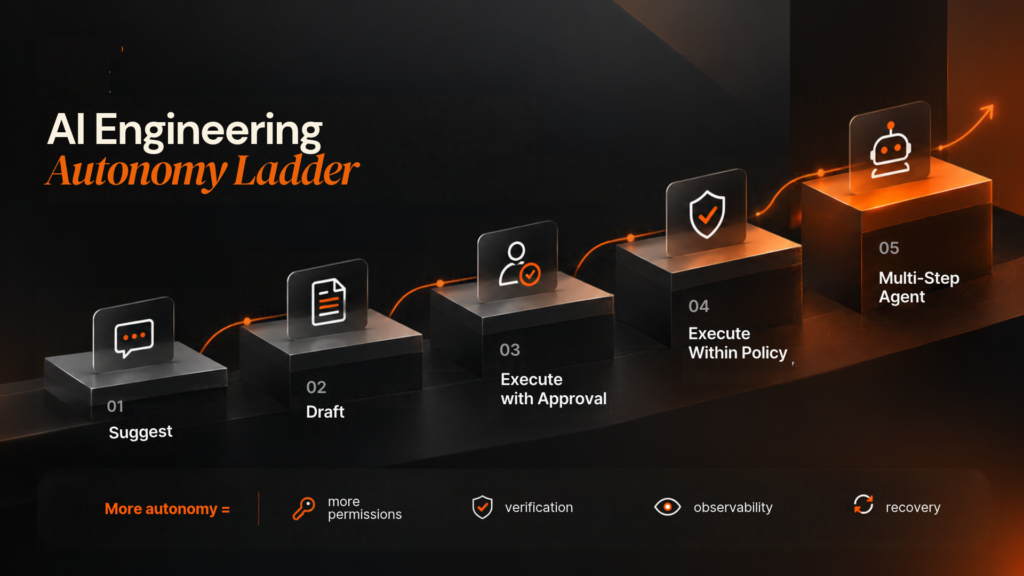
The terms are often used interchangeably, but the engineering implications are different.
| Approach | What it does | Typical control | Best Fit |
|---|---|---|---|
| AI coding assistant | Suggests code, explanations, and fixes | Developer-led | Everyday engineering |
| Coding agent | Plans work, uses tools, edits files | Developer supervises | Multi-step engineering |
| Embedded AI feature | AI works inside a product | User + application | Customer-facing intelligence |
| AI workflow | AI connects to business systems | Policy-controlled | Operations and automation |
| AI-native product | AI is core to product behaviour | Product architecture | New AI-first experiences |
Agent systems add a different dimension: action. Current OpenAI Agents documentation describes agents that can plan and complete tasks using tools while maintaining context across steps.
For a buyer, the progression is less about a “smarter model” and more about increasing system responsibility. Once AI can call APIs, update records, or run commands, architecture must account for permissions, validation, auditability, and failure recovery.
04
Choosing the Right Generative AI Architecture
The architecture should follow the workflow. Ask first: What information does the system need, and what should it be allowed to do?
Prompting
Use direct model interaction for relatively self-contained tasks such as summarisation, explanation, drafting or transformation. This is often the lightest pattern when private enterprise knowledge or system actions are not required.
Retrieval-Augmented Generation (RAG)
RAG retrieves relevant information at runtime and places it in context before generation:
-
1
Question
-
2
Retrieve
-
3
Ground
-
4
Generate
-
5
Validate
It fits private or changing information such as policies, support knowledge, technical documents, product catalogues and internal guidance. The key engineering challenge is not simply adding a vector database; it is retrieving the right source with the right access permissions.
Fine-tuning
Fine-tuning can make behaviour, style or output formats more consistent when you have a stable, representative dataset. It is not a replacement for live enterprise knowledge. A good first question is whether prompting, retrieval or better evaluation can solve the requirement with less operational overhead.
Tools and agents
Agents become relevant when the system needs to take actions. A simple example is:
User request → retrieve account data → call pricing API → validate eligibility → prepare proposal → request approval → update CRM
The model does not become the system of record. The application owns the available tools, arguments, permissions, business rules and validation.
Need
- Self-contained task
- Private or changing knowledge
- Stable specialised behaviour
- External actions
- Multiple needs
Pattern to consider
- Prompting
- RAG
- Fine-tuning
- Tools + orchestration
- Combined architecture
A good architecture is usually the simplest reliable pattern, not the most sophisticated one.
05
What a Production-Ready GenAI Architecture Looks Like
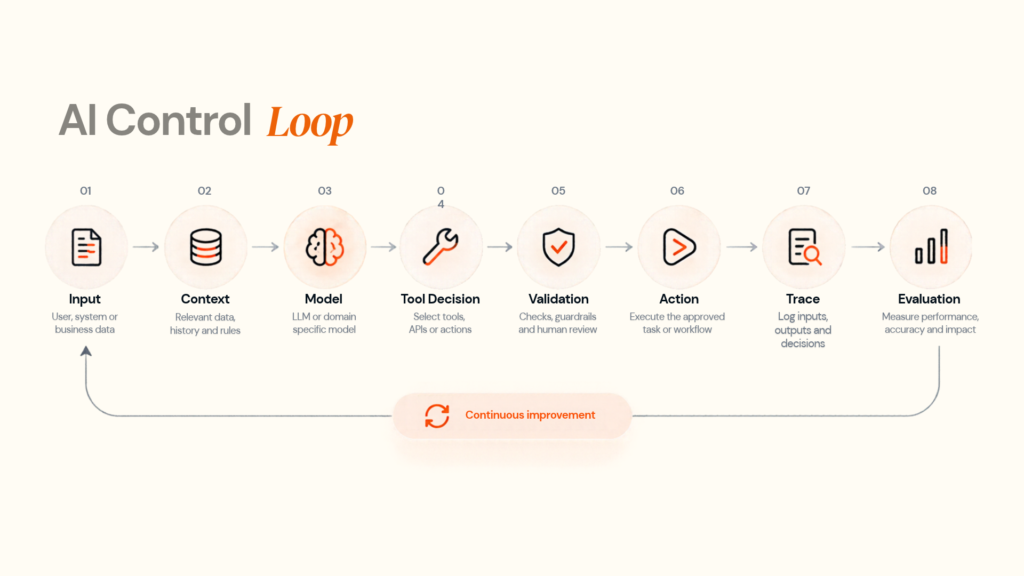
A production GenAI system is a controlled application stack, not an LLM API call with a chat box in front of it.
User → Application & Policy → Orchestration → Model Gateway → RAG / Tools / Code Context → Evaluation → Security & Observability → Human Approval or Controlled Release
Application and policy layer
This layer defines what the AI is allowed to see and do. It can include user permissions, tool allowlists, transaction limits, approval rules, output schemas, and business constraints.
Model gateway
A model gateway can centralise routing, versioning, cost controls, prompt management, and usage tracking. It also makes provider changes easier when the application uses a stable internal interface.
Context and retrieval
The goal is not to pass as much context as possible. It is to pass the right context. Better filtering, metadata, and retrieval ranking can improve quality while reducing token waste.
Tools and integrations
Expose narrow tools such as get_customer_order(order_id) rather than broad access to a database or production service. Narrow interfaces are easier to test, monitor and revoke.
Evaluation and observability
A production evaluation set should test factual accuracy, task success, structured output, retrieval quality, refusals, safety failures, human acceptance, latency and cost. Observability should capture model usage, tool calls, retrieval sources, timings and outcomes.
Human approval and recovery
Human review belongs where the consequence of failure justifies it. High-impact transactions, production infrastructure changes, sensitive record updates and external legal or financial communications may require explicit approval. Recovery should also be designed before autonomy increases.
06
Generative AI Development Cost and ROI
There is no single fixed price for generative AI software development. The cost depends on what the AI must know, what systems it must connect to, and how much autonomy and control the production environment requires.
Indicative 2026 planning ranges
| Project type | Indicative cost |
|---|---|
| AI proof of concept | $15,000–$40,000 |
| AI feature with production integration | $40,000–$100,000+ |
| RAG-powered enterprise application | $50,000–$120,000+ |
| Agentic workflow with multiple tools | $75,000–$150,000+ |
| Large enterprise AI programme | $150,000+ |
These are planning ranges, not fixed quotes. Data readiness, security, integrations, evaluation, deployment model, and ongoing maintenance can change the total materially.
What drives the cost?
Model inference, retrieval infrastructure, data preparation, API integrations, evaluation, security, observability, user experience and post-launch maintenance can all contribute to the total cost. In many enterprise projects, the integration and control layers matter as much as the model bill.
The ROI question should therefore be:
What measurable business output improves enough to justify total build + run cost?
Relevant measures include development cycle time, support handling time, manual processing volume, defect resolution time, customer self-service, throughput and cost per completed task.
07
Security, Privacy and Governance
GenAI changes the security boundary because risk can enter through user prompts, retrieved documents, model outputs, tool calls, and integrations.
Prompt injection
Treat retrieved material as data, not trusted instructions. Enforce tool permissions in the application layer rather than relying on the model to obey a rule.
Insecure output handling
Validate structured outputs, tool arguments, commands, and file paths before they reach sensitive systems. The model may propose an action; the application must decide whether it is allowed.
Sensitive data
Map what data enters the system, where it is processed, what is retained, who can retrieve it and what appears in logs. Tighter controls are appropriate for regulated or commercially sensitive information.
Governance
Useful frameworks include the NIST AI Risk Management Framework and its Generative AI Profile. OWASP’s Top 10 for LLM Applications is another practical reference for application-level threats.
| Control | Question |
|---|---|
| Data | What can the system access? |
| Identity | Who is making the request? |
| Tools | hich actions are permitted? |
| Validation | What must be checked? |
| Logging | Can we reconstruct the event? |
| Recovery | Can we reverse a bad outcome? |
08
How to Implement GenAI in Software Development
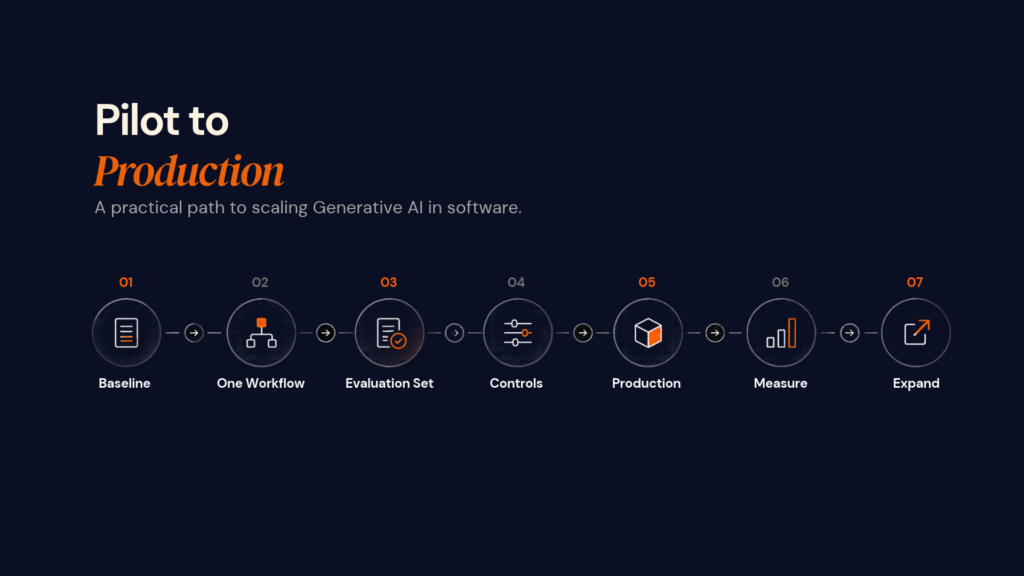
The safest implementation strategy is to scale the workflow, not the hype.
Step 1: Find high-friction work
Look for frequent, measurable tasks such as test creation, code documentation, issue triage, support summarisation, structured extraction or migration assistance.
Step 2: Score value and risk
A simple prioritisation model is:
Value × Frequency × Verifiability ÷ Risk
High-frequency, easy-to-verify workflows are usually easier starting points than rare, high-impact decisions with weak verification.
Step 3: Establish a baseline
Capture the current cycle time, defect rate, review effort, handling time, coverage or processing cost. Without a baseline, adoption can be mistaken for improvement.
Step 4: Pilot one workflow
Example development workflow:
Issue → AI implementation draft → Tests → Security scan → Human review → Pull request
Example business workflow:
Support ticket → Retrieve policy → Draft response → Confidence check → Human approval
Step 5: Add controls before autonomy
The progression should be:
-
1
Generate
-
2
Verify
-
3
Approve
-
4
Automate
Do not give an agent more production access simply because its demo looks impressive.
Step 6: Expand based on evidence
Once the workflow shows measurable improvement, reuse the successful components: prompts, retrieval patterns, evaluation sets, tools, security policies, monitoring and approval flows.
09
How to Evaluate an AI Development Partner
A strong AI development partner should be able to explain the product, architecture, and operating model, not just demonstrate a model.
| Area | What to ask for |
|---|---|
| Strategy | Clear problem definition and success metrics |
| Architecture | Why prompting, RAG, fine-tuning, or agents fit |
| Engineering | APIs, application architecture and deployment plan |
| Data | Access, retention and data-flow decisions |
| Evaluation | Task-specific tests and regression strategy |
| Security | Threat model, permissions and output validation |
| Operations | Monitoring, versioning and incident handling |
| Ownership | Clear source-code and infrastructure ownership |
| Scale | Cost, latency and capacity plan at higher usage |
10
Where Designoweb Fits
At Designoweb, we build generative AI into working software products and business workflows, not as a standalone chatbot added after the fact. We start with the outcome, then engineer the data, AI pattern, product experience, integrations, and controls around it.
Our AI development services cover generative AI, agentic AI, machine learning, conversational experiences, and enterprise integration. Those capabilities sit alongside broader product engineering services, application development, QA and deployment.
Our GenAI delivery model
Business Problem → Use-Case Validation → Data & Context → AI Architecture → Product Engineering → Integration → Evaluation → Security → Deployment → Optimisation
This matters because the model is only one component. A production AI feature may also need retrieval, identity, APIs, workflow logic, permissions, monitoring, human approval, and a fallback path.
11
When You Should Not Use Generative AI
A mature AI strategy includes knowing when a different technology is better.
Use conventional logic when the rule is deterministic
If the workflow is simply if X, then Y, a rules engine may be easier to test, audit and operate.
Use a normal query when the data question is simple
Do not put an LLM between a user and a database just because natural language is involved. A deterministic query can be faster and cheaper where the problem is straightforward.
Delay GenAI when verification is weak
High-impact workflows need an appropriate control layer. Fluent output is not the same as reliable output.
Delay GenAI when the context is missing
If the business cannot define what information the system should use or which source is authoritative, the problem may need data work first.
The strategic question is not “Can AI do this?” It is “Does AI create enough value here to justify the new operating cost and failure modes?”
Final Perspective
Generative AI is changing software development, but the objective is not to maximise AI usage. It is to improve a real workflow with measurable value.
For one team, that may mean an AI coding assistant. For another, it may mean a RAG-powered copilot, a bounded coding agent, or an AI-native product. The right architecture depends on the workflow, data, risk, integrations, and outcome.
At Designoweb, our focus is simple: build AI that works as software—not AI that only looks impressive in a demo.
Author

Frequently Asked Questions
01
What is generative AI in software development?
Generative AI in software development means using models that can generate or transform code, documentation, tests, technical explanations, requirements and other development artifacts. In newer agentic workflows, AI can also plan tasks, use tools, edit files and execute selected actions under defined controls.
02
How is generative AI changing software development?
It is changing software development by reducing manual work across several SDLC stages. Teams can use AI for requirements analysis, architecture exploration, code generation, testing, documentation, debugging, code review, operations and maintenance. The larger change is the ability to connect these capabilities into a single delivery workflow.
03
Can generative AI replace software developers?
Generative AI can automate parts of software development, especially repetitive work, but production software still requires human judgement around product requirements, architecture, security, trade-offs, testing and accountability. The practical shift is toward developers supervising, reviewing and orchestrating more AI-generated work.
01
What is the difference between an AI coding assistant and an AI coding agent?
An AI coding assistant generally helps with suggestions, code generation, explanations or debugging while the developer drives each step. A coding agent can plan a multi-step task, use tools, edit files and execute commands within defined boundaries. Agents therefore require more orchestration, permissions, monitoring and verification.
02
When should I use RAG for a software application?
Use RAG when the system needs reliable access to changing or private information such as documentation, policies, product data or internal knowledge. Retrieval allows the application to supply relevant context at runtime without retraining the base model whenever the source information changes.
03
When should I fine-tune a model instead of using RAG?
Fine-tuning is useful when you need more consistent model behaviour on a stable task and have quality training data. RAG is generally more suitable when the problem is access to current or private knowledge. Some systems benefit from both.
04
Do AI agents need APIs and tools?
Usually, yes when an agent must do more than generate text. APIs and tools give the agent controlled ways to retrieve information or take actions. The application should enforce permissions and validate tool arguments rather than relying on the model to self-limit.
01
How much does generative AI software development cost?
There is no single fixed cost. The budget depends on model usage, data and retrieval, integrations, evaluation, security, observability, infrastructure and ongoing maintenance. A simple summarisation feature and an enterprise agent connected to multiple systems have very different cost profiles.
02
How should a business measure the ROI of generative AI software development?
Start with a measurable baseline and compare it with the AI-enabled workflow. Useful measures include task completion time, defect rates, review effort, support handling time, cost per task, user adoption and business outcomes. Lines of generated code are not a useful ROI measure by themselves.
01
Is RAG safe against prompt injection?
No. RAG can improve the relevance of model responses, but it does not eliminate prompt injection risk. Retrieved content should be treated as untrusted data, with separate controls for tool permissions, output validation and high-impact actions.
02
How do companies protect sensitive data when using generative AI?
Start with a data-flow map. Identify what data enters the model, where it is processed and stored, which logs contain it, who can access it and what retention rules apply. Then use least-privilege access, redaction where appropriate, approved providers, encryption, monitoring and clear governance controls.
03
What should European companies consider when building AI software?
European teams should assess which parts of the EU AI Act apply to their specific system and role. The Act has phased requirements, including general-purpose AI obligations and Article 50 transparency obligations. Current European Commission guidance should be used for the latest scope and implementation details.
01
What should I ask an AI development company before starting a project?
Ask how the partner will define the use case, choose the architecture, measure success, protect data, evaluate model performance, control tool permissions, monitor production behaviour, manage model changes and support the system after launch.
02
How do I know whether an AI project is ready for production?
The project should have a defined use case, measurable success criteria, representative evaluation data, clear security controls, known failure modes, monitoring and a rollback or human-approval path for risky actions. A successful demo is evidence of feasibility, not production readiness.
03
What does a production-ready generative AI system include?
A typical production system includes application logic, model access, context or retrieval, integrations and tools, evaluation, security controls, observability, and operational processes. The exact architecture depends on the use case.