Phygital Sports Technology Explained: Use Cases, Benefits & Challenges
KP
Kalash Pachauri
Oct 26, 2026
26 min read
Key Takeaways
01
In phygital sports, the physical and digital parts aren't separate layers. They are one competition running on two fields at once.
02
Not every format has two stages. Football, basketball and shooter run a digital round then a physical round, while dancing is scored by the game engine during the physical performance itself.
03
A platform only works if player identity, timing, scoring and event state stay consistent everywhere someone is watching or playing.
04
AR, VR, IoT, motion tracking, mobile apps, computer vision and real-time cloud infrastructure each solve a different problem. No product needs all of them.
05
The money often sits outside the tournament: training, fan engagement, sponsorship, venue technology and content.
06
A good MVP doesn't chase every emerging technology. It needs one competitive mechanic that works every time, and indicative build costs start in the tens of thousands of dollars, not millions.
07
Real-time architecture and an operational fallback matter as much as how immersive the experience looks.
08
Privacy, accessibility, device compatibility and fair-play controls belong in the requirements from day one.
09
When choosing a partner, judge systems integration, live-event reliability and operational thinking. Nice 3D visuals are the easy part.
Introduction
For years, sports technology meant adding digital capabilities to physical sports. Scores moved from paper to platforms, wearables began capturing athlete performance, and mobile apps gave fans live statistics, highlights and personalised content. Augmented reality (AR) brought digital information into venues, and virtual reality (VR) opened new ways to train and to watch.
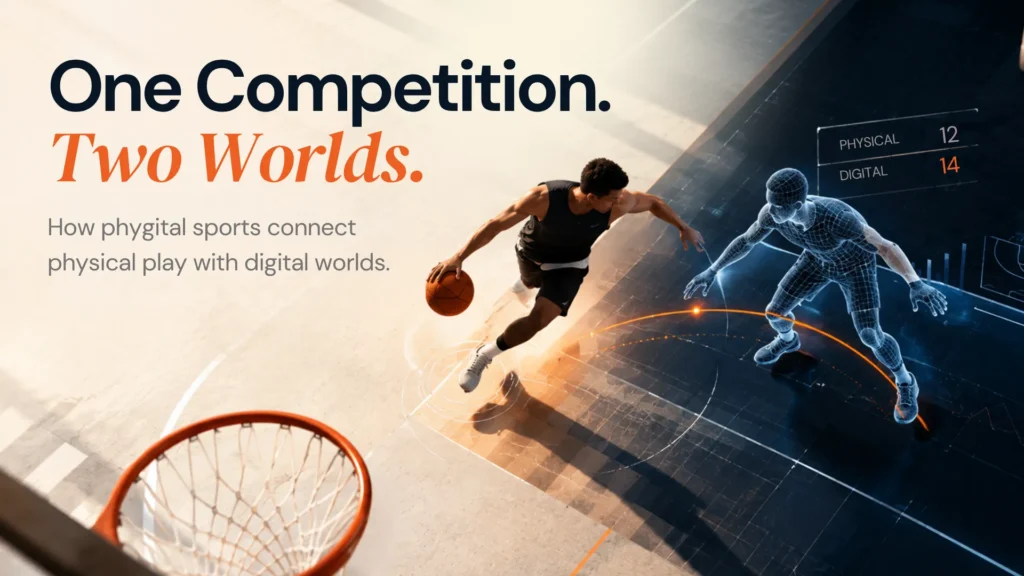
Phygital sports go a step further. Instead of adding a digital layer on top of a physical sport, they connect physical competition and digital gameplay as parts of the same contest. Players, rules, scoring, data and progression can span both environments. In the best-known formats, athletes play a video game version of the discipline and then a real-world match, and both results decide the winner.
The scale of the category is now hard to ignore:
Organised competition.Games of the Future 2026 in Astana ran from 29 July to 9 August and brought together more than 800 participants from over 50 nations across eight disciplines, with a prize pool above US$4 million.
A structured pathway. The World Phygital Community (WPC) runs ranking tournaments and qualification stages that lead to the Games, and its 2025/26 season launched with 96 member organisations across 92 countries.
Market forecasts. The Business Research Company sizes the phygital sports market at $2.7 billion in 2026 and forecasts $7.02 billion by 2030, a 26.9% CAGR. Estimates vary by analyst and scope. Market.us, for example, projects roughly $13.5 billion by 2034 from a much smaller 2024 base. Treat them as directional rather than precise.
The wider sports technology market.MarketsandMarkets projects sports technology overall growing from $34.25 billion in 2025 to $68.71 billion by 2030, a 14.9% CAGR, driven by AI, IoT, wearables and smart venues.
This creates a specific technology challenge. A sports app can show a live score. An AR app can overlay statistics on a venue. A VR app can simulate a pitch. A phygital sports platform has to connect all of these so that physical activity, digital gameplay and real-time data work as one competition.
This guide explains how phygital sports work, what technology sits behind them, where the commercial opportunities are, what they cost to build, and how to avoid the mistakes that sink most first attempts.
01
What Are Phygital Sports?
Phygital sports are hybrid sports experiences that combine digital gameplay or digital interaction with physical athletic competition, governed by shared rules that decide how each part contributes to the result.
The two best-known structures are:
Sequential (two-stage) formats: athletes compete in a digital round and then a physical round, and the results combine. Phygital Football, Phygital Basketball and Phygital Shooter follow this model.
Blended formats: the physical performance is measured by the digital system as it happens. Phygital Dancing is the clearest example: competitors copy on-screen choreography while the game's scoring algorithm evaluates their accuracy and rhythm.
For example, Phygital Football at Games of the Future pairs a video-game football match with a real 5v5 match, and performance in both counts towards the result.
How phygital sport differs from neighbouring categories
Format
Physical activity
Digital component
Shared competitive system
Traditional sport
Yes
Low / optional
Yes
Esports
No
Yes
Yes
AR sports experience
Yes
Yes
Sometimes
Connected fitness
Yes
Yes
Usually
Sports simulation
Optional
Yes
Yes
Phygital sport
Yes
Yes
Core to the format
Phygital sport vs esports. Esports are competitions played entirely through video games. In phygital sport, the physical performance is a required part of the contest, so an athlete can't win on gaming skill alone. This is also why the technical challenge is different. An esports platform manages digital events, while a phygital platform has to reconcile digital events with what happens on a real court, pitch or dance floor.
The term is sometimes used more loosely for any experience where physical and digital touchpoints work together. For technology buyers, it's useful to distinguish between a phygital competition and a broader phygital sports experience. That distinction prevents a common product mistake: building an impressive digital layer without defining what role it plays in the sport.
What makes a sport genuinely phygital?
A useful test is to ask four questions:
Does physical activity materially affect the experience or outcome?
Does the digital component materially affect the experience or outcome?
Are the two stages connected by common identity, rules, scoring or progression?
Would removing either stage fundamentally change the competition?
If the answer to all four is yes, you are much closer to a true phygital sports product than a conventional sports app with immersive features.
02
Popular phygital sports and how each works
The World Phygital Community currently oversees four core ranking disciplines: Phygital Football, Phygital Basketball, Phygital Dancing and Phygital Shooter. Each one poses a different engineering problem.
Discipline
Digital element
Physical element
Structure
What the platform must handle
Phygital Football
Competitive video-game football match
Real-world 5v5 match
Sequential
Carrying results between stages, combined scoring, substitutions
Phygital Basketball
Console basketball gameplay
Real-court 2v2 match
Sequential
Fast rotations, per-player identity across devices, live score sync
Phygital Shooter
Team-based tactical rounds across two maps
Real-world laser tag
Sequential
Team state, round timing, hit detection, disconnect recovery
Phygital Dancing
Dance game scoring on screen
Athlete performing physically, tracked by controller or motion capture
Blended
Low-latency capture, fair and consistent scoring, elimination brackets
Phygital Football and Basketball
Both use the classic two-stage model: a digital contest followed by a physical one. The platform's hardest job is the hand-off. Identity, score and match state have to survive the move from consoles to the court, often with substitutions, timeouts and penalties in between.
Phygital Shooter
Matches unfold in two stages: fast-paced digital rounds across two maps, then a real-world laser-tag game. That adds a third data source, hit detection, alongside game events and referee input.
Phygital Dancing
At Games of the Future, sixteen athletes compete in a double-elimination format, and matches are best-of-three tracks. Dancers use a Just Dance title on Nintendo Switch, and the game scores how accurately they copy the on-screen moves (Games of the Future). The WPC's own description adds that competitions run on a technical field with screens or projectors, with motion capture systems tracking participants (WPC). For builders, this is the format where real-time capture and consistent scoring matter most.
Why this matters for product teams: "phygital" isn't one architecture. A sequential format needs robust state hand-off. A blended format needs low-latency measurement of physical movement. Your first design decision is which of these patterns your sport uses.
03
Why Phygital Sports Are Gaining Attention in 2026
Phygital sports have moved well beyond a purely conceptual discussion.
Competition scale.Games of the Future 2026 took place in Astana from 29 July to 9 August, with more than 800 participants from over 50 nations across eight disciplines and a prize pool above US$4 million. Organisers expected more than 100,000 spectators across four venues. Four of the eight disciplines are core phygital formats. The others include Phygital Fighting, MOBA (on PC and mobile) and Battle Royale.
A real competitive pathway. Athletes qualify through regional (Phygital Origins) and national (Phygital Rivals) tournaments, with a final qualifier tier called Phygital Contenders. That means organised rankings, broadcasts and event operations, and all of that needs software.
A wide device footprint. Current implementations involve:
consoles and PCs
smartphones and web applications
AR/VR hardware
motion tracking
connected sports equipment
wearables
venue displays
live-streaming systems
real-time analytics
That means the opportunity is increasingly an integration problem, not just a game-development problem.
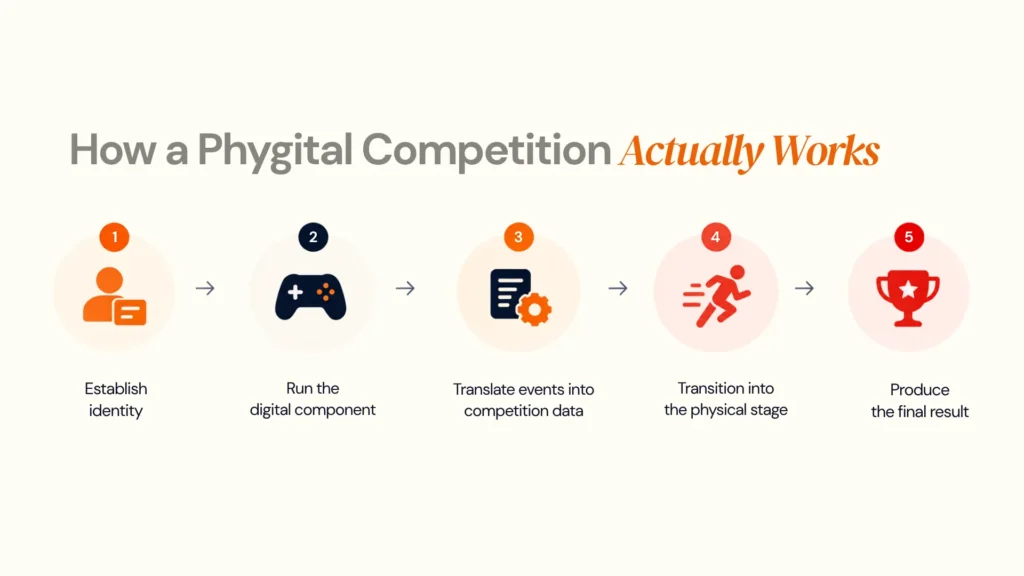
A sports organisation planning a phygital product should think about the whole chain:
The flow below describes a sequential format, where a digital stage is followed by a physical one. Not every phygital sport works this way. In a blended format such as Phygital Dancing, the game scores the athlete's physical performance as it happens, so there is no separate hand-off between stages.
For platform teams this changes the architecture:
Sequential formats need reliable state hand-off, so that identity, score and match state carry from one stage to the next.
Blended formats need low-latency capture and consistent real-time scoring during the performance itself.
Most of what follows applies to both. The rules layer, the single authoritative match state and the failure-mode testing are essential either way.
Stage 1: Establish identity
The system needs to know:
who the athlete is
which team they belong to
which device or account they are using
which competition and match they belong to
which permissions apply
Identity sounds basic until a tournament contains multiple devices, substitutes, operators and concurrent matches.
A single player ID may need to connect a console account, mobile profile, wearable session and physical participation record.
Stage 2: Run the digital component
The digital stage may involve:
a sports video game
a rhythm game
a tactical game
a simulated environment
a motion-based challenge
a mixed-reality experience
The choice of game engine depends on the competition mechanic, target devices and level of interaction required. For experiences that require custom 3D gameplay, physics, real-time interactions or integration with connected devices, Unity game development can provide a flexible foundation for building the digital competition layer.
The digital stage generates measurable events.
Examples include:
goals
points
time
completed actions
accuracy
successful challenges
game states
Stage 3: Translate events into competition data
The platform then needs to convert raw events into authoritative competition data.
For example:
1
Game Event
2
Event Validation
3
Rules Engine
4
Official Score
5
Match State
This is where product engineering becomes important.
A game client should not automatically become the final source of truth simply because it generated an event.
A production system may need:
event validation
timestamps
duplicate detection
rule checks
score reconciliation
operator override
audit logs
Stage 4: Transition into the physical stage
This is often where the experience becomes operationally difficult.
The system may have to carry state from the digital stage into the physical stage.
Depending on the rules, this could mean carrying a:
score advantage
countdown
ranking position
handicap
an accumulated performance value
The physical stage then produces a new stream of events.
Stage 5: Produce the final result
The scoring engine combines valid events from both stages.
A simplified version looks like:
Digital Score + Physical Score = Final Competition Score
But the production implementation is more sophisticated because the system must account for:
rule variations
penalties
timeouts
corrections
substitutions
tie-breaking
disconnected devices
operator interventions
The hidden product challenge: state synchronisation
For a normal mobile app, delayed state can be annoying.
For a competitive phygital event, inconsistent state can become a fairness problem.
Imagine:
the arena display shows 4–3
the referee tablet shows 3–3
the streaming overlay shows 5–3
the participant app still shows the previous score
The visual problem is obvious.
The real problem is that the system has no single authoritative event state.
That is why the scoring and event architecture should be designed before the visual layer.
05
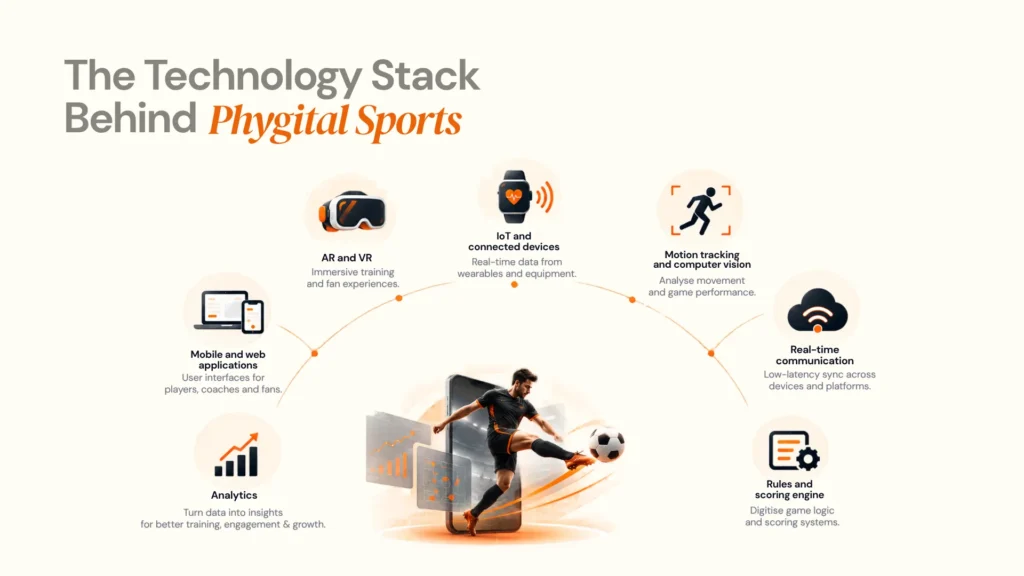
The Technology Stack Behind Phygital Sports
Phygital sports do not require every emerging technology. The right architecture depends on the competition mechanic.
1. Mobile and web applications
A mobile application can serve as the participant and fan layer.
Typical functions include:
registration
team management
match schedules
digital identity
live scores
leaderboards
challenges
rewards
notifications
venue navigation
sponsor activations
content
For many products, mobile is the most practical starting point because it avoids requiring every participant to wear specialised hardware.
Businesses planning the participant experience can also benefit from a dedicatedmobile app design approach that maps the journey before development begins.
2. AR and VR
AR is useful when the physical environment remains important.
Examples include:
live statistics over a court or pitch
digital targets
player information
interactive sponsor experiences
navigation inside venues
spectator challenges
VR is more appropriate when the user needs to enter a simulated environment.
Examples include:
virtual training
remote spectator experiences
simulated competition
digital practice environments
immersive fan zones
Building these experiences requires more than adding a 3D layer. Device compatibility, interaction design, spatial tracking, performance and integration with the wider sports platform all need to be considered. An AR VR app development company can help connect the immersive experience with the participant, venue and real-time data layers.
The important product decision is not “AR or VR?”
It is:
What part of the sports experience actually benefits from immersion?
3. IoT and connected devices
IoT becomes valuable when physical activity needs to generate digital events.
Potential data sources include:
smart equipment
motion sensors
wearables
cameras
venue devices
connected displays
location systems
Connecting these devices to a reliable software platform requires more than collecting sensor data. AnIoT app development company can help design the communication layer between connected equipment, device gateways, event-processing systems and the applications that use the resulting data.
AWS IoT Core is one example of a cloud IoT platform built for secure, two-way communication between connected devices and the cloud. It also supports device-shadow patterns, which can help applications maintain a representation of a device's last known state when the device temporarily goes offline.
For phygital products, that matters because real-world equipment is not always online, stable or available at the exact moment an application requests its state.
4. Motion tracking and computer vision
Computer vision can reduce the need for dedicated sensors in certain scenarios.
Possible applications include:
movement detection
object tracking
pose estimation
action recognition
boundary detection
automated event capture
performance analytics
The trade-off is important.
Computer vision can simplify physical hardware requirements, but it introduces its own challenges:
camera placement
lighting
occlusion
model accuracy
processing latency
calibration
compute cost
environmental variability
For a high-stakes competition, automated detection should also have a defined fallback path.
5. Real-time communication
Participants, referees, venue operators and viewers may all need rapidly updated state.
A robust real-time system typically separates:
event ingestion
event validation
canonical state
client delivery
analytics
That separation makes the platform easier to debug and scale.
It also reduces the risk of allowing one front-end application to become the unofficial source of truth.
6. Rules and scoring engine
This is one of the most important components.
Instead of embedding competition logic throughout the application, maintain a dedicated rules layer.
Conceptually:
Raw Event
↓
Validate
↓
Apply Rule
↓
Update Match State
↓
Publish Official State
This makes it easier to support:
different sports
different tournament formats
different regions
rule changes
tie-breakers
experimental competitions
It also creates a cleaner path from MVP to a multi-discipline platform.
7. Analytics
A mature phygital platform can produce more than a final score.
It can capture:
athlete performance
engagement
match duration
device reliability
participation
drop-offs
fan interactions
sponsor interaction
conversion events
content consumption
This data creates value for organisers, teams and commercial partners.
A Practical Phygital Architecture
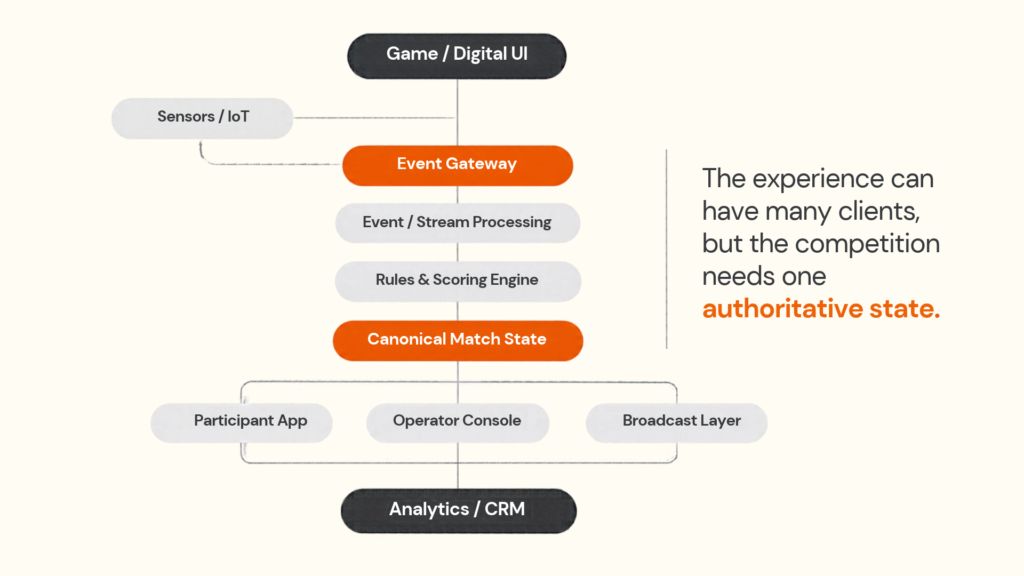
One useful architecture for a multi-participant phygital platform looks like this:
The key architectural principle is simple:
The experience can have many clients, but the competition needs one authoritative state.
06
Phygital Sports Use Cases Beyond the Tournament
The tournament has only one commercial model.
Fan engagement
Sports organisations can use phygital experiences to turn spectators into participants.
Examples include:
in-stadium challenges
AR scavenger hunts
virtual skill contests
fan leaderboards
prediction games
interactive sponsor experiences
digital collectibles
live venue challenges
AR can make these experiences more interactive by connecting digital content to the physical venue. Fans could use their phones or compatible devices to discover virtual content, complete challenges, access live information or interact with branded experiences. An augmented reality development company can help translate these concepts into venue-based AR experiences while connecting them with the wider mobile, data and engagement platform.
Sports technology companies are also combining mobile, immersive experiences, real-time data and fan engagement into connected ecosystems.
Training and athlete development
A phygital environment can connect simulated scenarios with physical practice.
For example:
Digital drill → physical execution → performance data → feedback
The value is not the headset.
The value is the closed feedback loop.
Sponsorship activation
Phygital experiences create more measurable sponsor interactions than passive signage.
A sponsor could own:
a digital challenge
an AR experience
a fan mission
an interactive venue zone
a branded digital environment
This also creates measurable interaction data.
Deloitte has highlighted how digital fan engagement and data can create new opportunities around attendance, engagement and sponsorship value.
Fitness and connected sport
Connected cycling, smart equipment and sensor-enabled training can turn physical activity into a dynamic digital experience.
This expands the category beyond elite competitions.
Education and grassroots sport
Phygital programmes can give schools and clubs another way to make participation more interactive.
The World Phygital Community says its ecosystem includes clubs, universities, colleges, schools and other organisations, while recent WPC material highlights youth participation and school programmes as part of the broader movement.
Immersive sports venues
A modern venue can become a technology platform rather than simply a place where an event happens.
That can include:
digital wayfinding
connected entry
interactive screens
AR navigation
live statistics
mobile commerce
personalised content
social experiences
EPAM and Infosys both describe the convergence of IoT, immersive technologies, digital products and venue operations as part of the evolving “stadium of the future.”
07
How to Design a Phygital Sports Platform
The wrong starting point is:
“Which immersive technology should we use?”
The better starting point is:
“What competitive or business problem becomes possible because physical and digital activity are connected?”
Step 1: Define the competitive mechanic
Write the rule in one sentence.
For example:
Teams complete a digital stage first, and the resulting score carries into a physical stage.
Then define:
inputs
outputs
timing
score calculation
tie-breaking
penalties
operator controls
Step 2: Map the physical-to-digital data
Before you get anywhere near choosing devices, build a data dictionary first.
For every event, define:
Data point
Source
Frequency
Required accuracy
Business use
Player identity
App / account
Session
High
Match integrity
Score event
Game / referee
Event-based
Critical
Final result
Position
Sensor / vision
Real-time
Sport-dependent
Tracking
Device state
IoT gateway
Periodic / event
High
Reliability
Match state
Scoring engine
Real-time
Critical
Participant + broadcast
Fan interaction
Mobile / web
Event-based
Medium
Engagement
This prevents teams from collecting data merely because the device makes it possible.
Step 3: Choose the minimum required technology
A practical decision framework:
Requirement
Most relevant technology
Digital gameplay
Game engine / game platform
Physical telemetry
IoT / sensors
Visual overlays
AR
Immersive simulation
VR
Movement analysis
Computer vision / motion tracking
Participant interaction
Mobile / web
Live event state
Real-time backend
Historical reporting
Data platform
Rules and official scores
Dedicated rules engine
The best implementation is often the smallest technology combination that reliably delivers the intended experience.
Step 4: Build a prototype around one end-to-end moment
Instead of developing the full platform first, prototype one complete interaction:
Athlete action → data capture → score calculation → live update → audience feedback
That prototype reveals the real engineering constraints much earlier.
Step 5: Test the failure modes
Do not test only the happy path.
Simulate:
sensor disconnect
network loss
duplicate event
wrong player ID
delayed telemetry
incorrect score
referee correction
app crash
game restart
venue screen failure
A phygital system shouldn’t depend on every device working perfectly because real events are unpredictable, and the system needs to keep working even when something goes wrong.
Step 6: Separate MVP from long-term platform
A sensible progression is:
Phase 1: one sport, one venue, one device model Phase 2: multiple matches and operator tools Phase 3: analytics, fan engagement, and sponsor modules Phase 4: multi-venue / multi-sport platform Phase 5: advanced immersive and computer-vision capabilities
This reduces unnecessary upfront complexity. A product development company can help turn the initial competition mechanic into an MVP, validate the architecture, coordinate integrations and establish a roadmap for scaling the platform as the product gains users and venues.
Phygital Sports: Build vs Buy vs Integrate
There is no single correct technology strategy.
Approach
Best suited to
Advantage 3
Trade-off
Build from scratch
New proprietary sport or platform
Maximum control
Highest engineering responsibility
Use existing game technology
Established digital game format
Faster digital competition layer
Platform dependency
Integrate specialist hardware
Sensor-rich experiences
Better physical telemetry
Hardware and support complexity
Buy specialist components
Standard capabilities
Faster implementation
Less differentiation
Hybrid approach
Most enterprise projects
Balances speed and control
Requires good integration architecture
For many organisations, the hybrid option is practical.
Keep the proprietary layer around:
competition rules
scoring
identity
participant experience
analytics
sponsor experience
operational controls
Use proven platforms for capabilities that do not need to differentiate the product.
What Does Phygital Sports Development Cost?
Two apparently similar phygital projects can have completely different technical scopes, so no honest quote comes without a scoping conversation. But budgeting shouldn't start from zero. The table below gives indicative investment ranges by stage. They are directional and exclude hardware procurement, venue installation and third-party licences.
Stage
Typical scope
Indicative investment
Typical timeline
Proof of concept
One competitive mechanic, one device class, one end-to-end moment (action → score → live update), basic operator view
$10,000 – $30,000
6–10 weeks
MVP
One discipline, one venue, participant app, operator console, rules and scoring engine, live leaderboard, audit log
$30,000 – $100,000
4–6 months
Multi-match / multi-venue platform
Multiple disciplines, device provisioning, analytics, sponsor and fan modules, broadcast overlays
$100,000 – $200,000
6–10 months
Enterprise / advanced immersive
Custom hardware integration, computer vision, AR/VR, multi-region operations, live-ops support
$200,000+
10+ months
Cost driver
Why it changes the budget
Number of disciplines
More rules, workflows and scoring variants
Hardware
Devices, sensors, gateways and installation
Real-time architecture
More demanding infrastructure and testing
AR/VR
3D assets, device support and performance optimisation
Computer vision
Data, model development, compute and calibration
Game integration
APIs, SDKs and platform restrictions
Mobile apps
Participant, fan and operator experiences
Venue integration
Screens, networking and operational interfaces
Broadcast
Overlays, feeds, content and synchronisation
Security
Identity, device security and access controls
Live operations
Monitoring, support and incident response
Analytics
Event pipelines, data warehouse and dashboards
A more useful budgeting split than a generic "app development price" is: Experience + Hardware + Integration + Real-time platform + Operations
Costs people forget
Build cost is only part of the picture. Plan for these ongoing costs from the start:
Cloud and real-time infrastructure, which scales with concurrent matches and viewers
Hardware refresh and calibration, since sensors and displays wear out and drift
Live-event operations, including on-site technicians and incident response
Platform and licence changes, as game and device vendors update their SDKs
Security and compliance reviews, especially where video, location or biometric data is involved
Analytics and content operations after launch
How to keep the budget under control
Start with a proof of concept for the single interaction your product depends on.
Keep the proprietary layer small. Own the rules, scoring, identity and experience. Buy the commodity parts.
Test failure modes early. Fixing a fairness bug after launch costs far more than a disconnect test during the prototype.
Add technology on evidence. Add AR, VR or computer vision only when the MVP shows the need.
How Phygital Sports Can Create Business Value
The commercial model depends on who owns the platform.
For sports clubs and leagues
Potential value areas include:
fan engagement
membership
ticketing
sponsorship
merchandising
digital content
player development
For event organisers
Potential value areas include:
registration
tournament operations
venue technology
sponsorship packages
broadcast
post-event analytics
For technology companies
The opportunity may be the platform itself:
SaaS subscriptions
licensing
white-label deployments
venue deployments
managed technology services
data products
For consumer brands
Phygital experiences can be used as campaign infrastructure.
A physical interaction can trigger a digital experience, which then creates measurable engagement.
That same principle can connect:
Product → Venue → Fan → App → Content → Commerce
The most valuable systems are therefore not necessarily the most visually impressive.
They are the ones that create a measurable loop.
08
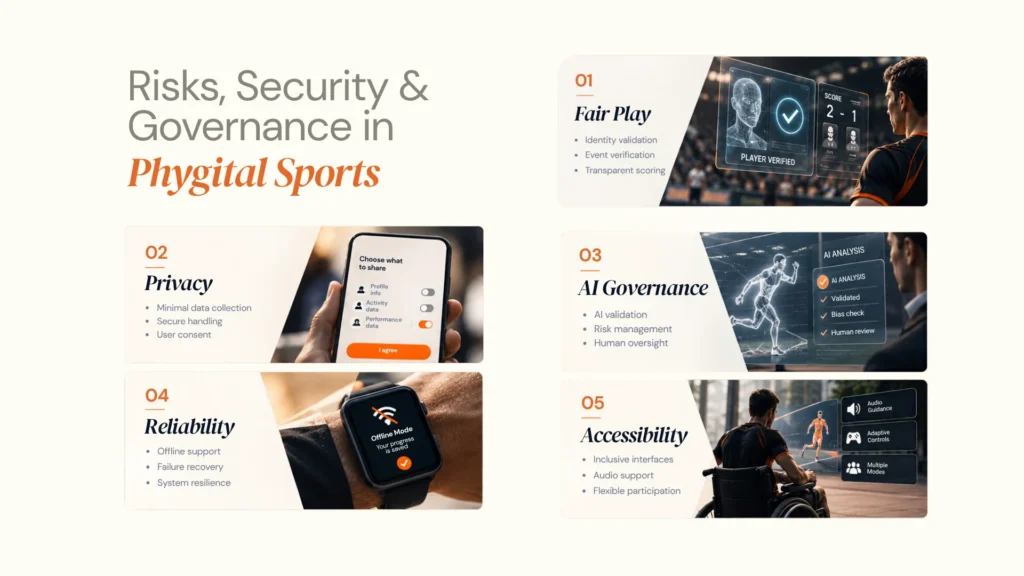
Risks, Security, and Governance
The more physical and digital systems interact, the larger the operational surface becomes.
Fair play
A phygital platform needs a clear source of truth for every competition-critical event.
Use:
authenticated identities
signed or validated events where appropriate
server-side scoring logic
audit trails
role-based operator controls
replayable event logs
Privacy
The platform may process:
account data
location
device identifiers
movement data
biometric or health-related information
video
behavioural analytics
Data collection should be proportional to the experience.
A platform should not collect sensitive information simply because a device can provide it.
For UK and European deployments, data protection design should be treated as part of the product architecture, not as a policy document added later.
AI governance
AI can be useful for:
performance analysis
automated highlights
moderation
recommendations
fan personalisation
computer vision
But AI should not automatically control competition-critical decisions without appropriate validation and governance.
Where AI is used, teams can use theNIST AI Risk Management Framework as one useful governance reference for risk identification, evaluation, and management. NIST describes the framework as a voluntary resource for organisations designing, deploying, and evaluating AI systems.
Reliability
Every event should have a fallback.
Ask:
“What happens if the internet disappears for 30 seconds?”
Good answers might include:
local buffering
edge processing
cached device state
operator override
delayed reconciliation
Bad answers are:
“the app reconnects”
“the player restarts”
“the network should be fine”
AWS's IoT architecture documentation demonstrates why device communication and state-management patterns matter when connected devices are not continuously available.
Accessibility
Immersive technology should not become a barrier to participation.
Consider:
alternative interfaces
readable UI
audio cues
non-headset experiences
adjustable controls
accessibility-friendly onboarding
A strong phygital platform gives the business more ways to participate rather than narrowing the audience to people who own a specific device.
When Should You Not Build a Phygital Sports Product?
This is an important question because phygital technology can be attractive before it is commercially justified.
Avoid building a full phygital platform when:
there is no clear physical-digital interaction
the digital layer does not materially improve the experience
hardware creates more friction than value
the target users do not need real-time interaction
the business case depends entirely on novelty
the concept cannot be operated reliably in a real venue
the rules are not yet defined
In some cases, a conventional sports app, connected-fitness product or AR experience will solve the business problem more simply.
Phygital should be an experience strategy, not a technology checkbox.
09
How to Evaluate a Phygital Technology Partner
A strong vendor should be able to answer questions across product, engineering and operations.
→ Buyer question
How will you model match state?
What happens when a device disconnects?
Where does the official score live?
Can rules change by competition?
How will you test latency?
How are operator corrections recorded?
How will multiple venues scale?
How do you integrate hardware?
Can the experience work without VR?
How will analytics feed back into the product?
Who owns the source code and platform data?
What happens after launch day?
→ What a strong answer should demonstrate
Clear event/state architecture
Recovery and reconciliation strategy
Canonical source of truth
Configurable rules engine
Defined performance benchmarks
Auditability
Multi-tenant / distributed architecture
API / SDK / IoT integration capability
Device-flexible product thinking
Event-driven data strategy
Clear commercial and technical governance
Monitoring, maintenance and live support
The key distinction is between a company that can build an immersive demo and a technology partner that can operate a real digital-physical product.
Why Designoweb Is Relevant to Phygital Sports
A phygital sports platform sits at the intersection of several disciplines:
Product strategy + mobile + immersive technology + IoT + real-time systems + cloud + analytics
That's why phygital sports are fundamentally an integration challenge. The individual technologies matter, but the hard part is making them work together reliably across participants, devices, venues and audiences.
Designoweb is a Product Engineering and Digital Transformation Partner with 150+ professionals and 1,000+ successful solutions delivered across 25+ industries. Our teams bring together capabilities across immersive experiences, AR/VR, IoT, mobile, cloud, and product engineering, capabilities that map directly to the technology layers of a phygital sports platform.
We haven't yet built a phygital sports competition, and we don't pretend otherwise. What we have built are products that solve many of the same underlying engineering challenges: connecting physical and digital experiences, integrating multiple technologies, supporting real-time interactions, and building systems designed for real-world use.
A Practical MVP Blueprint
A sports organisation does not need to launch with ten disciplines, a metaverse and a warehouse full of hardware.
A practical first release could contain:
Participant app
registration
identity
schedule
match status
live score
notifications
Operator console
match setup
participant verification
live event monitoring
score corrections
device status
incident logging
Real-time platform
event ingestion
rules engine
score calculation
match state
audit log
API layer
Physical integration
one device class
one sensor type
one venue configuration
Audience experience
live leaderboard
match updates
simple fan challenges
sponsor activation
Once that works reliably, additional technologies can be justified by evidence rather than enthusiasm.
The Future of Phygital Sports
The most interesting future of phygital sports may not be “more VR.”
It may be better for interoperability.
As sports systems become more connected, the value will increasingly come from how well different layers work together:
game engines
mobile devices
wearables
computer vision
connected equipment
cloud systems
digital identity
streaming
analytics
AI
The evolution of the category is already moving in this direction.
You can already see this playing out. At the 2026 Games of the Future, organisers put phygital competition alongside esports and other technology-driven disciplines, and behind the scenes, the ecosystem keeps growing: new ranking systems, qualification pathways, broadcast infrastructure, community programmes. Pulling all of that into one coherent system is the hard part that's still ahead.
The technical challenge will be turning those individual capabilities into one coherent system.
That is where product architecture matters.
The strongest phygital experiences will not feel like a collection of technologies.
They will feel like one sport.
Final Thought
Phygital sports are not interesting simply because they combine two technologies.
They are interesting because they change the definition of the product.
The product is no longer just a game, an app, a wearable or an event.
It is the system connecting all of them.
For sports organisations and technology buyers, the opportunity is therefore less about asking, “How immersive can we make it?”
The better question is:
““What physical and digital interactions would create a better sport—and what technology is actually required to make that experience reliable?””
That is the question that should shape the architecture, budget and roadmap.
Ready to explore a phygital sports product?
Designoweb can help turn a phygital concept into a connected digital product across immersive experiences, mobile applications, IoT integration and product engineering.
Kalash Pachauri is a Project Manager at Designoweb, focused on delivering technology-driven solutions. He explores phygital sports technology, covering how physical competition, gaming, IoT, AR/VR, and real-time systems integrate to create connected, engaging, and scalable sports experiences.
Phygital sports combine physical sports and digital gameplay or interaction within one connected competitive or participation experience. In established competition formats, athletes can compete in both a digital and a physical stage, with rules defining how performance across both contributes to the result.
02
Are phygital sports only for professional athletes?
No. The underlying model can be adapted for clubs, schools, fitness programmes, fan events, brands and recreational experiences. The technology and rules simply need to be designed around the intended audience.
03
What are examples of phygital sports?
Phygital sports come in many forms, from football and basketball to shooter games, dancing, and fighting. At the Games of the Future 2026, these formats shared the stage with traditional esports, bringing physical competition and digital gameplay together in a completely new way.
04
What technology is needed for phygital sports?
The tech stack behind a phygital platform really depends on what the platform is trying to accomplish. Depending on the use case, it might pull together mobile apps, game engines, APIs, IoT sensors, wearables, AR/VR, computer vision, real-time communication tools, cloud infrastructure, analytics, and a dedicated system to manage rules and scoring.
05
Does every phygital sports platform need AR or VR?
No. AR and VR are optional experience layers. Some phygital products can deliver their core value using mobile apps, connected devices, digital gameplay and real-time data.
06
Why is a real-time backend important?
The backend needs to keep match state, scores and participant information consistent across multiple clients. In a live competition, inconsistent state can affect both user experience and competition integrity.
07
Should the game itself be the source of truth?
Not necessarily. A dedicated competition platform can receive game events and validate them against tournament rules before publishing official match state.
01
How do you start building a phygital sports platform?
Start with the sport mechanic and define exactly how physical and digital stages interact. Then map the events, scoring, devices, participants and operator workflows before selecting the technology stack.
02
Can a phygital sports platform start as an MVP?
Yes. A focused MVP can use one discipline, one venue, limited hardware and a small number of user roles. The goal should be to validate the experience and reliability before expanding.
03
Can phygital sports work across multiple venues?
Yes, but multi-venue support introduces additional complexity around identity, configuration, connectivity, device provisioning, monitoring, data synchronisation and operational support.
01
How much does phygital sports development cost?
There is no useful universal price. Cost depends on the number of disciplines, hardware, immersive technology, real-time requirements, third-party integrations, venue requirements, mobile applications, analytics, security and ongoing operations.
02
What is usually the biggest cost driver?
Hardware and real-time integration can be significant, but the largest cost driver depends on the product scope. A highly immersive experience may spend more on 3D and device support, while a tournament platform may spend more on systems integration, reliability and live operations.
01
What data can phygital sports platforms collect?
Depending on the design, a platform may process identity, device, location, movement, video, performance and engagement data. Data collection should be limited to what is necessary for the defined experience.
02
Can AI be used in phygital sports?
Yes. AI can support performance analysis, computer vision, automated content, recommendations and fan engagement. Competition-critical decisions should be appropriately validated and governed rather than relying blindly on model output. NIST's AI Risk Management Framework provides one established risk-management reference.
01
What should I look for in a phygital sports development company?
Look for experience across product engineering, real-time systems, mobile, connected devices, immersive technology, APIs, analytics, security and post-launch operations—not only game or 3D development.
02
Can Designoweb build a phygital sports platform?
Designoweb currently offers AR/VR, IoT, Unity, mobile and broader product-development capabilities that map to many of the technical layers involved in a phygital platform. Relevant examples include its ArcX wearable/API integration work and Nexlead's physical-digital platform architecture.