
Key Takeaways
01
AI in autonomous vehicles is not one model. It is a collection of AI, software, sensor, computing, and control systems working together in real time.
02
Robotaxi AI typically has to solve five core problems: perception, localisation, prediction, planning, and control.
03
Cameras, LiDAR, radar, and positioning systems provide different forms of information. AI combines these signals through sensor fusion to build a representation of the surrounding environment.
04
The hard part is not just spotting a pedestrian or a car. The system needs to predict what might happen next and then select an appropriate action.
05
Edge computing handles time-sensitive workloads, while cloud infrastructure supports training, simulation, data analysis, storage, and fleet operations.
06
Autonomous-driving research increasingly explores multimodal and end-to-end systems, while system-level validation, monitoring and safety engineering remain essential.
07
Simulation and scenario-based testing help teams evaluate rare or difficult situations that are challenging to reproduce consistently on public roads.
08
Businesses entering mobility technology do not necessarily need to build a complete robotaxi autonomy stack. AI, computer vision, IoT, fleet software, and digital-product layers can address specific parts of the larger ecosystem.
The global robotaxi market was valued at $0.4 billion in 2023 and is projected to reach $45.7 billion, a 91.8% compound annual growth rate by 2030.
From a passenger's perspective, a robotaxi experience can appear simple. You request a ride, the vehicle arrives, you enter, and the system navigates and drives without a human driver.
Behind that experience, however, is a complex combination of artificial intelligence, sensors, onboard computing, software, maps, vehicle controls, cloud infrastructure, simulation, cybersecurity, and operational systems.
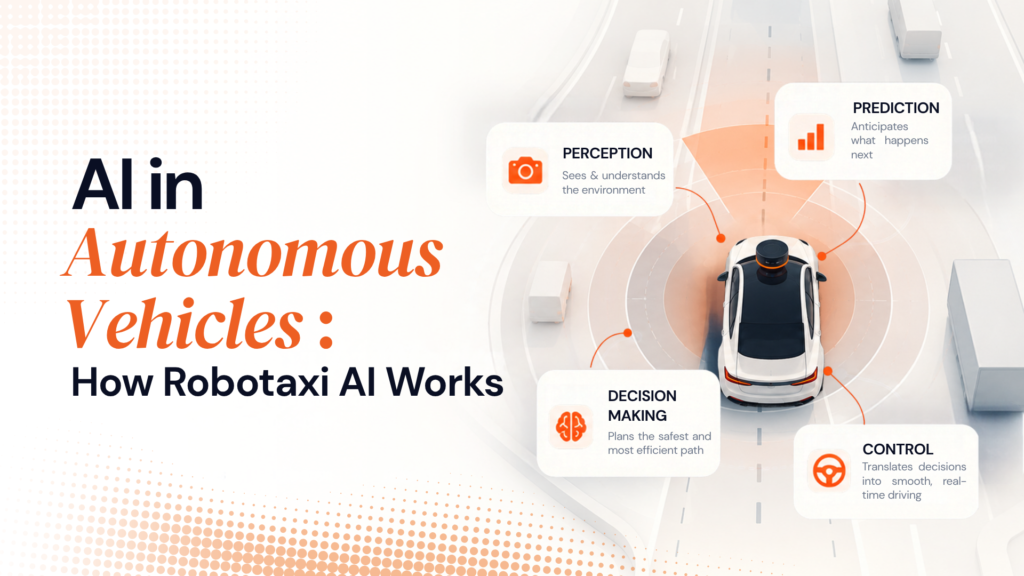
The vehicle needs to understand its surroundings, determine where it is, identify other road users and infrastructure, predict what could happen next, select an appropriate trajectory and control the vehicle. This is where AI in self-driving cars plays a crucial role, helping autonomous systems interpret sensor data, recognise objects, predict potential movements and support real-time driving decisions.
AI helps autonomous systems interpret large volumes of sensor data and identify patterns that support perception, prediction, and decision-making. However, AI is only one component of the complete autonomous-driving system.
Research from The European Commission’s research on trustworthy AI also highlights the importance of considering safety, reliability, security, privacy, transparency, and accountability when developing trustworthy autonomous-vehicle systems.
So, how does robotaxi AI actually work?
Let's break the system down from the data entering the vehicle to the decision leaving it.
01
What Is AI in Autonomous Vehicles?
At its core, AI in autonomous vehicles enables a vehicle to interpret its surroundings, understand driving situations, anticipate possible outcomes, and support decisions without continuous human steering.
A simplified autonomous-driving loop looks like this:
-
1
Sense
-
2
Understand
-
3
Predict
-
4
Plan
-
5
Act
-
6
Monitor
A robotaxi does not rely on one AI model that simply "drives the car." Instead, multiple systems work together.
| System layer | Primary responsibility |
|---|---|
| Sensors | Capture information from the environment |
| Perception | Detect and understand objects and road features |
| Sensor fusion | Combine multiple sensor inputs |
| Localisation | Estimate the vehicle's position |
| Prediction | Estimate what other road users may do |
| Planning | Select an appropriate trajectory |
| Control | Convert the planned trajectory into vehicle movement |
| Safety systems | Detect faults and support safe fallback behaviour |
| Cloud/data systems | Train, analyse, simulate and improve the system |
| Fleet platform | Manage vehicles, operations and passenger services |
This makes autonomous driving a broader systems-engineering challenge rather than simply an AI problem.
02
How Robotaxi AI Works
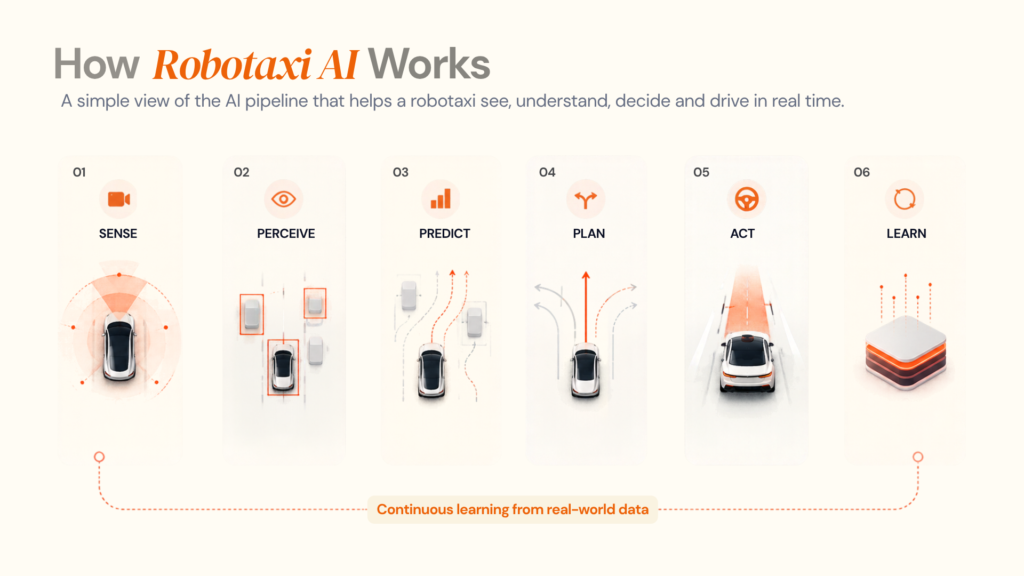
A robotaxi continuously processes information through a sequence of stages:
-
1
Sensors
-
2
Perception
-
3
Sensor Fusion + Localisation
-
4
Prediction
-
5
Planning
-
6
Vehicle Control
-
7
Monitoring
-
8
New Data
Each stage contributes to the next.
1. Perception: AI Helps the Vehicle Understand Its Environment
The first question an autonomous vehicle needs to answer is:
What is around the vehicle right now?
Cameras, LiDAR, radar, and other sensors capture information about the environment. AI models can process this data to identify:
- Vehicles
- Pedestrians
- Cyclists
- Road markings
- Traffic lights
- Road signs
- Obstacles
- Lane boundaries
- Drivable areas
- Intersections
- Free space
Computer vision and deep learning can support tasks such as object detection, semantic segmentation, depth estimation, 3D object detection, and scene understanding.
However, detecting an object is only the beginning.
If a camera detects a pedestrian, the system may also need to determine whether that person is standing on the pavement, approaching the road, already crossing, or partially hidden by another object.
The objective is to transform raw sensor data into an environmental representation that other parts of the driving stack can use.
2. Localisation: Where Is the Vehicle?
A robotaxi also needs to know where it is.
Positioning can involve:
- GNSS
- Inertial measurement units
- Camera-based localisation
- LiDAR-based localisation
- Map matching
- Vehicle odometry
Knowing that a vehicle is near an intersection is not enough. The system may also need to understand which lane it occupies, where the stop line is, which turn is permitted, and where the intended route continues.
Navigation therefore requires spatial context, not just geographic coordinates.
03
How Sensor Fusion Gives Robotaxis a View of the Road
One of the most important concepts in AI in autonomous vehicles is sensor fusion.
Different sensors provide different forms of information.
Cameras
Cameras provide rich visual information that can help identify:
- Traffic lights
- Road markings
- Signs
- Colours
- Visual context
LiDAR
LiDAR provides three-dimensional measurements that can help estimate:
- Distance
- Object geometry
- Spatial structure
Radar
Radar can provide information about:
- Distance
- Relative velocity
- Object presence
GNSS and IMU
These systems help estimate:
- Position
- Acceleration
- Orientation
- Movement
No individual sensor is perfect under every condition. Sensor fusion combines inputs from multiple sources to create a more complete representation of the environment.
Sensor Fusion Example
Imagine a vehicle approaching an intersection at night.
The camera identifies another vehicle, while radar provides information about its relative speed. LiDAR can contribute three-dimensional information about its position, while the localisation system provides context about where the autonomous vehicle is positioned relative to the intersection.
Combining these signals can provide the downstream driving system with more contextual information than relying on one sensor alone.
For businesses developing connected mobility products, this also introduces requirements around data synchronisation, calibration, data pipelines, computing capacity, latency and monitoring.
This is where broader software engineering becomes important. Businesses may need product development services to connect AI capabilities with applications, data infrastructure, APIs and other product components.
04
The Role of Machine Learning in Autonomous Driving
Machine learning is one of the foundations of modern autonomous driving.
Instead of manually programming every possible road situation, machine-learning systems can learn patterns from data.
ML can support tasks including:
- Object recognition
- Depth estimation
- Movement prediction
- Traffic-scene understanding
- Anomaly detection
- Trajectory prediction
- Scenario generation
Different problems can require different model architectures.
| Problem | Potential AI/ML approach |
|---|---|
| Object detection | CNNs, vision Transformers, 3D detectors |
| Segmentation | CNNs, Transformers |
| Object tracking | Temporal models, learned trackers, filtering |
| Behaviour prediction | Temporal neural networks, Transformers |
| Scene understanding | Multimodal models |
| Trajectory prediction | Deep-learning and probabilistic models |
| Anomaly detection | ML classification and statistical approaches |
| Planning | Optimisation, search and learned approaches |
| Scenario generation | Simulation and generative techniques |
There is no universal autonomous-driving algorithm. The appropriate approach depends on the task, data, hardware, operating environment and validation requirements.
05
Prediction and Motion Planning: How AI Decides What to Do Next
Recognising what is happening now is only part of autonomous driving.
The system also needs to estimate what could happen next.
Suppose a robotaxi detects another vehicle approaching from a neighbouring lane. It may consider:
- Current speed
- Relative position
- Acceleration
- Lane relationship
- Possible lane-change behaviour
- Potential future trajectories
The system can then consider several plausible outcomes.
The goal is not to perfectly predict another driver's intentions. Instead, the system needs to estimate possible future behaviours well enough for the planner to select an appropriate response.
What Is Motion Planning?
Motion planning determines how the vehicle should move through its environment.
Possible actions include:
- Continue
- Slow down
- Stop
- Turn
- Change lanes
- Yield
- Maintain distance
- Avoid an obstacle
A simplified process is:
-
1
Current State
-
2
Possible Future Outcomes
-
3
Candidate Trajectories
-
4
Safety / Rules / Comfort Constraints
-
5
Selected Trajectory
-
6
Vehicle Control
The system may need to account for:
| Objective | What it means |
|---|---|
| Safety | Avoid collisions and unsafe manoeuvres |
| Legality | Respect applicable road rules |
| Comfort | Avoid unnecessary harsh braking or steering |
| Efficiency | Avoid unnecessary delays |
| Predictability | Behave in ways other road users can understand |
This is why autonomous-driving AI is not simply a classification problem. The system operates under uncertainty, constraints and competing objectives.
06
Edge AI, Cloud Computing and the Autonomous Vehicle Data Loop
An autonomous vehicle cannot rely on a distant cloud server for every immediate driving decision.
Sending sensor data to a remote server and waiting for a response can introduce latency and connectivity dependence. Important real-time workloads therefore generally require onboard or edge computing.
Edge computing can handle:
- Perception inference
- Sensor fusion
- Localisation
- Prediction
- Planning
- Control
- Vehicle-health monitoring
Cloud infrastructure can support:
- Model training
- Data storage
- Dataset management
- Fleet analytics
- Simulation
- Experiment tracking
- Model evaluation
- Software lifecycle management
For example, AWS has published an autonomous-driving data-lake architecture covering areas such as data ingestion, processing, labelling, algorithm development, simulation, validation, and deployment.
The larger feedback loop can therefore look like:
Vehicle → Telemetry → Cloud → Data → Training → Simulation → Evaluation → Deployment → Vehicle
This continuous loop allows engineering teams to identify difficult scenarios, improve models, evaluate software changes and deploy validated updates.
07
How Robotaxi AI Is Trained, Tested and Improved
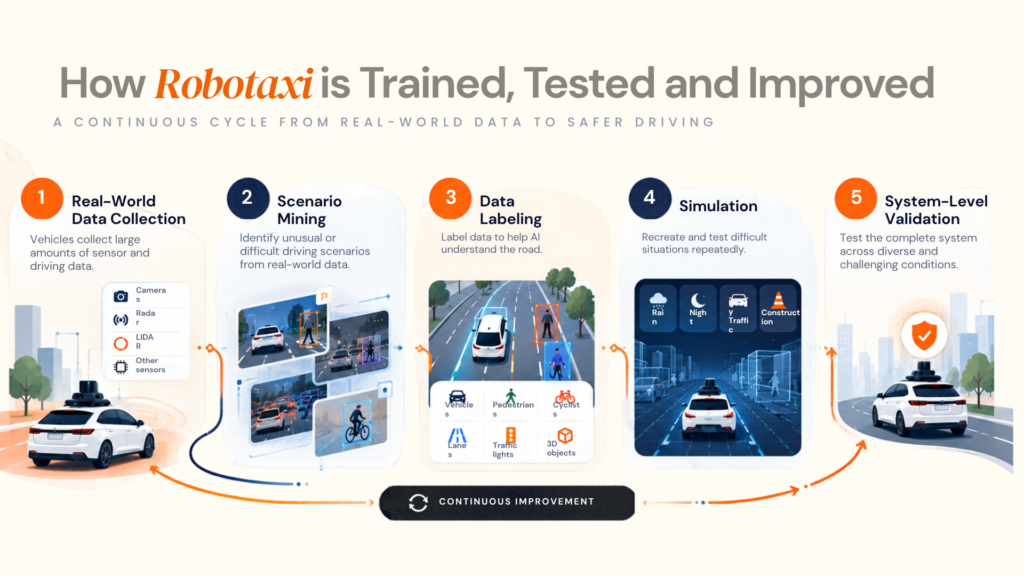
Training is only one part of the autonomous-driving development lifecycle.
1. Real-World Data Collection
Autonomous vehicles can generate large volumes of sensor and vehicle data.
However, more data does not automatically mean a better system. The important question is whether the data contains the situations where the system performs poorly.
2. Scenario Mining
Engineering teams can identify unusual or difficult scenarios from recorded driving data, including:
- Sudden lane changes
- Unusual pedestrian movement
- Road construction
- Temporary closures
- Emergency vehicles
- Difficult merges
- Heavy traffic
- Low-visibility conditions
These scenarios can then be incorporated into further testing and development.
3. Data Labelling
Depending on the application, datasets may require labels for:
- Vehicles
- Pedestrians
- Cyclists
- Lanes
- Traffic lights
- Road boundaries
- Trajectories
- 3D objects
- Scene categories
4. Simulation
Simulation allows development teams to recreate difficult situations repeatedly.
Teams can modify:
- Weather
- Traffic density
- Vehicle behaviour
- Pedestrian behaviour
- Road layouts
- Sensor performance
The major advantage is repeatability. The same scenario can be tested again after a model or software change.
5. System-Level Validation
A model can achieve strong benchmark results without proving that the complete autonomous-driving system behaves appropriately.
Testing needs to consider the complete chain:
Sensor → Model → Decision → Planning → Control → Vehicle Behaviour
This leads to an important distinction:
Model accuracy is not the same as system safety.
08
Modular vs End-to-End Autonomous Driving AI
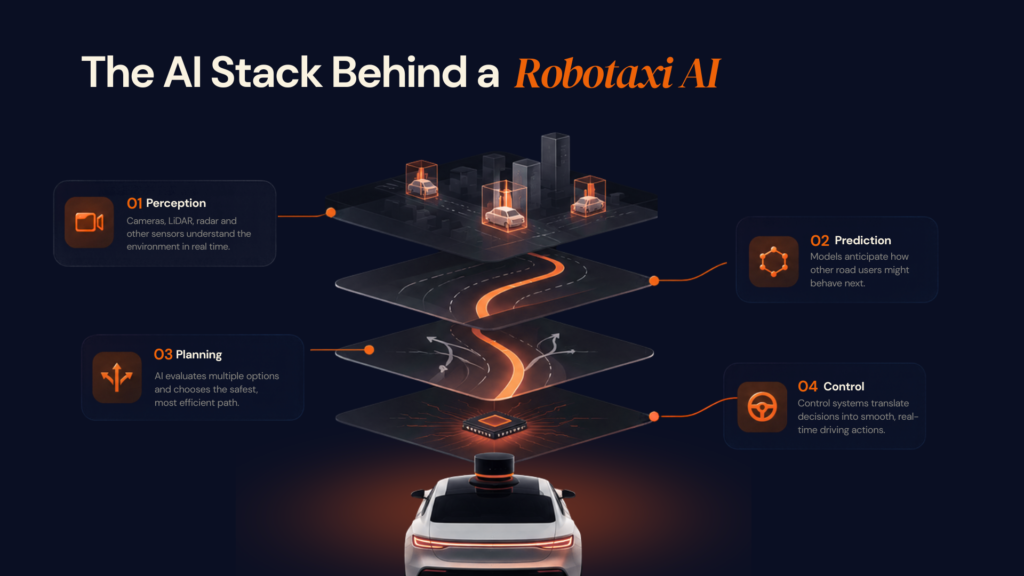
A major architectural question is whether autonomous-driving systems should remain modular or move toward end-to-end approaches.
Modular Architecture
A modular stack separates functions such as:
-
1
Perception
-
2
Prediction
-
3
Planning
-
4
Control
Potential benefits include:
- Easier component-level debugging
- Clearer interfaces
- Easier decomposition of testing
- Ability to replace individual components
Potential challenges include:
- More interfaces
- More integration work
- Potential error propagation between modules
End-to-End Architecture
An end-to-end approach attempts to learn a larger portion of driving behaviour jointly.
Current autonomous-driving research explores areas including multimodal systems, end-to-end approaches and large-scale machine-learning techniques.
Potential benefits include:
- Joint learning across multiple tasks
- Learned representations
- Potentially fewer manually designed intermediate interfaces
Potential challenges include:
- Greater validation complexity
- Interpretability challenges
- Large data requirements
- More difficult root-cause analysis in some architectures
The architecture needs to be evaluated against factors such as:
- Operating design domain
- Available data
- Hardware
- Latency
- Safety requirements
- Maintainability
- Validation strategy
- Deployment scale
09
The Future of AI in Autonomous Vehicles
The evolution of autonomous driving is increasingly about the entire development loop rather than one breakthrough algorithm.
That loop includes:
-
1
Data
-
2
Training
-
3
Simulation
-
4
Evaluation
-
5
Deployment
-
6
Monitoring
-
7
New Data
Research continues to explore increasingly capable multimodal and end-to-end models, while autonomous-driving companies are also working on the infrastructure required to train, validate, deploy, and operate these systems.
Waymo's current deployment updates provide a current view of how its autonomous-driving operations and deployment activities are developing.
The broader challenge extends beyond model capability and includes:
- Safety
- Infrastructure
- Hardware cost
- Software reliability
- Cybersecurity
- Regulation
- Fleet operations
- Passenger experience
This makes autonomous mobility a full-stack engineering problem involving AI, software, data, hardware, and operations.
10
Safety, Security and Regulation
Autonomous vehicles interact directly with the physical world, making safety engineering a core part of the development lifecycle.
Functional Safety
ISO 26262 addresses functional safety for road vehicles.
ISO 21448 addresses Safety of the Intended Functionality (SOTIF), including hazards that may arise from functional insufficiencies even when there is no conventional hardware or software fault.
AI Governance
The NIST's AI Risk Management Framework provides a structured framework built around:
-
1
Govern
-
2
Map
-
3
Measure
-
4
Manage
For businesses developing AI-enabled mobility systems, frameworks such as this can help organise AI risk identification, evaluation and governance.
Europe
The European Commission's work on trustworthy autonomous vehicles highlights the importance of considering issues such as:
- Safety
- Reliability
- Security
- Privacy
- Transparency
- Accountability
These considerations can become part of the wider product-development and governance process.
11
What Businesses Need to Build Around Autonomous Vehicle AI
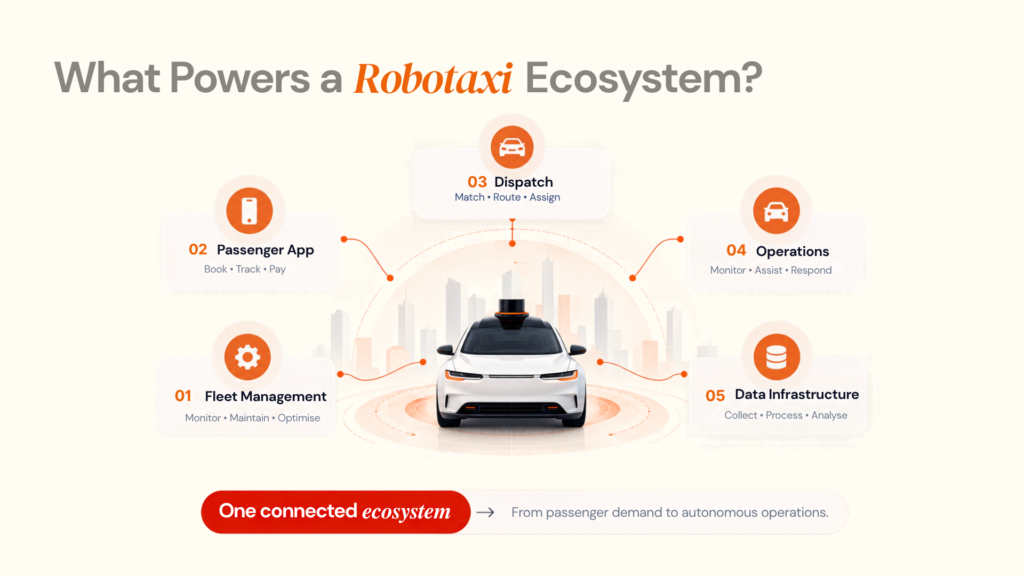
A robotaxi needs more than a driving stack. It also needs a broader digital ecosystem.
Passenger Applications
Customers may need:
- Account management
- Trip booking
- Pickup instructions
- Trip status
- Payments
- Support
- Accessibility features
Fleet Management
Operators may need:
- Vehicle status
- Maintenance monitoring
- Battery information
- Charging management
- Utilisation analytics
Dispatch
Systems may manage:
- Vehicle assignment
- Demand forecasting
- Route selection
- Pickup optimisation
Operations
Teams may need:
- Incident dashboards
- Telemetry
- System-health monitoring
- Exception management
- Analytics
Data Infrastructure
The wider platform may require:
- Data lakes
- APIs
- Cloud storage
- Event processing
- Analytics
- Model monitoring
- Software deployment pipelines
This is where AI in autonomous vehicles intersects with broader digital-product engineering.
A mobility business may not need to build a complete autonomous-driving stack to create value. It could instead develop AI-powered fleet intelligence, connected-vehicle software, computer-vision applications, mobility platforms, predictive-maintenance systems, sensor analytics, route-optimisation tools or passenger applications.
12
How to Evaluate an AI Development Partner
Choosing an AI development partner for mobility requires more than checking whether a company can build machine-learning models.
Consider questions such as:
Can they build production software around AI?
AI applications may require APIs, databases, applications, monitoring, integrations and deployment infrastructure.
Can they handle real-time requirements?
Consider how the team approaches:
- Latency
- Edge inference
- Event processing
- System monitoring
Can they handle data?
The development process may involve:
- Collection
- Preprocessing
- Labelling
- Storage
- Model evaluation
- Data pipelines
Can they connect AI to a business workflow?
A model only creates practical value when its output can support a real product, workflow or user experience.
Do they understand the boundaries of their expertise?
This is particularly important in autonomous mobility.
A software partner should clearly distinguish between:
- AI development
- Connected mobility
- Computer vision
- Fleet software
- Autonomous-driving engineering
- Automotive safety engineering
13
How Designoweb Fits Into AI-Powered Mobility
For businesses exploring AI in autonomous vehicles, Designoweb’s relevance sits across the AI, IoT, product and software layers that surround mobility systems, rather than the autonomous-driving stack itself. With 150+ professionals and 1,000+ successful solutions delivered across 25+ industries, Designoweb brings experience across connected products, intelligent systems, and complex technology environments.
Designoweb's AI development services cover areas such as machine learning, computer vision, predictive analytics, and AI application development.
AI and Machine Learning
An autonomous-mobility product may need computer vision, predictive analytics, anomaly detection, intelligent workflows, and data-driven decision support. These capabilities can form part of a wider mobility software product.
IoT and Connected Systems
Connected mobility involves devices, sensors, communications, and cloud systems. Designoweb's IoT capabilities support products involving connected vehicles, sensor data, telemetry, real-time monitoring and connected-device applications.
Product Engineering
Mobility technology also needs a product layer. Designoweb's product development services can support businesses building custom digital products and MVPs around specific technology opportunities.
Relevant Mobility Experience
Designoweb's PRO BIKE Sensor App provides an example of work involving sensor-driven riding data, real-time metrics, and mobile software.
Its Road Trip Tribes case study demonstrates experience with navigation, trip planning and collaborative mobility experiences.
The VASD case study provides an additional example involving AI-powered image analysis and software workflows.
These examples represent adjacent mobility and AI capabilities rather than autonomous-driving deployments. That distinction is important when evaluating technology partners.
The opportunity for a software engineering company is not necessarily to claim that it built an entire robotaxi. It can instead contribute the AI, connected systems, and digital-product layers surrounding autonomous mobility.
14
Final Thoughts
AI in autonomous vehicles enables machines to interpret sensor information, understand their environment, estimate possible future events, and support driving decisions.
But AI alone does not create a robotaxi.
A production autonomous-driving system brings together:
Sensors + AI + Computing + Prediction + Planning + Controls + Safety + Data + Simulation + Fleet Software
For businesses entering autonomous mobility, the opportunity does not necessarily require building every layer of the autonomy stack.
The starting point should be the mobility problem, operating environment, available data and required technology capabilities.
That could mean building an AI application, connected-vehicle platform, computer-vision solution, fleet-management system, passenger application or data infrastructure.
The technology strategy should follow the business problem rather than the other way around.
Author

Frequently Asked Questions
01
What is AI in autonomous vehicles?
AI in autonomous vehicles refers to machine-learning and artificial-intelligence technologies that help a vehicle perceive its environment, understand driving situations, predict possible outcomes, and support real-time navigation and decision-making.
02
How does AI work in a robotaxi?
Robotaxi AI typically processes information through several stages: perception, localisation, sensor fusion, prediction, planning, and control. These functions work together continuously while the vehicle is operating.
03
How is AI different from traditional vehicle software?
Traditional vehicle software can rely heavily on predetermined logic. AI-based systems can learn patterns from data and handle complex perception and prediction problems that are difficult to represent entirely through manually written rules.
01
What AI technologies are used in autonomous vehicles?
Depending on the system, technologies can include computer vision, deep learning, CNNs, Transformers, multimodal models, trajectory prediction, anomaly detection, optimisation and control algorithms.
02
What is sensor fusion in autonomous vehicles?
Sensor fusion combines information from multiple sensors, such as cameras, LiDAR and radar, so that the autonomous-driving system can build a more useful representation of the surrounding environment.
03
Why do robotaxis need edge AI?
Critical driving workloads require predictable low-latency processing. Running key workloads close to the vehicle reduces dependence on a remote network round trip.
04
What is the role of cloud computing in autonomous vehicles?
Cloud infrastructure can support data storage, model training, analytics, simulation, evaluation, fleet intelligence and software lifecycle management.
05
Are end-to-end AI models replacing modular autonomous-driving systems?
End-to-end approaches are receiving significant research attention, but autonomous-driving systems still need validation, monitoring, safety engineering and operational controls. The appropriate architecture depends on the vehicle's requirements and operating environment.
01
How are autonomous vehicles tested?
Testing can include real-world driving, recorded-data replay, simulation, synthetic scenarios, hardware-in-the-loop testing, system-level evaluation and post-deployment monitoring.
02
Is AI model accuracy enough to prove autonomous-vehicle safety?
No. Model accuracy is only one part of the evidence required. The complete system needs to be evaluated under relevant operating conditions, failure modes and safety requirements.
03
What standards matter for autonomous-driving AI?
Relevant frameworks can include ISO 26262 for functional safety and ISO 21448 for Safety of the Intended Functionality. Additional requirements depend on the market, vehicle system and use case.
04
Does regulation affect autonomous vehicle AI development?
Yes. Autonomous vehicles operate in regulated physical environments, so requirements around safety, cybersecurity, data governance, traceability and system oversight can influence architecture and development.
01
How much does it cost to build an AI-powered autonomous vehicle system?
There is no meaningful universal price. Cost depends on the scope, sensors, onboard computing, software architecture, data requirements, simulation, testing, safety engineering, regulatory work and fleet scale.
02
Does a company need to build its own AI model?
Not necessarily. Depending on the use case, businesses may combine third-party models, open-source technologies and proprietary software. The important question is where proprietary technology creates meaningful differentiation.
03
Can an AI development company help build a robotaxi?
An AI development company can contribute to specific software layers such as AI applications, computer vision, machine learning, IoT systems, fleet platforms and digital products. A full autonomous-driving programme may also require specialist automotive, safety and regulatory engineering capabilities.
04
What should businesses look for in an autonomous-mobility technology partner?
Look for evidence across AI engineering, product development, data pipelines, real-time software, cloud infrastructure, integrations, monitoring and security. For safety-critical autonomy, verify that specialist automotive safety expertise is part of the overall programme.