
Key Takeaways
01
AR/VR in healthcare is most valuable when spatial computing solves a problem that a conventional 2D interface cannot solve as effectively.
02
VR works well for repeatable simulation, training, therapy and controlled patient experiences; AR/MR is more appropriate when clinicians need information or guidance within a physical environment.
03
AI adds value through computer vision, movement analysis, adaptive learning, predictive models and carefully bounded conversational interfaces—not through indiscriminate automation.
04
Clinical integrations can include EHR data, FHIR APIs, imaging systems, devices and analytics platforms, which makes interoperability part of product architecture rather than a later integration task.
05
Privacy considerations are broader than ordinary application security because XR hardware can capture video, audio, movement, spatial and potentially biometric data.
06
US, UK and EU requirements differ, and intended medical purpose can materially change validation, documentation and market-entry requirements.
07
The strongest healthcare XR products begin with one measurable workflow, validate it in a controlled environment and then expand the experience, device coverage and integrations.
08
The right technology decision is sometimes not AR/VR at all. A strong product strategy should identify when a mobile, web or conventional clinical interface is sufficient.
Healthcare has no shortage of new technologies competing for attention. The harder question is not whether AR, VR, AI, or spatial computing is interesting. It is whether putting those technologies into a healthcare workflow creates enough value to justify the additional complexity.
That distinction matters. The healthcare XR market is also moving from experimentation toward commercial adoption: Grand View Research estimates the global virtual reality in healthcare market at $10.9 billion in 2026, with the market projected to reach $29.4 billion by 2030.
A VR application that allows a surgical resident to repeatedly practise a procedure is solving a very different problem from an AR system that overlays information during a live clinical workflow. A patient-education experience that visualises an upcoming procedure has a different risk profile from software that generates clinical recommendations.
So the real opportunity with AR/VR in healthcare is not “making healthcare immersive.”
It is using immersion selectively to make a task easier to understand, practise, perform, measure or personalise.
The FDA's guidance on AR/VR in medical devices describes potential uses across treatment, diagnosis, preparation and delivery of care, while also highlighting safety and effectiveness considerations for medical devices that incorporate AR/VR.
For healthcare startups and established healthcare organisations, that leads to a more useful question:
Where does immersion materially improve the outcome, and what technology architecture is required to make that improvement safe, measurable and scalable?
That is the question this guide is designed to answer.
Planning an AR/VR healthcare product?
Designoweb helps healthcare and medtech teams turn immersive concepts into production-ready products across AR/VR, AI, 3D, integrations, and scalable engineering.
What AR/VR in Healthcare Actually Means
AR, VR, and MR are often grouped together as “XR,” but they create different product experiences.
| Technology | What the user experiences | Strong healthcare fit | Typical product requirement |
|---|---|---|---|
| Augmented Reality (AR) | Digital information layered over the physical world | Patient education, guided rehabilitation, procedural guidance, anatomy visualisation | Camera/sensors, spatial understanding, real-world alignment |
| Virtual Reality (VR) | A fully simulated environment | Surgical simulation, medical training, pain management, exposure therapy, rehabilitation | Head-mounted display, motion tracking, immersive 3D environment |
| Mixed Reality (MR) | Digital objects remain anchored to and interact with the physical environment | Advanced simulation, visualisation, collaborative clinical workflows | Spatial mapping, hand/eye tracking, environment understanding |
| Extended Reality (XR) | Umbrella term covering AR, VR and MR | Enterprise strategy and multi-modal immersive products | Cross-device architecture and experience design |
For developers, OpenXR is particularly important because it provides a common API for AR and VR applications across a wide range of devices and runtimes, reducing dependence on individual proprietary implementations.
That does not mean every healthcare product should be cross-platform from day one.
A better approach is to decide:
Clinical problem → interaction model → device environment → technical architecture → expansion strategy
rather than:
Headset → technology demo → search for a use case
The difference between an immersive demo and a healthcare product
A demo might show a highly realistic 3D heart.
A healthcare product needs to answer additional questions:
- Who is the user?
- What clinical or operational task is being improved?
- What data enters the system?
- What happens when the AI is uncertain?
- What happens if connectivity fails?
- How is performance measured?
- Who can see the data?
- Does the intended purpose make the software a medical device?
- What evidence is required before deployment?
That is where AR/VR healthcare development becomes product engineering rather than visual experimentation.
Where AR/VR Creates Real Healthcare Value
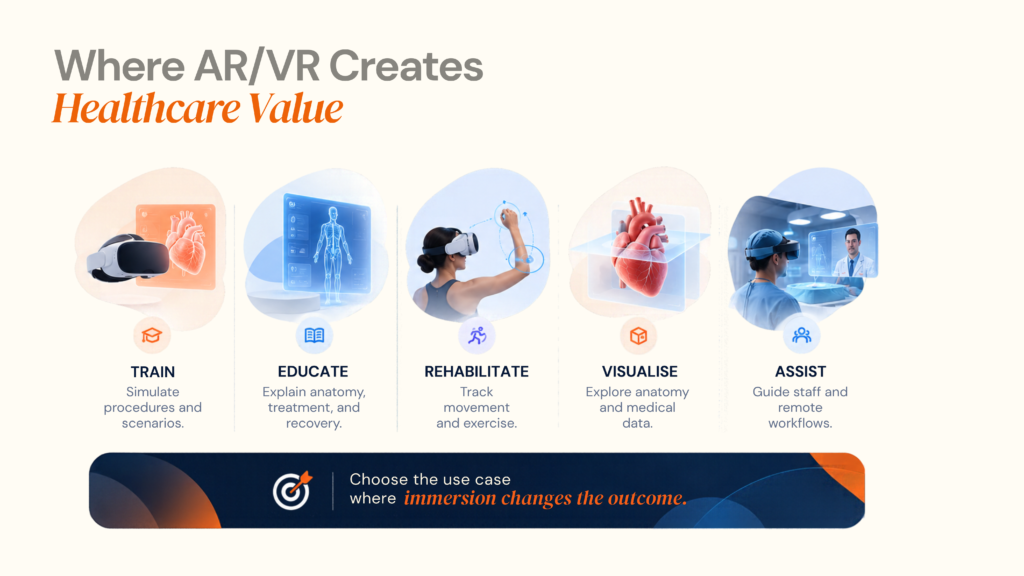
The most useful applications of AR/VR can be grouped into a smaller number of repeatable business and clinical patterns.
1. Medical training and simulation
VR can create a controlled environment where trainees practise clinical scenarios without putting a patient at risk.
Examples include:
- surgical procedure rehearsal
- emergency-response scenarios
- patient communication training
- anatomy education
- procedural simulations
- clinical decision scenarios
AI can make these simulations adaptive.
Instead of every trainee receiving the same scenario, the system can monitor performance and alter the next scenario based on defined learning objectives.
For example:
Trainee misses a procedural step → system records event → assessment model categorises the error → next scenario focuses on the weak area → educator dashboard shows progression
That is more useful than simply adding a virtual character to a simulation.
Recent research into AI-driven characters in XR healthcare simulations reviewed 132 studies published from 2015 to 2025. The authors found promising results for knowledge and task performance but rated the certainty of the evidence as low because studies were heterogeneous and quality-assurance practices such as bias audits and transparency measures were often poorly documented. Read the systematic review on PubMed.
For a product team, the implication is straightforward:
adaptive training should be measurable, explainable, and evaluated, not assumed to work because the experience feels realistic.
Designoweb already works across immersive application development and Unity-based interactive experiences, supported by a broader product portfolio. Its AR/VR App Development Services and Unity Solutions can therefore sit naturally within a training-product roadmap, particularly where the project needs interactive simulation, multi-device support, or a staged MVP.
2. Patient education and procedure preparation
Patients regularly have to understand something spatial that is difficult to explain through a brochure or 2D diagram.
AR/VR can help communicate:
- anatomy
- treatment pathways
- upcoming procedures
- post-procedure expectations
- rehabilitation steps
- medication or device instructions
A well-designed experience can turn an abstract explanation into something a patient can explore.
A 2026 randomised trial on AR-supported preoperative education for caesarean patients reported improvements in postoperative self-care knowledge, reduced preoperative anxiety, and higher satisfaction with the recovery experience.
The product lesson is not that every preoperative workflow needs AR.
It is that visualisation should be used where the patient has something difficult to understand spatially or procedurally.
Designoweb's 3D Product Design Services are directly relevant here because high-quality immersive healthcare experiences depend heavily on accurate 3D content, interaction design, and presentation, not just app development. The page also features Pharmatop, a medical-course platform built for healthcare professionals and learners.
3. Rehabilitation and physical therapy
Rehabilitation is one of the more natural intersections between immersive experiences, computer vision, and analytics.
A system can potentially:
- capture movement,
- estimate posture or range of motion,
- compare the movement with a defined exercise pattern,
- provide feedback,
- track progression,
- adapt the next exercise within clinically defined limits.
Recent systematic reviews continue to report potential benefits from XR in rehabilitation, while also highlighting variation in intervention design, technology, and evidence quality. A 2026 systematic review synthesised evidence across 58 randomised controlled trials.
This makes rehabilitation a strong example of where AI should have a bounded role.
The AI does not need to “run the therapy.”
It can instead perform narrower tasks such as:
- pose estimation
- movement classification
- repetition counting
- exercise adherence tracking
- progress analytics
- alerting a clinician when predefined conditions are met
This architecture is easier to test and govern than an unconstrained autonomous system.
4. Pain management and procedural support
VR has been studied extensively as a non-pharmacological approach to pain management.
A systematic review and meta-analysis covering 92 randomised clinical trials and 7,133 participants found a significant reduction in pain scores across the medical procedures studied, although heterogeneity across studies remained high.
At the same time, newer evidence on chronic musculoskeletal pain still reports uncertainty around which intervention characteristics, such as dose, frequency, platform and level of immersion, work best, and reports adverse effects such as motion sickness, nausea and vertigo.
This distinction is important for product leaders.
A useful healthcare VR platform should not only measure:
“Did the patient complete the VR session?”
It should consider:
“What clinical outcome is the session intended to influence, under what conditions, and how will we know?”
5. Surgical planning and clinical visualisation
AR and MR can be especially useful when the physical environment itself matters.
Potential applications include:
- anatomy visualisation
- 3D imaging review
- procedural planning
- education around anatomical structures
- spatial collaboration
- hands-free information display
Commercial healthcare VR research has already identified 3D medical-imaging visualisation as an important application category, including systems capable of viewing MRI and CT-derived datasets in 3D.
This area also creates a much higher integration requirement.
Instead of loading a static 3D asset, the platform may need to work with:
EHR → patient identity → imaging system → image processing → 3D representation → immersive client
That means clinical interoperability needs to be designed from the start.
6. Remote assistance and workforce enablement
AR can also be useful when a specialist cannot be physically present.
Potential workflows include:
- guided technical procedures
- hands-free instructions
- remote expert collaboration
- equipment support
- staff onboarding
- procedural checklists
In these scenarios, the greatest business value may come from reducing travel, improving consistency, or helping less-experienced staff complete specialised workflows.
This can be valuable even when the system never becomes a medical device.
01
What the Current Evidence Tells Healthcare Leaders
AR/VR in healthcare has moved beyond pure experimentation, but the evidence should not be described as universally mature.
A 2025 systematic review of XR in cardiovascular care included 164 studies and found applications spanning education, training, peri-procedural care and rehabilitation. However, the authors emphasised the heterogeneity of study designs and called for stronger randomised controlled trials to clarify benefits and limitations.
A 2026 systematic review focused on rehabilitation found continuing potential across rehabilitation domains while reinforcing the importance of understanding implementation and clinical outcomes rather than treating XR as an intervention category with one universal effect.
That leads to a useful evidence hierarchy for healthcare buyers:
| Evidence level | What it tells you |
|---|---|
| Prototype/demo | The experience is technically possible |
| Usability study | Users can interact with the product |
| Pilot | The workflow is feasible in a defined setting |
| Controlled study | The intervention can be compared against a control |
| Clinical validation | Evidence supports a defined intended use |
| Post-market evidence | Real-world use continues to support safety and performance |
A frequent mistake is treating a technically impressive demo as if it were evidence of clinical effectiveness.
-
1
Demo
-
2
Usability
-
3
Pilot
-
4
Controlled Evidence
-
5
Clinical Validation
-
6
Real-World Monitoring
Each stage answers a different question. A working prototype proves technical feasibility; it does not, by itself, prove clinical effectiveness.
It is not.
The more consequential the healthcare decision, the more important it becomes to separate:
technical performance
from
clinical effectiveness
from
commercial viability
Building a healthcare XR product and need to validate the business case first?
Designoweb can help you define the use case, technical architecture, MVP scope, and validation path before a larger investment.
02
How AI Changes an AR/VR Healthcare Product
AI does not automatically make AR/VR more valuable.
It becomes valuable when the product must perceive, predict, personalise, retrieve, or adapt.
Where AI genuinely fits
| AI capability | Example in healthcare XR | Business/clinical implication |
|---|---|---|
| Computer vision | Detect body position during rehabilitation | Enables measurable movement feedback |
| Speech recognition | Voice-controlled simulation or documentation | Reduces interaction friction |
| Machine learning | Learner-performance scoring | Enables adaptive training |
| Predictive analytics | Detect patterns in rehabilitation progress | Helps surface trends for review |
| Generative AI | Generate bounded educational explanations | Reduces content-navigation friction |
| RAG | Retrieve approved clinical education content | Keeps responses grounded in controlled sources |
| Recommendation systems | Select the next approved training module | Supports personalisation |
| AI agents | Coordinate bounded operational steps | Potentially useful for workflow automation, but requires strong guardrails |
When RAG is useful
Suppose a VR medical-education platform allows a trainee to ask:
“Why is this step important?”
A conventional LLM may produce a fluent answer.
A healthcare product should be more disciplined.
A RAG architecture can retrieve information from an approved knowledge base, such as:
- institutionally approved learning content
- procedure manuals
- validated training materials
- controlled clinical references
The model then generates an answer from that retrieval layer.
The architecture becomes:
User question → retrieval → approved context → model → safety rules → response
For patient-facing applications, this should be bounded even more tightly.
The product should distinguish:
educational information
from
clinical advice
and route consequential decisions to appropriate human professionals where required.
When fine-tuning makes sense
Fine-tuning is not the default solution.
It may make sense when a company has:
- a stable task,
- sufficient proprietary training data,
- a clear evaluation set,
- repeatable output requirements,
- and a reason a carefully prompted or retrieval-based model cannot meet the requirement.
For many healthcare XR products, RAG + strong prompting + validation will be easier to manage than constant model retraining.
When AI agents should not be the first architecture
Healthcare product teams should resist using agentic architectures simply because agents are currently popular.
An autonomous agent that can independently choose actions across a clinical workflow introduces substantially more complexity than a model that:
- retrieves information,
- classifies an event,
- generates a bounded response,
- or recommends the next approved action.
In healthcare, autonomy should be earned through evidence and controls, not added for marketing purposes.
Need help deciding where AI belongs in your healthcare XR product?
Designoweb combines immersive development with AI engineering to design the right architecture around your workflow, data, and intended outcome.
03
A Production Architecture for AR/VR in Healthcare
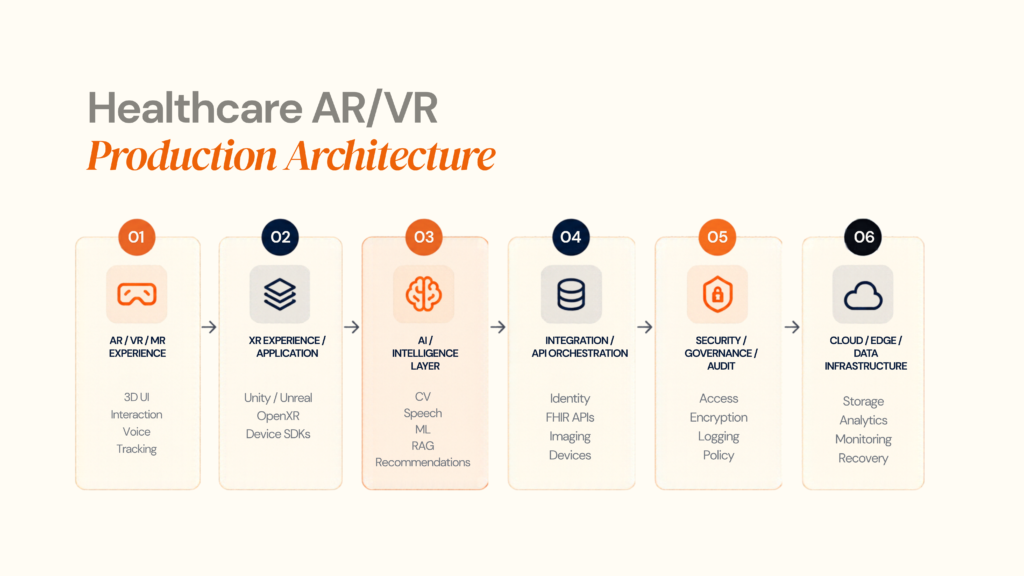
A scalable healthcare XR platform is better understood as a set of layers than as one headset application.
The immersive client
The client application manages:
- rendering
- spatial interaction
- user input
- device sensors
- 3D assets
- voice interaction
- session state
OpenXR can provide an abstraction layer across supported XR devices and runtimes.
Designoweb's Unity Solutions are relevant where a project requires interactive simulations, virtual reality experiences, or cross-platform immersive experiences.
The AI layer
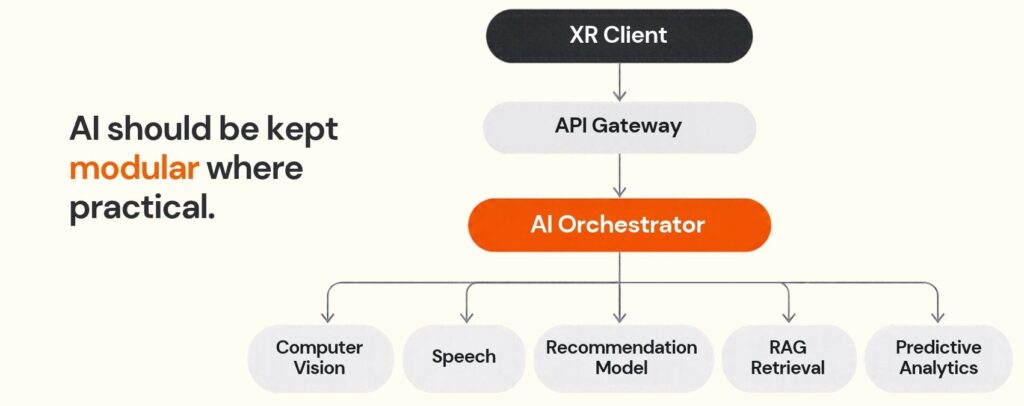
This makes it easier to:
- replace models,
- run evaluations,
- control access,
- monitor inference,
- isolate failures,
- and support different clinical workflows.
The clinical-data layer
Healthcare applications frequently require interoperability with existing data systems.
FHIR (Fast Healthcare Interoperability Resources) is a standard for exchanging healthcare information electronically through structured resources and APIs. It is widely used as an interoperability foundation for connecting healthcare applications and data.
The FHIR RESTful model supports resource-level interactions such as read, update, and search.
That does not mean every XR application needs direct access to every clinical system.
A safer architecture often uses an integration service that controls:
- what data can be retrieved,
- which fields are exposed,
- who is authorised,
- how long data is retained,
- and what the immersive application is allowed to send back.
On-device vs edge vs cloud AI
| Approach | Advantage | Trade-off | Good fit |
|---|---|---|---|
| On-device | Low latency, potentially reduced data transfer | Limited compute and model size | Real-time tracking, simple CV |
| Edge | Lower latency with greater compute | More infrastructure complexity | Hospital/local-network workflows |
| Cloud | Flexible compute and centralised models | Network dependency and data-governance concerns | Analytics, model workloads, content services |
| Hybrid | Balances latency, privacy and scale | More architectural complexity | Enterprise healthcare XR |
A common pattern is:
real-time interaction locally + sensitive workflow controls at the edge + heavier analytics/model processing centrally
The right decision depends on latency, connectivity, sensitivity, device capability and operating environment.
04
Security, Privacy and Regulatory Considerations
Healthcare XR introduces privacy considerations that a standard mobile application may not encounter.
A headset or smart-glasses system can potentially collect:
- video,
- audio,
- hand movements,
- body movements,
- environmental information,
- eye movement,
- interaction behaviour,
- patient-specific information.
A 2025 commentary on XR privacy specifically identified risks associated with visual displays, audio capture, data processing, and cloud systems in healthcare environments.
Start with data minimisation
Do not ask:
“What data can we collect?”
Ask:
“What is the minimum data required for this function?”
For example, a rehabilitation application may need joint-position or pose information for a specific exercise, without needing to continuously store raw video.
Identity and access
Controls should include:
- strong authentication,
- role-based permissions,
- least-privilege access,
- device management,
- session timeout,
- remote lock/wipe where appropriate,
- audit logging.
HIPAA and US deployments
Whether a software vendor is a HIPAA business associate depends partly on whether it creates, receives, maintains, or transmits protected health information on behalf of a covered entity.
HHS states that simply providing software does not automatically create a business-associate relationship if the vendor does not access PHI. When a vendor does need access to PHI, the relationship can become subject to business-associate requirements and contractual safeguards.
That distinction should be established during architecture and contracting—not after development.
UK healthcare products
In the UK, software and AI can fall within medical-device regulation when they meet the relevant intended-purpose criteria.
The UK's MHRA guidance on software and AI as a medical device covers products that meet the relevant medical-device criteria, including pre-market and post-market considerations.
The practical implication is that product teams need to define intended purpose carefully.
EU healthcare products
The European Commission's AI Act guidance and applicable medical-device framework should be considered alongside the product's intended purpose and deployment context.
The EU AI Act is now an additional layer of consideration.
The Act became applicable on 2 August 2026, although certain requirements have different transition dates. The current implementation schedule extends certain high-risk AI rules for AI systems embedded in regulated products to 2 August 2028.
For healthcare companies operating in Europe, this means AI architecture, documentation, risk management, human oversight, and cybersecurity should be considered before commercial deployment.
The EU's European Health Data Space regulation also entered into force in March 2025, with key implementation milestones beginning later in the decade.
A practical governance stack
A healthcare XR product should be evaluated across:
| Layer | Key question |
|---|---|
| Clinical | What outcome is this intended to influence? |
| Safety | What happens when the system fails? |
| Data | What information is collected and why? |
| AI | How is model performance evaluated? |
| Security | Who can access data and systems? |
| Regulatory | Does intended purpose trigger medical-device obligations? |
| Human oversight | When must a clinician intervene? |
| Monitoring | How are errors and drift detected after launch? |
NIST's AI Risk Management Framework is a useful general framework for managing AI risks throughout design, development, deployment, and evaluation.
05
How to Choose the Right AR/VR Approach
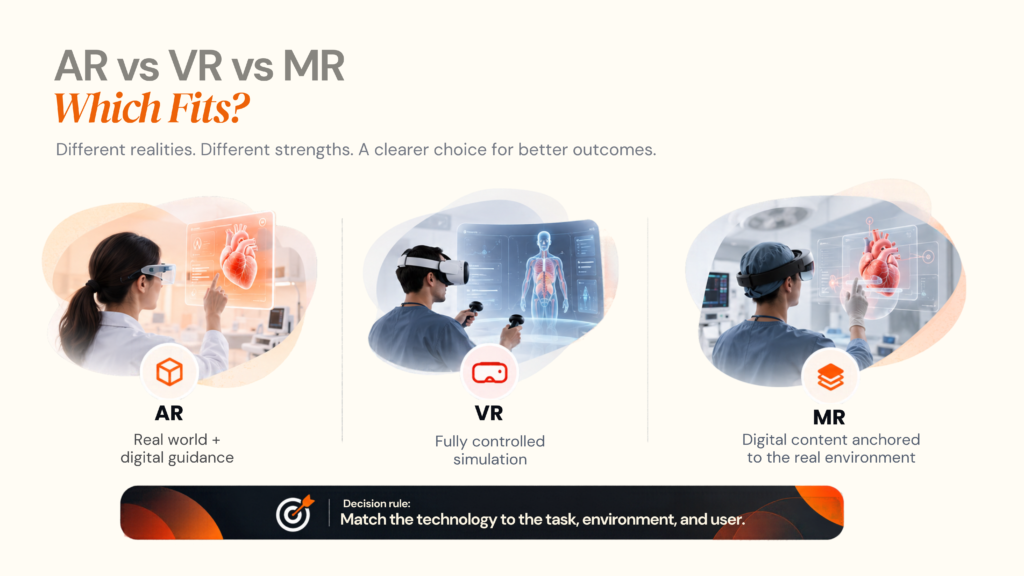
There is no single “best” immersive technology for healthcare.
| Requirement | AR | VR | MR |
|---|---|---|---|
| Controlled training environment | △ | ✓ | ✓ |
| Real-world procedure guidance | ✓ | △ | ✓ |
| Patient education | ✓ | ✓ | ✓ |
| Rehabilitation | ✓ | ✓ | ✓ |
| Remote collaboration | ✓ | ✓ | ✓ |
| Fully isolated simulation | △ | ✓ | ✓ |
| Hands-free information | ✓ | ✓ | ✓ |
| Physical-environment awareness | ✓ | — | ✓ |
The 5-question Immersive Fit Test
Before building anything, ask:
1. Is the problem spatial?
Does the user need to understand anatomy, movement, location, or a 3D relationship?
2. Is simulation important?
Would repeated practice in a controlled environment add value?
3. Does immersion change behaviour?
Would the user make a different decision or perform a different action because the experience is immersive?
4. Can the outcome be measured?
Can you define a meaningful KPI such as training accuracy, procedure comprehension, exercise adherence, or task completion?
5. Does the deployment environment support it?
Can the target users realistically access and operate the hardware?
If most answers are “no,” a conventional web or mobile product may be the better starting point.
That is not a failure of the AR/VR strategy.
It is successful product selection.
06
What Healthcare AR/VR Development Actually Costs
There is no meaningful universal price for a healthcare AR/VR product.
The budget changes dramatically depending on what is being built.
A simple anatomy-learning experience is fundamentally different from an enterprise platform connected to EHR, imaging systems, medical devices, AI models, and clinical workflows.
The main cost drivers
| Cost driver | Lower complexity | Higher complexity |
|---|---|---|
| 3D content | Existing/basic assets | Custom anatomical or procedural models |
| Device support | One device class | Multiple XR platforms |
| AI | Rules/CV | Multiple models + adaptive intelligence |
| Clinical integrations | None | EHR, imaging, devices, identity |
| Data sensitivity | No patient data | PHI/clinical data |
| Backend | Simple API | Enterprise multi-tenant infrastructure |
| Validation | UX/usability | Clinical validation and formal evidence |
| Security | Standard application controls | Enterprise healthcare security architecture |
| Regulatory | Education/wellness | Medical-device intended purpose |
| Operations | Basic analytics | Continuous monitoring, auditability and support |
A better way to budget a healthcare XR product is to separate the investment into five buckets:
Experience → Intelligence → Integration → Validation → Operations
This avoids underestimating the non-visual parts of the project.
For a startup, the goal should usually be to prove the highest-risk assumption first.
That might mean:
- validating an interaction,
- proving user engagement,
- testing AI movement analysis,
- validating an integration,
- or demonstrating a measurable training outcome.
Designoweb's MVP Development Services can support that staged approach by narrowing the initial product to a testable minimum rather than building the entire future platform at once.
For products that have already established product-market fit, Product Development Services can provide the next-stage path from MVP to a larger market-ready software product.
Need a realistic AR/VR development roadmap and budget?
Designoweb can break the product into the experience, AI, integration, validation and infrastructure layers so the scope is clear before development begins.
07
When AR/VR Is the Wrong Technology
One of the strongest signs of a mature healthcare technology strategy is knowing when not to use immersive technology.
AR/VR may be unnecessary when:
- a standard mobile interface already solves the problem,
- the user is frequently on the move and wearing a headset adds friction,
- the clinical environment is too constrained,
- the expected benefit is difficult to measure,
- hardware procurement becomes the main obstacle,
- the use case depends on long periods of continuous wear,
- accessibility requirements are difficult to support,
- or the product adds visual complexity without improving the underlying workflow.
There is also a difference between novelty and clinical utility.
A 3D body model may impress a buyer in a demo.
A rehabilitation platform that reliably measures movement and helps patients complete a clinically defined exercise may create far more durable value.
The technology should follow the outcome.
How to Evaluate an AR/VR Healthcare Development Partner
Healthcare XR projects sit at the intersection of product strategy, immersive engineering, AI, security and domain constraints. A development partner should therefore be evaluated on more than its ability to create a visually impressive prototype.
| Evaluation question | What a strong answer should cover |
|---|---|
| Can you define the clinical/use-case boundary? | Intended purpose, users, workflow and measurable outcome |
| How do you approach XR architecture? | Device strategy, OpenXR, application architecture and backend separation |
| How will healthcare data move? | APIs, FHIR/interoperability and controlled data access |
| Where should AI run? | Device, edge, cloud and latency/privacy trade-offs |
| How do you evaluate AI? | Validation datasets, metrics, edge cases and drift monitoring |
| How are security controls designed? | IAM, encryption, audit logs, device security and data minimisation |
| How do you handle regulatory boundaries? | Intended purpose and market-specific review |
| How do you approach accessibility? | Interaction alternatives, motion sensitivity and device constraints |
| How will the MVP be tested? | Defined hypotheses, pilot users and measurable KPIs |
| What happens after launch? | Monitoring, support, model updates and platform maintenance |
Designoweb's Our Process emphasises early understanding of the business problem, scalability, security and user experience before execution begins.
Looking for a healthcare technology partner, not just an AR/VR developer?
Designoweb brings together product strategy, immersive engineering, AI, integrations and scalable software development under one delivery approach.
→ Explore Designoweb's Product Development Services
For healthcare founders who do not yet have a dedicated technology leader, Virtual CTO Services can also play a roadmap and architecture role before a larger engineering commitment is made.
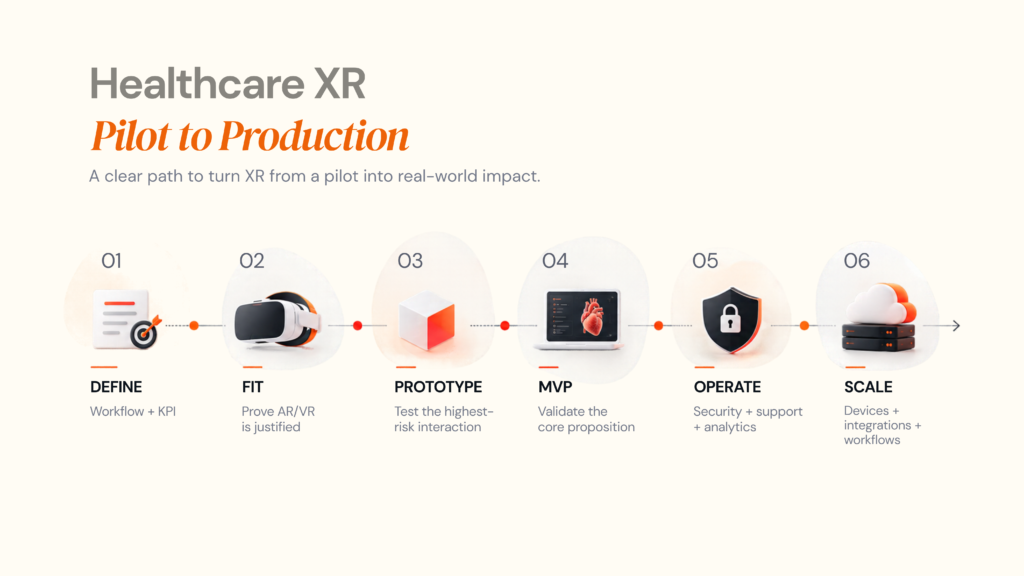
08
From Pilot to Production: A Practical Implementation Path
Ready to validate your healthcare XR idea?
Before investing in a full platform, Designoweb can help define the workflow, device strategy, AI opportunity, MVP scope, and technical architecture.
→ Discuss Your Healthcare Product
Stage 1: Define the workflow
Document:
- target users,
- current workflow,
- pain points,
- desired outcome,
- environment,
- constraints,
- success metrics.
Stage 2: Decide whether immersion is justified
Run the Immersive Fit Test.
Compare AR/VR against:
- mobile,
- web,
- video,
- conventional simulation,
- or existing clinical software.
Stage 3: Prototype the highest-risk interaction
Do not build everything.
Validate the hardest assumption first.
That might be:
- body tracking,
- spatial anchoring,
- anatomy interaction,
- device integration,
- AI scoring,
- or clinician workflow.
Stage 4: Build the smallest meaningful MVP
The MVP should include enough functionality to test the actual proposition.
It should not include every future feature.
Stage 5: Validate the operational model
Test:
- device management,
- user onboarding,
- data flows,
- security,
- analytics,
- support procedures,
- failure handling,
- and user training.
Stage 6: Scale deliberately
Only after the workflow is validated should the organisation consider:
- additional devices,
- additional geographies,
- additional clinical workflows,
- richer AI,
- enterprise integrations,
- multi-site rollout,
- and deeper analytics.
This is where an engineering partner needs to think beyond the headset.
Designoweb's AR/VR App Development Services cover immersive application development and integration, while its AI Development Services provide capabilities including computer vision, predictive analytics, generative AI, and AI/ML-oriented engineering.
The company's portfolio also includes an Eye Anatomy VR experience, demonstrating a directly relevant immersive healthcare example rather than relying only on generic AR/VR capability claims.
09
AR/VR in Healthcare: What the Future Is More Likely to Look Like
The next phase of healthcare XR is unlikely to be defined simply by better graphics.
The more meaningful shift is toward systems that understand:
the user + the environment + the clinical context + the task
That may mean:
- AI-assisted simulation,
- context-aware interfaces,
- spatial clinical education,
- movement-aware rehabilitation,
- connected immersive environments,
- 3D clinical visualisation,
- adaptive training,
- and tighter interoperability with healthcare platforms.
But maturity will also mean more discipline.
Healthcare XR products will increasingly need to demonstrate:
- evidence,
- reliable evaluation,
- privacy protection,
- strong interoperability,
- measurable outcomes,
- accessibility,
- explainable AI behaviour,
- and operational resilience.
That is why the best AR/VR healthcare strategy is not:
“How can we add AI and immersive technology?”
It is:
“Which healthcare problem becomes meaningfully better when users can see, practise, interact with or understand it spatially, and what technical and governance architecture is required to make that improvement real?”
For startups, that framing can prevent expensive technology-first decisions.
For healthcare providers, it can turn a technology pilot into a measurable workflow improvement.
For product and technology leaders, it creates a roadmap that can move from prototype to production without treating compliance, interoperability and AI governance as afterthoughts.
Building an AR/VR Healthcare Product
The strongest healthcare XR projects usually begin with a narrow workflow, a measurable outcome, and a clear architecture.
Designoweb combines AR/VR App Development Services with [AI Development Services], Unity Solutions, 3D Product Design Services, MVP engineering, and broader product development capabilities to support that journey across strategy, experience, engineering, and scale.
A practical first step is not a giant AR/VR roadmap.
It is a focused product discussion covering:
- the healthcare workflow,
- AR/VR fit,
- device strategy,
- AI opportunities,
- data and integration requirements,
- security/regulatory considerations,
- MVP scope,
- and the metrics that will determine whether the product should scale.
Ready to build a healthcare AR/VR product?
Bring us the workflow, the target users, and the outcome you want to improve. We’ll help translate that into the right immersive, AI, and product architecture.
Author

Frequently Asked Questions
01
What is AR/VR in healthcare?
AR/VR in healthcare refers to the use of augmented reality, virtual reality and related immersive technologies to support healthcare activities such as training, education, rehabilitation, treatment support, visualisation and selected clinical workflows.
02
How is AR/VR used in healthcare?
Common applications include surgical and clinical training, patient education, rehabilitation, pain management, anatomy visualisation, remote assistance and selected planning or procedural-support workflows. The strongest use cases are those where immersion provides a meaningful advantage over a conventional interface.
03
What is the difference between AR and VR in healthcare?
VR places the user inside a fully simulated environment and is particularly suited to training, simulation and controlled therapeutic experiences. AR overlays digital information onto the physical world and is more suited to guidance, education and workflows where the real environment remains important.
01
How does AI work with AR/VR in healthcare?
AI can analyse movement, visual input, speech or other signals; personalise approved content; support adaptive training; retrieve controlled information through RAG; and generate analytics. AI should be assigned a clearly defined task with measurable performance rather than added as a general-purpose layer.
02
What technologies are used to build AR/VR healthcare applications?
A typical stack may include an immersive development engine such as Unity or Unreal, OpenXR for cross-device development, device-specific SDKs where needed, APIs and backend services, healthcare interoperability standards such as FHIR, cloud or edge infrastructure, analytics and AI services. OpenXR provides a common interface for XR applications across supported platforms.
03
Should a healthcare AR/VR application use a cloud or on-device AI model?
It depends on latency, privacy, connectivity and computational requirements. Real-time tracking and other time-sensitive functions can benefit from local inference, while heavier analytics and model workloads may fit cloud infrastructure. A hybrid model is often appropriate for enterprise healthcare systems.
04
Does an AR/VR healthcare application need FHIR?
Not every application needs direct FHIR connectivity. However, when an immersive product needs to exchange clinical or administrative health data with healthcare information systems, FHIR-based interoperability can provide an important integration layer.
01
Is AR/VR healthcare software a medical device?
Not automatically.
Whether software qualifies as a medical device depends on its intended purpose and applicable regulations. In the US, the FDA maintains a dedicated resource covering AR/VR medical devices. In the UK, MHRA guidance covers software and AI as medical devices. EU guidance likewise evaluates medical-device software according to intended purpose.
02
Is AR/VR data covered by HIPAA?
It can be when the data involved qualifies as protected health information and the application operates within a HIPAA-regulated relationship. HHS explains that software vendors may become business associates when they access or handle PHI on behalf of covered entities.
03
What are the biggest privacy risks with healthcare XR?
Potential risks include camera and microphone capture, spatial data, movement or behavioural information, exposure of clinical information through displays, insecure device storage and cloud data leakage. XR-specific healthcare privacy research highlights the need for controls addressing visual, audio and data-processing risks.
04
What should healthcare startups know about the EU AI Act?
The EU AI Act became applicable on 2 August 2026, but different provisions have different transition dates. Certain high-risk AI rules for AI systems embedded in regulated products have an extended transition period to 2 August 2028 under the current implementation framework.
01
How much does it cost to build an AR/VR healthcare application?
There is no reliable universal price. Cost depends on device coverage, 3D content, AI complexity, healthcare integrations, data sensitivity, backend architecture, validation, security and regulatory requirements. A realistic estimate should be produced after the use case and intended purpose are defined.
02
How should a healthcare startup begin an AR/VR project?
Start with one workflow, one target user group and one measurable outcome. Validate the hardest technical or clinical assumption first, build a focused MVP, test it in the target environment and only then expand device support, integrations and AI capabilities.
03
When should a healthcare company avoid AR/VR?
Avoid it when a conventional mobile or web experience solves the same problem with less friction, when the benefit cannot be measured, when hardware access is unrealistic, or when immersive complexity does not materially improve the healthcare workflow.