
Key Takeaways
01.
AIaaS is a delivery model, not a single technology; it spans APIs, managed platforms, RAG, fine-tuning, and full agent systems.
02.
A production AI system needs data pipelines, retrieval, orchestration, security, and monitoring, not just a model.
03.
RAG, fine-tuning, and agents solve different problems; the right choice starts with the business requirement.
04.
Real cost includes integration, data prep, monitoring, and human review — not just inference pricing.
05.
AI is not automatically the right answer. Deterministic logic still wins for predictable processes.
06.
EU and UK organisations need governance designed alongside the architecture, not bolted on afterward.
Most businesses don't need convincing that AI exists. What they need is a straight answer to a harder question: what part of the AI stack should you own, what should you consume as a service, and what should a development partner build around it? That question is where "AI as a Service" stops being a buzzword and becomes an architecture decision. A leadership team wanting a document Q&A assistant, a product team wanting recommendations, and an operations team wanting a multi-step workflow agent are all technically different problems, even though all three get pitched under the same "AIaaS" label. This guide breaks down what AIaaS actually includes, what it costs beyond the API bill, how to choose between RAG, fine-tuning and agents, and how to implement it without turning a pilot into an open-ended experiment.
01
AIaaS Market & Adoption Snapshot
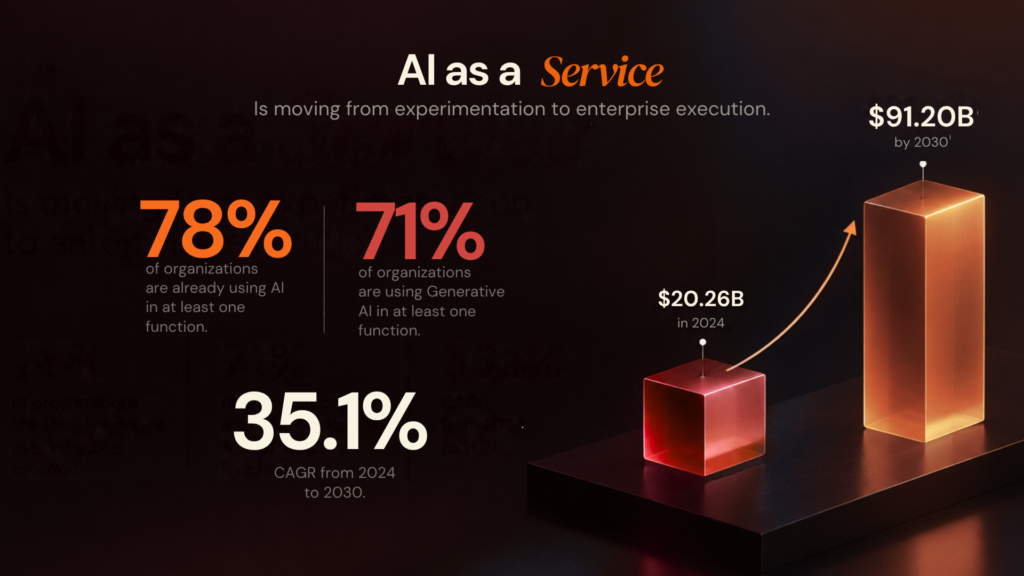
AI adoption is no longer limited to innovation teams. McKinsey’s 2025 State of AI survey found that 78% of respondents said their organisations use AI in at least one business function, while 71% reported regular generative AI use in at least one business function. The research also shows organisations using AI across an average of three business functions, even as many struggle to move experiments into scaled production.
The market around AIaaS is expanding alongside that adoption. MarketsandMarkets forecasts the global AI as a Service market to grow from $20.26 billion in 2025 to $91.20 billion by 2030, a 35.1% CAGR over the period. This is a market forecast, not a project-cost estimate or a guarantee of business results.
For enterprises, the more useful takeaway is that AI is becoming an operating layer that needs product engineering, data integration, evaluation, security, governance, and ongoing optimisation.
Read McKinsey’s 2025 State of AI research and review the MarketsandMarkets AIaaS market forecast.
02
What Is AI as a Service?
AI as a Service (AIaaS) is a delivery model where an organisation consumes AI capabilities, a hosted model, an API, retrieval infrastructure, an agent framework, or a fully managed application, through the cloud instead of building and operating every component in-house. IBM defines it as cloud-based access to AI tools without the need to build local infrastructure; Microsoft frames it similarly, as access to ML, NLP, vision and generative capabilities through hosted APIs.
The definition alone doesn't help a CTO make a build decision, though. What matters is where AIaaS sits relative to a finished product.
| Model | What you consume | Typical control | Example use |
|---|---|---|---|
| SaaS | Finished application | Low | CRM, accounting, HR platform |
| AI API | One specific capability | Medium | Text classification, speech-to-text |
| AIaaS platform | AI infrastructure + models + tools | Medium–High | Enterprise AI application platform |
| Managed AI solution | System built around your use case | High | Internal knowledge assistant |
| Custom AI development | Bespoke AI product | Highest | Proprietary AI-powered platform |
A SaaS customer is buying an application. An AIaaS customer is often buying an ingredient — intelligence they still have to wire into their own data, logic and workflows. That distinction is the one businesses get wrong most often: AIaaS removes infrastructure complexity, not product complexity.
For teams moving from AI experimentation to a production product, Designoweb’s AI development services cover strategy, custom AI solutions, autonomous agents, predictive analytics, computer vision, and operational AI/MLOps.
What it removes: hardware procurement, model-infrastructure operation, foundational model training, parts of the deployment lifecycle.
What it never removes: data quality, system integration, business rules, evaluation, security, governance, UX, and operational ownership.
03
Practical Business Applications of AIaaS
AIaaS earns its budget when it's wired into a real workflow with a metric attached, not when it exists as a standalone demo. Here's where it's delivering measurable results right now.
1. Customer Support and Service Automation
An AI layer can classify an incoming request, retrieve the relevant knowledge, check the customer's account context, draft a response, and route anything below a confidence threshold to a human. Done well, this isn't "a chatbot"; it's a decision pipeline with a built-in escalation path, and the KPI to track is average handling time or first-contact resolution, not "number of AI conversations."
For a real product example, Designoweb’s VASD case study shows AI-powered image diagnosis connected to recommendations and professional-service workflows. Gold Sky demonstrates AI-powered candidate matching inside a recruitment workflow.
2. Internal Enterprise Knowledge
Policies, contracts, technical documentation, and support material change constantly, which makes them a poor fit for baking into a model through training. Retrieval-Augmented Generation (RAG) lets an application pull the current version of that knowledge at query time, so the assistant is never citing a policy that was superseded last quarter.
3. Document Intelligence
Extracting fields from contracts, invoices, claims forms, or patient records combines OCR, vision, and language models with business rules and, usually, a human review step for anything unusual. This is one of the highest-ROI AIaaS applications because the alternative, manual data entry, is slow, expensive and error-prone at volume.
4. Recommendation and Personalisation Systems
Product recommendations, content ranking and next-best-action suggestions can run on a generative model, a traditional ML model, or a blend of both. The architecture decision here is less about the AI and more about the data pipeline feeding it; stale or thin behavioural data will undercut even a well-tuned recommendation engine.
5. Predictive Analytics
Demand forecasting, churn prediction, fraud detection, and predictive maintenance are AIaaS applications that frequently don't involve an LLM at all; classical machine learning is often the better fit. The mistake to avoid is assuming "AI" automatically means "generative AI."
6. Computer Vision
Image and video analysis, inspecting products, reading documents, monitoring manufacturing environments, is one of the more mature AIaaS categories, and increasingly available as a managed capability rather than a from-scratch model build.
7. AI Agents for Multi-Step Workflows
Agents go beyond answering questions: they plan steps, call tools, check results, and take an approved action. For example, "find delayed orders that need attention" can become a pipeline that queries the order system, checks shipping status, classifies the delay reason, drafts a recommended action, and routes it for approval before touching the live system. The more actions an agent can take, the more permissions, auditability, and human oversight matter; this is not the place to cut corners on control.
04
How Different Industries Use AIaaS
The use case determines the architecture, not the other way around. Here's how AIaaS maps across sectors, including where it overlaps with work already shipped in Designoweb's own portfolio.
| Industry | AIaaS Use Case | How It's Applied | Business Outcome |
|---|---|---|---|
| Financial services | Fraud and anomaly detection | Real-time transaction scoring against behavioural patterns | Faster risk identification |
| Healthcare | Diagnostic assistance, image analysis | Vision + predictive models cross-referenced with patient history | Faster, more consistent triage |
| Retail / e-commerce | Recommendations, demand forecasting | Personalisation engines + inventory prediction | Higher conversion, lower stockouts |
| Manufacturing | Predictive maintenance | Sensor + historical data flagging failure risk before it happens | Reduced unplanned downtime |
| Logistics | Route and demand intelligence | Real-time optimisation against traffic/weather/volume | Lower cost per delivery |
| Insurance | Automated claims review | Document + image recognition against policy rules | Faster claims turnaround |
| Recruitment | Candidate matching | NLP-based matching against role requirements and signal data | Faster, more consistent shortlisting |
| Home services | Image-based diagnostics | Vision models assessing condition from user-submitted photos | Faster first-response accuracy |
Designoweb's own AI practice touches several of these directly: image-based diagnostics for VASD's home-maintenance platform, AI-driven candidate matching for Gold Sky's recruitment platform, and AI-powered visual transformation combined with booking logistics for Hollywood Hair. In each case, the AI is embedded in the product workflow, not bolted on as a separate feature, which is the pattern that tends to actually move a business metric.
See the Hollywood Hair AI-powered transformation and booking case study for an example of AI working as part of a broader customer journey.
AI adoption is rising, but production scale is still the hard part.
Deloitte’s January 2025 enterprise GenAI research found that more than two-thirds of respondents expected 30% or fewer of their experiments to be fully scaled in the following three to six months, while nearly three-quarters said their most advanced GenAI initiative was meeting or exceeding ROI expectations. The practical takeaway is simple: proving a use case and scaling it are different engineering problems.
Read Deloitte’s State of Generative AI in the Enterprise update.
Ready to see where AIaaS fits inside your own product or workflow?
We'll walk your use case against our maturity model and tell you honestly whether you need an API, RAG, or a full agent, before you commit a budget.
→ Book an AI Architecture Review
05
How AI as a Service Works
AI as a Service (AIaaS) may look simple from the outside: a user sends a request, an AI model processes it, and the application returns an answer.
In a production environment, however, there is much more happening behind that interaction.
A reliable AIaaS solution typically combines application interfaces, business logic, AI models, enterprise data, external tools, cloud infrastructure, security controls, and continuous monitoring. These layers work together to turn a raw AI capability into a usable business service.
A practical way to understand the architecture is through seven interconnected layers:
Users / Business Systems
↓
Application & API Layer
↓
Orchestration / Business Logic
↓
AI Model Layer
↓
Retrieval / Tools / Data
↓
Infrastructure & Security
↓
Monitoring / Evaluation / Governance
Not every AIaaS implementation will use every component in the same way. The architecture depends on the use case, data sensitivity, model requirements, workload, and level of automation. But this layered model helps businesses understand where intelligence is created, where data flows, and where operational or security risks need to be controlled.
1. Application & API Layer
The application layer is the part of the AIaaS platform that users and business systems actually interact with.
It can take many forms, including:
- Web applications
- Mobile applications
- Customer portals
- AI chatbots
- Voice assistants
- Internal employee dashboards
- CRM interfaces
- Enterprise APIs
- Embedded AI features inside existing software
For example, a customer may ask a support chatbot, “Where is my order?” The user sees a simple conversational interface, but the application is responsible for more than displaying the response.
It typically handles authentication, session management, user permissions, request validation, rate limits, and communication with the backend AI services.
This is why businesses should generally avoid exposing an underlying AI model directly to end users. The application layer creates a controlled boundary between the user and the model.
It can determine:
- Who is making the request
- What information the user is allowed to access
- Which AI capability should handle the request
- Which business rules must be applied
- Whether a request should continue automatically or require approval
Why it matters:
Without a controlled application layer, an AI model may be technically capable but difficult to secure, govern, or integrate into real business workflows.
2. Orchestration & Business Logic Layer
The orchestration layer acts as the decision-making workflow around the AI model.
Instead of sending every request directly to an LLM, this layer determines what should happen before, during, and after the model call.
A typical workflow may look like this:
Customer asks a question
↓
Authenticate the user
↓
Identify the request type
↓
Check permissions
↓
Retrieve relevant customer information
↓
Retrieve approved business knowledge
↓
Select the appropriate AI capability
↓
Generate a response
↓
Validate the output
↓
Return the answer or escalate to a human
This becomes especially important when AI moves beyond simple chat and starts handling multi-step workflows.
For example, an AI assistant for an e-commerce company may need to identify a customer's intent, check the order system, verify the refund policy, calculate eligibility, and then either initiate a refund or send the request for human approval.
The model can contribute intelligence at different points in this process, but the orchestration layer coordinates the overall workflow.
Modern agent architectures are increasingly designed around this concept. OpenAI’s current agent documentation describes architectures that combine models, tools, application logic, and agent workflows rather than treating the model as the entire application.
Why it matters:
The orchestration layer is where AI becomes part of a business process rather than functioning as an isolated chatbot.
3. AI Model Layer
The model layer provides the intelligence that performs the core AI task.
Depending on the business requirement, an AIaaS platform may use:
- Large language models (LLMs)
- Small language models
- Classification models
- Recommendation models
- Computer-vision models
- Speech recognition models
- Text-to-speech models
- Forecasting models
- Multimodal models
- Domain-specific machine-learning models
One of the most important architectural decisions is choosing the model according to the task rather than automatically selecting the largest or most expensive model.
For example:
| Business Task | Possible Model Strategy |
|---|---|
| Intent classification | Smaller, lower-cost model |
| Document summarisation | General-purpose LLM |
| Complex reasoning | More capable reasoning model |
| Image inspection | Computer-vision model |
| Demand forecasting | Statistical or specialised ML model |
| Voice interaction | Speech recognition + LLM + speech generation |
| Sensitive enterprise workflow | Private or controlled deployment, depending on requirements |
A production AIaaS platform may also use model routing, where different requests are sent to different models based on complexity, cost, latency, or data sensitivity.
For instance, a simple FAQ request might be handled using a smaller model, while a complex financial or technical query could be routed to a more capable model.
This approach helps businesses balance performance with operational cost.
The goal is not maximum model size. The goal is fit-for-purpose intelligence.
Why it matters:
Choosing the right model strategy can influence response quality, latency, scalability, data controls, and the overall cost of running the AI service.
4. Data & Retrieval Layer
AI models do not automatically know a company's latest internal information.
A business may have thousands of documents, product records, policies, contracts, support articles, technical manuals, or customer records that need to be available at runtime.
This is where the data and retrieval layer becomes important.
A common approach is Retrieval-Augmented Generation (RAG).
A simplified workflow looks like this:
Business documents and data
↓
Parsing and preprocessing
↓
Chunking/indexing
↓
Embeddings
↓
Vector or hybrid search index
↓
User question
↓
Semantic retrieval
↓
Relevant business context
↓
AI model
↓
Grounded response
Instead of expecting the model to contain every piece of company information, the application retrieves relevant information when the request is made and supplies that context to the model.
AWS’s Amazon Bedrock documentation describes managed foundation-model access and production capabilities around knowledge bases, evaluation, and AI applications. Its evaluation tooling also supports assessing both model performance and RAG retrieval quality.
This is useful for business information such as:
- Internal policies
- Product catalogues
- Technical documentation
- Customer-support knowledge
- Contracts
- Employee handbooks
- Compliance documents
- Pricing information
- Enterprise knowledge bases
The retrieval layer can also include structured data sources, databases, search systems, and real-time business systems rather than relying only on vector search.
Why it matters:
RAG and retrieval systems allow AI applications to work with private, changing, and business-specific information without requiring the model itself to contain that information.
5. Tools, APIs & Business Integrations
AI becomes significantly more useful when it can interact with business systems instead of only generating responses.
A production AI application may need to:
- Check an order
- Retrieve a customer record
- Search inventory
- Create a support ticket
- Update a CRM record
- Book an appointment
- Generate a report
- Query an ERP
- Trigger a workflow
- Send an approved notification
- Initiate a business process
These capabilities are enabled through APIs, tools, databases, enterprise connectors, and external services.
Consider an AI customer-support assistant.
The model may determine that the customer wants to cancel an order.
But the AI model should not necessarily have unrestricted authority to cancel anything.
A safer architecture separates AI reasoning from system authorization:
AI identifies intent
↓
Business logic checks eligibility
↓
Permission system validates access
↓
Approved API performs the action
↓
System records the transaction
This distinction becomes increasingly important as businesses deploy AI agents that can perform actions on behalf of users.
The principle is simple:
Let AI determine intent where appropriate. Let deterministic application logic control permissions and irreversible actions.
Why it matters:
Tool integrations are what connect AI to real business processes. Without them, many AI systems remain useful mainly for generating or summarising information rather than completing work.
6. Infrastructure & Security Layer
Underneath the AI application sits the infrastructure that makes the entire service available, scalable, and secure.
This layer can include:
- Cloud compute
- GPU or accelerator infrastructure
- Storage
- Databases
- Networking
- Containers
- API gateways
- Load balancing
- Caching
- Secrets management
- Identity and access management
- Encryption
- Backup and disaster recovery
- Private networking
- Infrastructure monitoring
The architecture depends heavily on how the AI service will be used.
A lightweight customer-facing chatbot may rely heavily on managed cloud AI services.
A highly regulated enterprise platform may require private networking, stricter access controls, dedicated environments, data residency requirements, or additional isolation between workloads.
Security also needs to be considered across the entire AI request lifecycle—not only at the infrastructure level.
For example, businesses may need controls around:
- Who can access enterprise data
- What information can be sent to a model
- Which tools an agent can call
- How API credentials are stored
- What data is retained in logs
- How sensitive outputs are handled
- How access is audited
Why it matters:
A high-performing model is not enough for production. AIaaS needs infrastructure that can support the required traffic, availability, security, compliance, and data-protection requirements.
7. Monitoring, Evaluation & Governance
Launching an AI system is not the end of the engineering process.
Once the system is in production, businesses need to continuously measure how it behaves.
Traditional software monitoring might focus on uptime, latency, errors, and infrastructure health. AI systems require those measurements plus additional indicators related to model and data quality.
Teams may need to track:
- Response accuracy
- Retrieval quality
- Hallucination or unsupported responses
- Model latency
- Token or inference costs
- Failure rates
- Tool-call failures
- Human escalation rates
- User feedback
- Prompt and workflow performance
- Data or model drift
- Safety and policy violations
- Performance across different user groups
NIST's AI Risk Management Framework treats measurement as an ongoing activity, recommending that AI systems be tested before deployment and regularly while operating. It also highlights production monitoring because system behaviour and risk can change as the operating environment evolves.
This makes evaluation part of the architecture rather than a reporting exercise performed after launch.
A mature AIaaS implementation may therefore use an evaluation loop such as:
Deploy
↓
Collect production signals
↓
Evaluate outputs
↓
Identify failures and drift
↓
Improve prompts, retrieval, models or workflows
↓
Retest
↓
Redeploy
Governance sits across this process, defining who owns the system, what controls apply, how decisions are reviewed, and what happens when the AI system produces an unacceptable result.
Why it matters:
AI systems operate in changing environments. Continuous evaluation helps businesses detect quality degradation, emerging risks, and operational problems before they become larger business issues.
Putting the AIaaS Architecture Together
These layers should not be viewed as seven isolated components.
They work together as one production system:
User request
↓
Application authenticates and validates the request
↓
Orchestration determines the required workflow
↓
Retrieval layer gathers relevant business information
↓
AI model generates or interprets the result
↓
Tools and APIs perform approved business actions
↓
Infrastructure delivers the service securely at scale
↓
Monitoring and governance evaluate the outcome
That is the difference between simply using an AI model and building an AI service around a business process.
For decision-makers, the important question is therefore not only “Which AI model should we use?”
It is:
“What architecture do we need around the model to make AI secure, reliable, scalable, and useful in our business?”
06
AIaaS Architecture: What Sits Behind the Interface
An AIaaS product may look like a simple chatbot, search bar, dashboard, or API from the outside. Behind that interface, however, there is usually an architecture connecting AI models with business data, enterprise systems, security controls, and operational monitoring.
A useful way to understand this architecture is to separate it into five core responsibilities:
Experience → Intelligence → Enterprise Context → Control → Operations
These are not always five isolated technical layers. In production, security and governance can span across the entire stack, while data, tools, and models are connected through orchestration.
The result is an AI system designed not just to generate outputs, but to deliver useful, controlled, and measurable business outcomes.

Layer 1: Experience
The experience layer is where people or business systems interact with AI.
Depending on the use case, this might be:
- Conversational AI
- AI-powered search
- Recommendation engines
- Document automation
- Voice interfaces
- AI copilots
- Internal dashboards
- AI features embedded inside existing applications
But the important question is not simply “Where can we add AI?”
It is:
“What part of the user or business experience should AI improve?”
For example, an enterprise could introduce AI into customer support to reduce the time employees spend searching for answers. A financial platform might use AI to summarise reports. A SaaS product might add an AI copilot that helps users complete complex workflows.
The interface is only the visible part. The real value depends on what happens behind it.
Layer 2: Intelligence
The intelligence layer contains the technologies responsible for understanding requests, generating outputs, making predictions, and deciding which capability should be used.
This may include:
- Foundation models and LLMs
- Custom machine-learning models
- Prompt and instruction layers
- Model routing
- Retrieval
- Agent planning
- Tool selection
- Structured output generation
- Output validation
- Guardrails
A production system may use more than one model rather than relying on a single model for every task.
A simple request could be handled by a smaller, lower-cost model, while a complex reasoning task could be routed to a more capable model. Likewise, an image-processing workflow may use a vision model while a forecasting use case may rely on specialised machine learning.
Modern AI platforms increasingly support this broader architecture around models, including tools, context, and agent workflows. OpenAI, for example, describes its current platform around models, agent workflows, tools, and enterprise controls rather than treating the model as the entire application.
This is an important shift in how AIaaS should be designed.
The model is the intelligence engine. It is not the complete product.
Layer 3: Enterprise Context & Integrations
AI becomes significantly more useful when it can work with the information and systems a business already relies on.
This layer can connect AI to:
- CRM platforms
- ERP systems
- Product databases
- Data warehouses
- Document repositories
- Customer records
- Internal knowledge bases
- Business APIs
- Internal services
- Event and data streams
Consider an AI support assistant.
Without enterprise context, it may be able to explain how refunds generally work.
With access to approved business data, it can determine:
What is the customer's order?
Has it shipped?
Is it eligible for a refund?
What does the current company policy allow?
That is the difference between generic AI and business-connected AI.
This layer is also where technologies such as Retrieval-Augmented Generation (RAG) become important. RAG allows an application to retrieve relevant information from external knowledge sources at runtime and provide that information to the model as context, rather than relying only on what the model learned during training.
For enterprise use cases, this makes AI more suitable for information that is private, frequently updated, or specific to the organisation. AWS also documents RAG and knowledge-base patterns for connecting foundation models to enterprise information at runtime.
The goal is not simply to give AI more data. It is to give AI the right business context at the right time.
Layer 4: Control
Once AI is connected to enterprise data and business systems, control becomes essential.
This is the layer that determines what the AI system is allowed to access, generate, and do.
Typical controls include:
- Authentication
- Authorisation
- Role-based access
- Tenant isolation
- Encryption
- Data-retention policies
- Audit logging
- Prompt and output filtering
- Tool allowlists
- Approval workflows
- Model access policies
- Data-loss prevention controls
This becomes particularly important when AI is connected to operational systems.
For example, an AI assistant might identify that a customer wants to cancel an order. The AI can interpret the request, but a deterministic business rule should still determine whether cancellation is permitted and which system is authorised to execute it.
A useful principle is:
Let AI determine intent where appropriate. Let application logic control permissions and irreversible actions.
This distinction becomes increasingly important as organisations move from AI that answers questions toward AI that takes actions. Enterprise agent architectures commonly combine RAG, tool access, permissions, approval points, and execution controls for this reason.
Layer 5: Operations
An AI system does not become production-ready simply because the first version works.
Once deployed, teams need visibility into how the system performs in real-world conditions.
The operations layer typically covers:
- Monitoring
- Evaluation
- Logging
- Prompt and model versioning
- Alerting
- Incident management
- Cost monitoring
- Latency tracking
- Performance optimisation
- MLOps and LLMOps
Traditional software monitoring can tell you whether an application is running.
AI monitoring also needs to help answer:
Is the answer useful?
Did the system retrieve the right information?
Did the model follow the required instructions?
Did the agent use the correct tool?
Did costs increase unexpectedly?
Are users escalating more frequently?
This makes evaluation an ongoing engineering function rather than a one-time test before launch.
Current production AI platforms similarly emphasise evaluation, monitoring, versioning, controlled tool access, and lifecycle management. AWS Bedrock’s evaluation documentation, for example, describes evaluating model and knowledge-base performance with automated and human-based methods.
What a Production AIaaS Architecture Looks Like
A practical AIaaS architecture brings these responsibilities together:
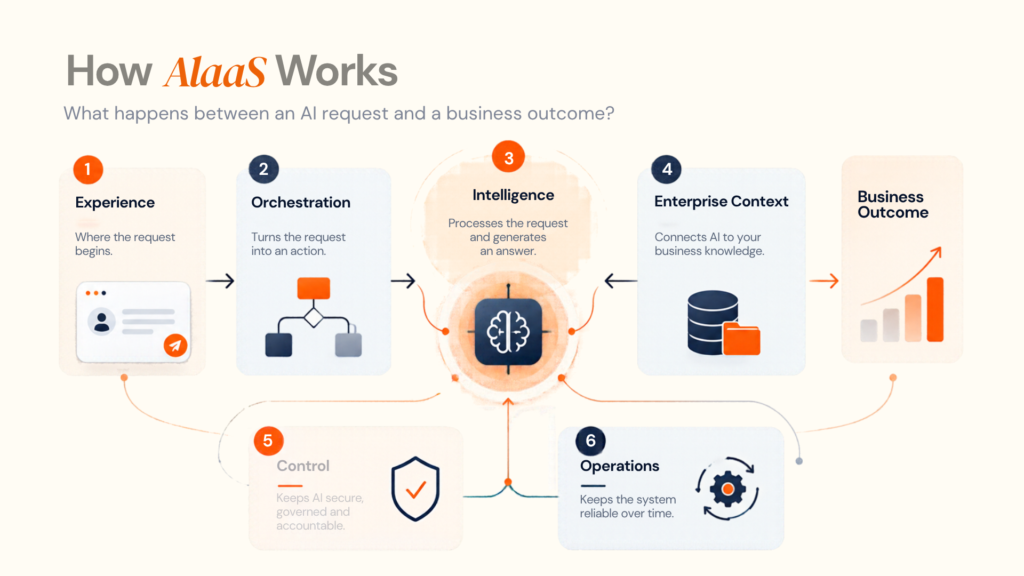
In practice, security and governance should not be treated as a single box at the bottom. Access controls, data protection, validation, auditability, and policy enforcement need to operate throughout the architecture.
That is why AIaaS projects often become software-engineering and systems-integration projects, not simply model-integration projects.
The first model call is often the easy part.
The harder work is building everything around it so the system can work with business data, follow permissions, integrate with existing software, handle failure, control cost, and remain measurable in production.
07
RAG, Fine-Tuning or AI Agents?
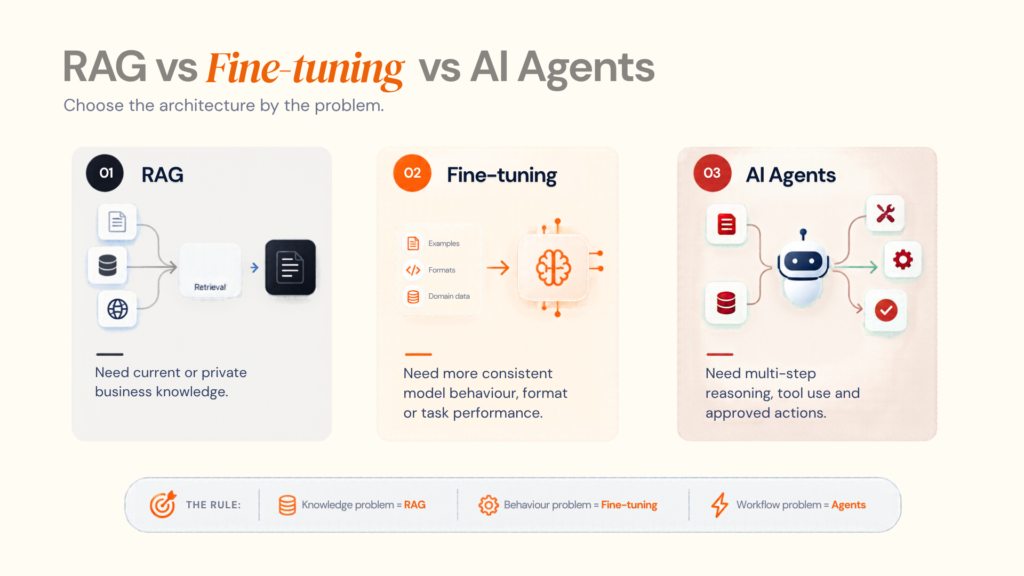
RAG, fine-tuning, and AI agents are often discussed together, but they solve different architectural problems. The right choice depends on what you are trying to change in the AI system.
| Requirement | RAG | Fine-tuning | AI Agents |
|---|---|---|---|
| Use changing enterprise knowledge | Strong fit | Limited fit | Strong fit |
| Improve response behaviour or format | Limited–Moderate | Strong fit | Moderate |
| Connect AI to business tools | Possible | Limited | Strong fit |
| Work with private business knowledge | Strong fit | Possible | Strong fit |
| Execute multi-step workflows | Limited | No | Strong fit |
| Adapt a model to a specific task or style | Limited | Strong fit | Moderate |
| Use fresh source information at runtime | Strong fit | Weak fit | Strong fit |
| Operational complexity | Medium | Medium–High | High |
RAG
Use RAG when the main problem is knowledge access.
For example, a company wants an AI assistant to answer questions using its latest policies, product documentation, contracts, or internal knowledge base.
The model does not need to permanently learn that information. The application retrieves the relevant content when the user asks a question.
Fine-tuning
Use fine-tuning when the main problem is model behaviour.
It can be useful when a business needs more consistent outputs for a particular task, format, style, or classification pattern.
Fine-tuning should not normally be treated as the solution for frequently changing business information. That information is generally better handled through retrieval or another runtime data-access mechanism.
AI Agents
Use agents when the main problem is workflow execution.
An agent can combine a model with context, tools, APIs, business rules, and multiple steps to complete a defined task.
For example:
Understand request → Retrieve information → Check business rules → Call API → Validate result → Complete workflow
That can be valuable for customer service, operations, sales, finance, IT support, and other processes where AI needs to move beyond generating text.
However, not every workflow needs an autonomous agent.
A deterministic workflow is often simpler and easier to control when the steps, rules, and outcomes are already known.
The Practical Rule
Use RAG when AI needs better access to changing information.
Use fine-tuning when AI needs more consistent behaviour for a specific task.
Use agents when AI needs to coordinate tools and multi-step actions.
And in many production systems, these approaches are combined rather than selected exclusively. An AI agent may use RAG for enterprise knowledge, a fine-tuned model for a specialised task, and controlled APIs to execute approved actions.
The architectural goal is not to use the most advanced AI technique available.
It is to use the simplest architecture that reliably solves the business problem.
Explore Designoweb’s AI blog hub for related coverage of generative AI, agentic AI, automation, and machine learning.
08
AIaaS Delivery Models and Technology Choices
There is no single AIaaS model that fits every organisation.
Model 1: Consume an existing AI API
This is the simplest way to adopt AI as a Service. Instead of developing and hosting an AI model yourself, you connect your application to an existing AI provider through its API and use the provider’s models and infrastructure to power features such as chat, content generation, summarisation, search, or automation. The provider handles the underlying model infrastructure, while your development team focuses on integrating AI into the product, business logic, data, and workflows.
Best for:
- early-stage products
- straightforward AI features
- experimentation
- document classification
- text generation
- speech
- image analysis
Advantages:
- fast implementation
- low infrastructure ownership
- broad model access
- easy experimentation
Trade-offs:
- external dependency
- usage-based costs
- provider-specific APIs
- less control over underlying infrastructure
Model 2: Build on a Managed AI Platform
A managed AI platform gives businesses access to AI models along with the cloud infrastructure and tools needed to build, deploy, and manage AI applications. Instead of working directly with a single model API, organisations can use a managed platform that brings together foundation models, security controls, data integration, evaluation tools, and other AI capabilities in one environment.
AWS, for example, describes Amazon Bedrock as a fully managed service that provides access to multiple foundation models through a common API, along with capabilities for retrieval-augmented generation (RAG), model customisation, evaluation, and AI agents.
This approach can be useful for enterprises that need more control and flexibility than a basic AI API while still avoiding the operational burden of managing the underlying infrastructure themselves.
It can provide:
- Greater infrastructure control
- Access to multiple models
- Enterprise system integration
- Built-in security controls
- Managed deployment
- AI evaluation and monitoring capabilities
Model 3: Build a Managed AI Application
In this model, the business owns the product, user experience, and business objectives, while an AI development partner designs and engineers the AI system around those requirements. Rather than simply connecting an application to an AI API, the partner builds the orchestration, data integrations, retrieval systems, tools, security controls, and monitoring needed to make the solution work in a real business environment.
A typical architecture may look like:
Your application
↓
Custom orchestration
↓
Provider model(s)
↓
Your enterprise data
↓
RAG / APIs / tools
↓
Security + monitoring
This approach is particularly relevant when AI needs to become part of an existing product, customer journey, or internal workflow.
The organisation is not simply looking for access to an AI model. It needs to turn AI capabilities into a reliable, scalable, and business-specific solution.
That is where an experienced AI development partner can add value—from selecting the right technology stack to integrating enterprise data, building workflows, and managing the system in production.
Model 4: Hybrid or Private AI
Some organisations need more control over how their AI systems are hosted, accessed, and managed, particularly when they are working with sensitive data, strict compliance requirements, or highly specialised workloads. In these situations, businesses may choose a hybrid or private AI architecture in which some parts of the AI stack run within a controlled environment while other services continue to use managed cloud infrastructure.
The approach can help organisations manage requirements around:
- Data location
- Model hosting
- Network access
- Privacy
- Latency
- Infrastructure costs
- Vendor dependence
For example, sensitive enterprise data may remain inside a private environment while selected AI services are accessed through a managed cloud platform.
The trade-off is important: greater control can provide more flexibility around security, data, and infrastructure decisions, but it also increases the organisation's responsibility for deployment, maintenance, scaling, monitoring, and ongoing operational management.
For businesses evaluating AIaaS, the right delivery model therefore depends not only on the AI capability required, but also on how much control the organisation wants over the underlying technology and infrastructure.
A practical decision framework
| Question | Favour managed AI service | Favour greater control |
|---|---|---|
| Need rapid experimentation? | Yes | |
| Simple AI feature? | Yes | |
| Highly sensitive data? | Yes | |
| Strict data residency requirement? | Potentially | |
| Large predictable workload? | Maybe | Potentially |
| Need model portability? | Yes | |
| Complex enterprise integrations? | Either | Either |
| Need specialised proprietary models? | Yes | |
| Limited AI operations team? | Yes | |
| Need deep infrastructure optimisation? | Yes |
There is no universal answer.
The correct architecture is determined by workload, risk, data, budget and operating capability.
Need help choosing the right AIaaS delivery model?
Compare API-first, managed platform, managed application, and private/hybrid options against your data, security, scale, and operating model.
Business Use Cases for AI as a Service
AIaaS becomes commercially useful when it is connected to a workflow with a measurable improvement target.
Customer support
AI can classify incoming requests, retrieve relevant answers, summarise conversations and assist human agents.
A mature implementation might look like:
Customer message
↓
Intent classification
↓
Retrieve knowledge
↓
Check customer context
↓
Generate response
↓
Confidence / policy check
↓
Answer or escalate
The KPI is not "number of AI conversations."
It might be:
- average handling time
- first-contact resolution
- escalation rate
- response time
- customer satisfaction
Internal enterprise knowledge
An AI knowledge assistant can provide natural-language access to internal material.
Potential sources include:
- policies
- product documentation
- procedures
- technical documents
- HR documentation
- contracts
- support information
RAG is particularly relevant where documents change frequently because the system can retrieve current information at query time.
Document intelligence
Businesses can use AI to:
- extract fields
- classify documents
- summarise contracts
- detect anomalies
- route requests
- compare versions
- create structured records
The system can combine OCR, vision, language models, business rules and human review.
Recommendation systems
Retail, e-commerce, media and SaaS companies can use AI services for:
- product recommendations
- content ranking
- personalisation
- next-best-action suggestions
- customer segmentation
A recommendation system can also be combined with traditional ML rather than relying on a generative model.
Predictive analytics
AI services can support:
- demand forecasting
- churn prediction
- anomaly detection
- fraud detection
- predictive maintenance
- risk modelling
For these applications, "AIaaS" does not necessarily mean an LLM.
Machine learning remains an important part of enterprise AI.
Computer vision
AI services can analyse:
- products
- images
- documents
- manufacturing environments
- medical imagery
- video
- physical environments
Designoweb's current AI capability set includes computer vision, predictive analytics, conversational AI, generative AI, autonomous agents and operational AI/MLOps.
AI agents
Agents are useful where a workflow involves:
- understanding the request
- planning steps
- retrieving information
- calling tools
- checking results
- taking an approved action
For example:
"Find the delayed orders that need attention."
↓
Identify relevant orders
↓
Query order system
↓
Check shipping status
↓
Classify delay reason
↓
Draft recommended action
↓
Request approval
↓
Update system
That is materially different from a chatbot answering a question.
The more actions an AI system can take, the more important permissions, auditability, fallbacks, and human oversight become.
Industry applications
| Industry | Example AIaaS application | Typical business outcome |
|---|---|---|
| Financial services | Fraud/anomaly detection | Faster risk identification |
| Healthcare | Document and diagnostic assistance | Workflow efficiency |
| Retail | Recommendations | Better personalisation |
| Manufacturing | Predictive maintenance | Reduced operational disruption |
| Logistics | Demand/route intelligence | Operational optimisation |
| Insurance | Claims document analysis | Faster review |
| SaaS | AI copilots | Improved user productivity |
| Recruitment | Candidate matching | Faster search and triage |
| Professional services | Knowledge assistants | Faster information retrieval |
| Media | Personalisation | Better content discovery |
The use case determines the architecture.
A company should therefore avoid starting with:
"Which AI model should we use?"
Start with:
"Which business workflow should change, and how will we measure the change?"
Designoweb's portfolio currently includes AI-powered work such as VASD's image-based home-maintenance diagnostics and Gold Sky's AI-powered candidate matching.
These examples illustrate an important difference between generic AI access and embedded AI products: the intelligence is part of a broader user workflow.
09
AIaaS Costs: What You Actually Pay For
One of the most common mistakes in AIaaS planning is treating AI cost as nothing more than the price of a model API.
In production, the model is only one part of the total cost.
An AIaaS solution may also require data preparation, retrieval infrastructure, integrations, cloud resources, security controls, monitoring, human review, and ongoing maintenance. The actual economics therefore depend on how the complete system is designed and how it is used.
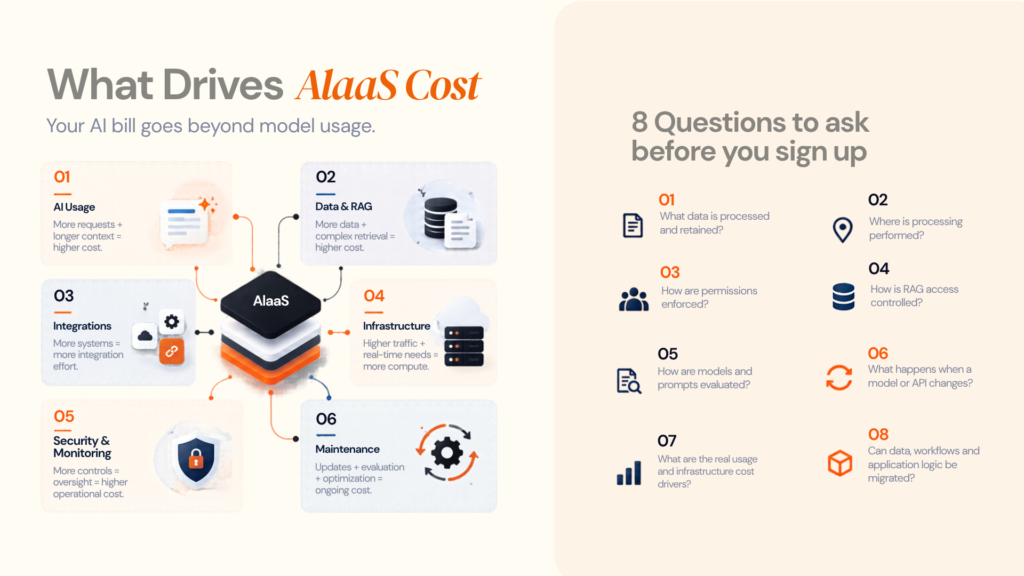
A practical AIaaS cost model looks like this:
Total AI Cost = Model / Inference + Data Preparation + Retrieval + Storage + Integration + Infrastructure + Monitoring + Security + Human Review + Maintenance
Cost benchmark to keep in view: MarketsandMarkets forecasts the AIaaS market to grow at 35.1% CAGR from 2025 to 2030, reaching $91.20 billion by 2030. The forecast is market-level, not a project-cost estimate. Your economics will depend on request volume, model mix, data, integrations, infrastructure, and the business outcome being measured.
View the market forecast.
Understanding each cost driver before development begins can help businesses avoid building a solution that works technically but becomes difficult or expensive to operate at scale.
1. Model and Inference Costs
Model usage is usually one of the most visible AIaaS expenses, but it is also one of the costs that can vary most widely.
Inference costs can depend on:
- Model selection
- Input volume
- Output volume
- Context size
- Request frequency
- Caching
- Model routing
- Processing requirements
For example, an AI application handling thousands of simple classification requests does not necessarily need the same model used for complex reasoning tasks.
This is why model selection should be based on the actual workload rather than simply choosing the most capable model available.
A well-designed AIaaS architecture may route simple requests to smaller models and reserve more capable models for tasks where additional reasoning or accuracy justifies the additional cost.
The objective is not to minimise model cost at any cost. It is to achieve the required business outcome at a sustainable cost per interaction.
2. Data Preparation Costs
Enterprise data is rarely ready to be consumed by an AI system immediately.
Documents may need to be parsed, cleaned, structured, classified, segmented, and enriched with metadata before they can be used effectively.
Depending on the use case, this can involve:
- Document parsing
- Data cleaning
- Chunking
- Metadata extraction
- Access-control mapping
- Deduplication
- Data transformation
This is particularly important for organisations working with large volumes of unstructured information such as PDFs, contracts, manuals, reports, emails, and internal documentation.
The quality of this preparation directly affects the quality of the resulting AI system.
Better models cannot fully compensate for poor or poorly structured source data.
3. Retrieval Costs
If an AI application uses Retrieval-Augmented Generation (RAG), additional infrastructure and processing costs may be introduced.
These can include:
- Embedding generation
- Vector storage
- Retrieval
- Reranking
- Indexing
- Document refresh and reprocessing
The cost depends not only on how much information the organisation stores, but also on how frequently that information changes and how often users query it.
A small internal knowledge base used by a limited number of employees will have a very different cost profile from a customer-facing AI platform retrieving information from a large and constantly changing document corpus.
This makes retrieval architecture another important part of AIaaS cost planning.
4. Integration Costs
Integration is one of the most underestimated costs in enterprise AI projects.
Connecting an AI application to an existing business system is rarely as simple as adding an API endpoint.
Depending on the environment, the solution may need to integrate with:
- Salesforce
- SAP
- Oracle
- Microsoft systems
- Custom CRMs
- ERPs
- Payment systems
- Internal APIs
Each integration can introduce authentication requirements, data-mapping work, business rules, error handling, testing, and ongoing maintenance.
For example, an AI assistant that only answers questions from a knowledge base may be relatively straightforward.
An assistant that can check a customer's account, determine eligibility, update a CRM record, and trigger a downstream workflow requires considerably more engineering.
For enterprise AIaaS, therefore, the integration layer can become a significant part of the overall development and operating cost.
5. Monitoring and Evaluation Costs
Production AI needs more than infrastructure monitoring.
Teams also need systems that help them understand whether the AI is producing useful and reliable outcomes.
This may require:
- Logs
- Traces
- Evaluation datasets
- Alerting
- Performance metrics
- Error analysis
- Model and prompt tracking
- Cost monitoring
For an AI application, it is not enough to know that an API request succeeded.
Teams may also need to determine whether the response was accurate, whether the right source information was retrieved, whether the model followed the intended instructions, and whether the workflow produced the expected outcome.
As AI systems become more complex, evaluation and observability become ongoing operating costs rather than one-time development activities.
6. Human Review Costs
Some AI workflows cannot reasonably be fully automated.
Where an AI output could create a significant financial, legal, operational, safety, or customer impact, a human may need to review the result or approve the next action.
For example, an AI system could identify a potentially valid insurance claim, flag a suspicious transaction, or recommend a customer action. A human approval step may still be required before the system performs the final action.
That human effort should be included in the business case from the beginning.
The goal is not necessarily to put a person between every AI request and its outcome. Instead, the architecture should define where human review adds value and where automation can safely continue without intervention.
AIaaS Cost Drivers at a Glance
| Cost Driver | Lower-Cost Scenario | Higher-Cost Scenario |
|---|---|---|
| Model calls | Low request volume | High volume or long-context requests |
| Model complexity | Smaller model | Frontier or high-capability model |
| Data | Clean, structured data | Large unstructured corpus |
| RAG | Small knowledge base | Large, frequently changing corpus |
| Integrations | Single API | Multiple enterprise systems |
| Security | Standard application | Sensitive or regulated workload |
| Latency | Flexible response times | Real-time requirements |
| Scale | Pilot or internal deployment | Global, customer-facing platform |
| Human review | Minimal intervention | Mandatory approval workflows |
| Operations | Basic monitoring | Continuous evaluation and MLOps |
Should AIaaS Be Treated as Opex?
Often, AIaaS shifts a meaningful portion of technology spending toward ongoing operating expenditure rather than large upfront infrastructure ownership.
That can make initial adoption easier, but it does not automatically mean the solution will be cheaper over its entire lifecycle.
A low-volume API-based application may remain highly economical.
A global AI platform handling millions of requests, large retrieval workloads, multiple integrations, and continuous evaluation can become a significant recurring technology expense.
That is why looking only at the monthly API bill can give businesses an incomplete picture.
The more useful question is:
What does it cost to achieve a successful business outcome?
Depending on the application, this could be measured as:
- AI cost per resolved support case
- AI cost per processed document
- AI cost per qualified lead
- AI cost per completed workflow
- AI cost per recommendation
Connecting AI spending to business outcomes makes it much easier to evaluate whether an AIaaS implementation is creating measurable value.
10
Security, Privacy and AI Governance
AIaaS can move part of an organisation's technology stack outside its own infrastructure, making provider selection and technical due diligence particularly important.
Businesses need to understand not only what an AI service can do, but also what happens to their data before, during, and after an AI request.
Questions to Ask About Data
Before sending business information to an AI service, organisations should understand:
- Where is the data processed?
- Where is it stored?
- How long is it retained?
- Is it used for provider model training?
- Who can access it?
- Can sensitive information appear in logs?
- How is tenant isolation handled?
- Can the organisation delete its data?
- Can the data be exported?
- What happens when the contract ends?
These questions should be addressed through both technical controls and contractual terms.
A provider's security documentation can explain how a system is designed, but organisations should also understand what their specific configuration, data flows, retention policies, and contractual arrangements mean in practice.
Security Is a System Property
AI security should not be treated as something that happens only inside the model.
A production AI application can have security dependencies across the entire architecture, including the:
- API gateway
- Identity layer
- Application layer
- Retrieval layer
- Vector database
- Tool layer
- Infrastructure layer
- Logging layer
For example, even if the underlying LLM is securely configured, the overall system can still be exposed if an internal API provides excessive permissions or if a retrieval system returns information a particular user should not be allowed to see.
That leads to an important architectural principle:
A secure model does not automatically create a secure AI application.
Security has to be enforced across the complete request and data lifecycle.
Prompt Injection and Untrusted Content
RAG systems and AI agents introduce additional security considerations because AI systems may process information that has not been fully trusted or controlled by the application.
For example, a business knowledge assistant could retrieve a document containing instructions designed to manipulate the model's behaviour.
Similarly, an AI agent connected to enterprise APIs could be influenced into attempting an action that the requesting user is not authorised to perform.
Depending on the use case, protections can include:
- Permission boundaries
- Content validation
- Tool allow-lists
- Output validation
- Sandboxing
- Least-privilege credentials
- Human approval
- Monitoring and audit trails
The key principle is to avoid allowing model output alone to determine access to sensitive data or irreversible business actions.
Human-in-the-Loop AI
Human oversight becomes especially important when AI outputs may influence:
- Financial outcomes
- Employment decisions
- Healthcare
- Legal decisions
- Access to services
- Safety
- Sensitive customer outcomes
That does not mean every AI response needs to be reviewed by a person.
Instead, businesses can design escalation rules that trigger human intervention when the system encounters:
- Low confidence
- High-risk decisions
- Exceptions
- Policy conflicts
- Unusual inputs
- Irreversible actions
This creates a more practical balance between automation and control.
The architecture remains automated for routine cases while creating a clear path to human oversight when the consequences of error are higher.
Building AI for a regulated or data-sensitive workflow?
Design governance, permission boundaries, human review, and auditability into the architecture from day one.
NIST as an Operational Framework
NIST's AI Risk Management Framework organises AI risk management around four core functions:
-
1
Govern
-
2
Map
-
3
Measure
-
4
Manage
The framework treats governance as an ongoing activity rather than something that happens only after development. For an AIaaS implementation, these functions can be translated into practical activities:
| Function | Practical AIaaS Application |
|---|---|
| Govern | Policies, ownership, accountability |
| Map | Use case, context, risks, users |
| Measure | Accuracy, safety, performance, reliability |
| Manage | Mitigation, controls, monitoring, improvement |
This gives organisations a useful structure for moving from high-level AI principles to actual operating processes.
See NIST’s AI Risk Management Framework and its generative-AI profile for a practical risk-management reference.
UK Considerations
UK organisations using AI need to consider applicable data-protection requirements as well as sector-specific regulation.
The ICO's AI and data-protection guidance addresses areas including accountability, transparency, lawfulness, accuracy, fairness, security, and data minimisation. The wider UK approach to AI regulation also emphasises principles such as safety, security and robustness; transparency and explainability; fairness; accountability and governance; and contestability and redress.
For organisations operating AI in the UK, these considerations are best addressed during architecture and product design rather than added after deployment.
EU Considerations
Organisations operating in the EU, or placing relevant AI systems on the EU market, also need to consider the risk-based requirements introduced by the EU AI Act.
The regulatory implications can depend on factors such as the intended purpose of the system, the role of the organisation, the type of AI involved, and the risk category that applies.
An AI implementation may therefore need to account for areas such as:
- Intended purpose
- Risk classification
- Data governance
- Logging
- Human oversight
- Transparency
- Cybersecurity
- Documentation
- Monitoring
For organisations serving multiple markets, regulatory and governance requirements should be considered as part of the initial AI architecture rather than treated as a final compliance exercise.
For UK teams, the ICO’s AI and data-protection guidance covers accountability, transparency, lawfulness, accuracy, fairness, security, and data minimisation.
For EU deployments, the regulatory timeline is now a live delivery consideration. The European Commission states that 2 August 2026 marked the start of enforcement for certain AI Act provisions, including prohibited AI practices, transparency requirements, and rules for general-purpose AI models; other requirements apply on different dates depending on the system and obligation. See the European Commission’s current AI Act enforcement update.
11
How to Choose an AIaaS Provider or Development Partner
Choosing an AI platform and choosing a team to build an AI system are two different decisions.
Some organisations may need an AI provider, some may need a development partner, and others may use both.
The right approach depends on how much of the AI stack the organisation wants to own, customise, and operate.
AIaaS Provider Evaluation Checklist
| Evaluation Area | Questions to Ask |
|---|---|
| Models | Which models are available? Can models change over time? |
| Data | What happens to prompts, documents, and outputs? |
| Security | What controls, certifications, and isolation mechanisms are available? |
| Geography | Where is processing performed? |
| Integration | How easily can enterprise systems be connected? |
| RAG | Can knowledge bases enforce access control and provide source traceability? |
| Agents | Can agents use approved tools securely? |
| Evaluation | What testing and monitoring capabilities are provided? |
| Cost | What factors drive usage and total cost? |
| Portability | Can data, prompts, workflows, and application logic be moved? |
| Support | What happens when a production incident occurs? |
| Governance | Can the platform support the organisation's regulatory requirements? |
A strong evaluation should look beyond model quality.
A technically impressive platform may still create problems if it has weak integration capabilities, unclear data policies, limited observability, or significant vendor lock-in.
What to Request During Technical Due Diligence
A product demonstration can show what an AI platform is capable of under ideal conditions.
It does not necessarily show how the system behaves in a real production environment.
Before committing, ask the provider or development partner to walk through:
- Architecture
- Data flow
- Authentication
- Data retention
- Model routing
- RAG implementation
- Failure handling
- Monitoring
- Evaluation
- Incident response
- Deployment model
- Exit strategy
The final point is easy to overlook.
An AI architecture may depend on a provider for models, APIs, infrastructure, or tooling. Businesses should therefore understand how they would migrate their data, prompts, workflows, and application logic if the provider, pricing model, technology, or business relationship changes.
A solution can work well today and still create unnecessary dependency tomorrow if portability was never considered.
When a Development Partner Adds Value
A specialist AI development partner becomes particularly useful when AI needs to become part of a larger product or operational workflow.
This can include situations where a business needs to:
- Connect AI to existing software
- Build a customer-facing AI product
- Create a proprietary AI workflow
- Integrate multiple models
- Develop a RAG-based knowledge system
- Build AI agents
- Design an AI product architecture
- Move from proof of concept to production
- Establish AI monitoring and MLOps
In these scenarios, the challenge is often less about accessing a model and more about engineering the system around it.
Designoweb’s product development process is built around discovery, architecture, design, iterative development, testing, deployment, and ongoing improvement—useful when an AI initiative has to become a production product rather than remain a proof of concept.
12
How Designoweb Can Fit Into the AIaaS Journey
Businesses often do not need another AI subscription.
They need the technology layer that connects AI to their product, data, systems, and operations.
Designoweb's current AI practice spans strategy and advisory, custom AI solutions, autonomous agents, predictive analytics, computer vision, operational AI, MLOps, and AI governance. Its product development approach is focused on taking AI initiatives from early ideas and proof of concepts toward production-ready systems.
That makes the role of an AI development partner broader than simply connecting an application to an AI API.
The work can involve selecting the right architecture, integrating business data, designing workflows, establishing guardrails, connecting enterprise systems, and creating the monitoring and operational layer required after launch.
Explore Designoweb's AI development services
Explore Designoweb's product development process
View Designoweb's portfolio
Explore Designoweb's company and delivery background
13
When AIaaS Is the Wrong Choice
A mature AI strategy is not just about identifying where AI can be used.
It also requires identifying where AI would add unnecessary complexity.
Use Traditional Software When the Logic Is Deterministic
Consider a simple business rule:
IF customer status = "inactive"
AND subscription = more than 30 days overdue
THEN trigger reminder
There is no need to introduce an LLM when the logic is already known and deterministic.
Traditional software can often handle such processes in a way that is:
- Predictable
- Cost-efficient
- Explainable
- Testable
AI should not replace deterministic logic simply because AI is available.
The goal is to use AI where interpretation, prediction, generation, or adaptive reasoning creates genuine value.
Avoid AI When the Data Does Not Support It
AI initiatives also depend on the quality and availability of the underlying data.
If an organisation lacks:
- Sufficient historical data
- Reliable source information
- Clearly defined business outcomes
- Appropriate labels
- Operational feedback
then an AI project can quickly become an expensive experiment with no dependable way to measure whether it is working.
Before selecting a model, businesses should first establish whether the available data can support the intended use case.
Avoid Autonomous Agents Where Mistakes Are Expensive
An AI agent may technically be capable of completing an action, but that does not mean it should have permission to perform that action autonomously.
Examples of higher-risk actions can include:
- Transferring money
- Approving credit
- Terminating accounts
- Making employment decisions
- Issuing regulated advice
- Modifying safety-critical systems
The architecture should reflect the consequences of failure.
Where an incorrect action could create material harm, the system may need stricter permissions, additional validation, and human approval rather than unrestricted autonomy.
This is why the right AI architecture is not always the most autonomous one.
14
How to Implement AIaaS Without Creating an Expensive Experiment
The easiest way to control AI project complexity is to avoid starting with technology alone.
Begin with the business problem, define the constraints, select the simplest architecture that can solve it, and then increase complexity only when evidence shows that it is necessary.
Deloitte’s enterprise research reinforces why this discipline matters: organisations are investing in GenAI while many experiments still struggle to reach full production scale. Pilot design, evaluation, workflow integration, and operating discipline therefore matter as much as model selection.
Stage 1: Define the Business Outcome
Start by describing the problem as an operational outcome rather than as an AI feature.
Weak:
"We need an AI chatbot."
Better:
"Reduce the amount of time the internal support team spends locating policy information."
Better still:
"Reduce average internal support resolution time by improving access to approved policy information."
The difference is important.
The first statement specifies a technology.
The second and third define the business result that the technology is expected to create.
Stage 2: Establish the Constraints
Before selecting a model or platform, define the operating environment.
This should include:
- Users
- Systems
- Data
- Security requirements
- Geographic requirements
- Regulatory requirements
- Latency expectations
- Expected request volume
- Budget
- Human review requirements
These constraints can significantly influence the architecture.
A customer-facing, real-time AI application has very different requirements from an internal document-processing workflow that can operate asynchronously.
Stage 3: Choose the Simplest Viable Architecture
A useful decision sequence is:
Can existing software solve the problem?
If not:
Can a simple AI API solve it?
If not:
Do we need RAG?
Then:
Do we need fine-tuning?
And only then:
Do we actually need an AI agent?
This sequence helps prevent businesses from introducing unnecessary architectural complexity.
The most sophisticated architecture is not automatically the most effective architecture.
Stage 4: Build an Evaluation Set Early
Do not wait until after development to decide how AI quality will be measured.
Create representative examples before the system is considered production-ready.
For a knowledge assistant, an evaluation set might include:
- Easy questions
- Ambiguous questions
- Questions with no answer
- Conflicting documents
- Outdated information
- Permission-restricted information
- Adversarial inputs
The purpose is to create a repeatable way to measure whether changes to models, prompts, retrieval, or workflows are actually improving the system.
Stage 5: Pilot the Real Workflow
A meaningful pilot should test the complete business process—not just demonstrate that a model can generate a convincing response.
The real workflow should look more like:
Real user
↓
Real application
↓
Real business data
↓
Real AI workflow
↓
Real approval or escalation path
↓
Real measurement
This is where many AI proofs of concept reveal gaps that are invisible in a simple model demo.
Stage 6: Monitor Production
Once the system is deployed, monitor both technical and business performance.
Key signals can include:
- Quality
- Latency
- Errors
- Cost
- User feedback
- Human escalation
- Retrieval quality
- Model behaviour
Monitoring should help teams identify when the system is becoming less effective, more expensive, or less reliable than expected.
Stage 7: Scale Carefully
Additional autonomy and traffic should be introduced only after the underlying workflow has demonstrated sufficient reliability.
A practical maturity path can look like:
Assistant
↓
Copilot
↓
Workflow automation
↓
Controlled agent
↓
Multi-step agentic system
The important principle is that autonomy should be earned through evidence.
A business does not need to jump directly from a chatbot to a fully autonomous agent.
15
A Practical AIaaS Maturity Model
| Stage | Capability | Typical Architecture | Main Question |
|---|---|---|---|
| 1. | AI feature | API + application | Does it solve a useful problem? |
| 2. | AI assistant | Model + context | Does it produce reliable results? |
| 3. | Knowledge AI | Model + RAG | Can it use trusted enterprise information? |
| 4. | AI workflow | Model + APIs + business rules | Can it improve an end-to-end process? |
| 5. | Controlled agents | Agent + tools + permissions | Can it safely take approved actions? |
| 6. | AI platform | Multiple models + services + MLOps | Can AI operate reliably at scale? |
This maturity model highlights an important shift in enterprise AI adoption.
AI often starts as an individual feature and gradually becomes connected to data, workflows, systems, and operational infrastructure.
At that point, AIaaS starts to look less like a technology purchase and more like an organisational capability.
16
What Production-Ready AIaaS Looks Like
A production AI system should have clear answers to six basic questions.
1. What Is It Allowed to Do?
The system should have clearly defined boundaries.
2. What Information Can It Access?
Data access should be based on explicit permissions rather than simply making an entire information store available to the model.
3. What Happens When It Is Uncertain?
There should be a defined fallback, escalation, or human-review path for situations where the system cannot confidently complete the task.
4. How Is Quality Measured?
The organisation should have defined evaluation criteria for accuracy, reliability, relevance, safety, or whatever outcomes matter to the use case.
5. How Is It Monitored?
Teams need operational visibility into performance, errors, latency, usage, cost, and changes in AI behaviour.
6. How Can the System Be Changed?
A production architecture should support controlled changes to models, prompts, retrieval systems, tools, and workflows.
This is particularly important because AI providers can change models, versions, pricing, capabilities, and availability over time.
A resilient AIaaS architecture should therefore avoid assuming that today's model will remain unchanged indefinitely.
Model replacement should be an architectural possibility—not an emergency response.
17
AIaaS Is Becoming a Systems Decision
The first stage of enterprise AI adoption often starts with a simple question:
"How do we get AI into our application?"
The next question becomes:
"How do we connect AI to our data and business systems?"
As AI moves deeper into production, the more important question becomes:
"How do we operate AI as part of the business?"
That means thinking beyond the model itself and considering the complete system:
- Architecture
- Data
- APIs
- Models
- Retrieval
- Agents
- Security
- Evaluation
- Governance
- Monitoring
- Economics
AIaaS makes advanced AI capabilities easier to consume without requiring an organisation to build every underlying component from scratch.
But access to intelligence is only one part of the equation.
The real value comes from engineering that intelligence into a product, process, or workflow where it can produce measurable business outcomes.
18
Designoweb's Role in the AIaaS Journey
An AI service on its own rarely becomes the complete product.
The product emerges when models, data, workflows, integrations, and user experiences work together.
Designoweb's AI practice currently spans strategy and advisory, custom AI solutions, autonomous agents, predictive analytics, computer vision, operational AI, MLOps, and AI governance.
Our portfolio also demonstrates how AI can become part of a broader product experience rather than existing as an isolated model capability.
For example, the VASD case study describes an AI-powered home-maintenance platform combining image-based diagnosis, recommendations, and professional-service workflows.
The Gold Sky case study demonstrates another model: AI integrated into a recruitment workflow around candidate matching and hiring.
Hollywood Hair provides another example of AI-powered visual transformation combined with booking and operational functionality.
These examples reinforce a broader principle:
AI creates more value when it becomes part of the product or workflow, not simply another feature added to the interface.
Explore Designoweb's AI-powered portfolio and case studies
See the VASD case study
Explore the Gold Sky case study
See the Hollywood Hair case study
19
Final AIaaS Decision Checklist
Before selecting an AIaaS approach, businesses should evaluate the problem from five perspectives.
Business
Start with the outcome.
- What problem are we solving?
- What business metric should change?
- Who benefits from the solution?
- What does success look like?
Data
Then determine what information the system needs.
- What data does the AI require?
- Is the source information reliable?
- Does the data change frequently?
- Does the solution require RAG?
Technology
Next, determine the level of technical complexity that is actually justified.
- Do we need an API, managed platform, custom model, or managed solution?
- Is fine-tuning actually necessary?
- Do we need AI agents?
- What enterprise integrations are required?
Security
Security requirements should be defined before implementation.
- Where is data processed?
- What information can the AI access?
- Who can approve actions?
- How are logs and sensitive data protected?
Operations and Economics
Finally, consider how the system will work after launch.
- How will performance be measured?
- How will AI costs be monitored?
- What happens when the underlying model changes?
- Who owns the system after launch?
- What is the total cost of ownership?
- What is the cost per useful business outcome?
- What happens when usage increases by 10×?
- How difficult would it be to switch providers?
A strong AIaaS decision considers all of these factors before development begins.
The Bottom Line
AI as a Service makes advanced AI capabilities easier to access, but access is only the starting point.
The more important question is how those capabilities will be engineered around the business.
For some organisations, that may mean connecting an existing AI API to an application.
For others, it may require RAG, custom machine learning, AI agents, enterprise integrations, private infrastructure, or an entire AI-powered product platform.
There is no universal architecture.
The right approach depends on the workflow, data, risk, scale, technical requirements, and economics of the use case.
That is why a strong AIaaS strategy starts with the business problem—not with a model catalogue.
Ready to Turn an AI Opportunity Into a Production System?
Designoweb works across AI strategy, custom AI development, autonomous agents, predictive analytics, computer vision, AI integrations, MLOps, and production engineering.
Author

Frequently Asked Questions
01
What is AI as a Service?
AI as a Service (AIaaS) is a delivery model where businesses access AI capabilities through cloud platforms, APIs, managed infrastructure or hosted AI solutions instead of building and operating every AI component themselves.
02
What does AIaaS stand for?
AIaaS stands for Artificial Intelligence as a Service.
03
Is AIaaS the same as SaaS?
No. SaaS generally provides a finished software application, while AIaaS can provide models, APIs, AI infrastructure or managed intelligence that can be incorporated into another application or workflow.
04
Who uses AIaaS?
Startups, SaaS businesses, enterprises, public-sector organisations and digital product teams can use AIaaS when they need AI capabilities without building the entire AI technology stack internally.
01
Does AIaaS require an LLM?
No. AIaaS can include machine learning, predictive analytics, computer vision, speech, NLP, recommendation engines and other AI technologies.
02
What is RAG in AIaaS?
Retrieval-Augmented Generation, or RAG, combines retrieval from an external knowledge source with an AI model's generation capability. It is useful when an application needs current or private information that should be retrieved at runtime.
03
When should a business use RAG instead of fine-tuning?
RAG is generally more suitable when the primary requirement is access to changing or proprietary information. Fine-tuning is more appropriate when the desired improvement concerns model behaviour, task performance or response patterns rather than simply supplying the model with current information.
04
Do AI agents form part of AIaaS?
They can. AI agents extend AI systems beyond generation by coordinating models, tools, data and workflows to perform multi-step tasks. Current cloud AI platforms and agent APIs increasingly support this pattern.
05
Does AIaaS require a vector database?
No. Vector databases are commonly used for semantic retrieval and RAG, but not every AIaaS application requires them.
01
How much does AI as a Service cost?
There is no single AIaaS price. Cost depends on model usage, data processing, integrations, retrieval, infrastructure, security, monitoring, human review and scale. The most useful financial metric is often cost per successful business outcome rather than raw model/API spend.
02
Is AIaaS cheaper than building AI in-house?
It can reduce some infrastructure and specialist-AI overhead, particularly for early-stage or variable workloads, but it is not automatically cheaper. Total cost depends on workload, usage volume, engineering requirements, integration complexity and long-term provider dependency.
03
What are the biggest hidden AIaaS costs?
Commonly underestimated costs include data preparation, enterprise integrations, evaluation, monitoring, security controls, human review and production support.
01
Is AIaaS secure for enterprise data?
It can be, but security depends on the provider, architecture, contractual terms, deployment model and application controls. Businesses should evaluate data processing, retention, access control, encryption, auditability and geographic processing requirements before deployment.
02
Does AIaaS create compliance requirements?
Potentially. Requirements depend on the use case, data, industry and jurisdiction. UK organisations need to consider data-protection and sector-specific obligations, while organisations affected by the EU AI Act need to consider its risk-based requirements and applicable timelines.
03
Should AI systems have human oversight?
For higher-risk applications, human oversight may be an important architectural control. It can be designed around exceptions, low-confidence outputs or consequential actions rather than requiring a person to review every AI-generated response.
01
How do I choose an AIaaS provider?
Assess the provider's model options, security, data handling, integration capabilities, evaluation tools, pricing structure, operational support, portability and governance capabilities—not only its list of available models.
02
Should a business use one AI provider?
Not necessarily. Multi-model or multi-provider architectures can provide flexibility, but they can also create additional operational complexity. The right approach depends on requirements around cost, performance, resilience, capability and portability.
03
What should I ask an AI development company before hiring it?
Ask how it approaches architecture, data, integrations, evaluation, security, monitoring, deployment, support, model changes and ownership. A strong technical discussion should extend beyond the initial proof of concept.
01
How long does AIaaS implementation take?
Time varies significantly by scope. A basic AI feature can be relatively quick to integrate, while a production enterprise system involving RAG, multiple APIs, security controls, evaluations and workflow automation requires substantially more engineering.
02
What is the best way to start an AIaaS project?
Start with one clearly defined business workflow, establish measurable success criteria, identify the required data and constraints, and build the simplest architecture capable of validating the idea before expanding scope.