Case study ยท Social ยท Hospitality

Flambao: How We Built a Social Dining App That Turns Shared Interests Into Shared Tables

Choose who, where and what kind of table. Share a request. Connect over dinner.

Client
Flambao S.L., Majadahonda, Spain
Category
Social (Google Play), rated 12+
Industries
Social ยท Hospitality ยท Community ยท Professional networking
Where to find it
Flambao on Google Play
Overview

A case study in social product design, interest-based matching and real-world community building for a restaurant-table app.

This case study follows the product from the problem it set out to solve to the engineering behind it, the matching that puts people at the right table, the layers that keep meeting strangers safe and the design that makes an empty seat feel like an invitation. It also shows the research it was built on, with sources.

Insert reference here (Image: hero banner with the Flambao wordmark beside a candle-lit table of people raising their glasses)

THE STORY IN SIX LINES

Read this box and you have the whole project

  1. 01The world

    Adults have more ways to message each other than ever, and fewer easy ways to actually meet.

  2. 02The problem

    Swiping and chatting rarely lead to a real conversation, and events rarely match what you care about.

  3. 03The idea

    Sit at a table of up to eight people built around something you care about, whether that is science, psychology, travel or a fresh start.

  4. 04The product

    A mobile app where people choose who, where and what kind of table, then request a seat, talk first and meet over dinner.

  5. 05The safeguard

    Small tables, public restaurants, join requests before seats and a chat before the meal.

  6. 06The outcome

    A live app on Google Play that turns shared interests into shared evenings, with room to grow into new cities and new kinds of table.

THE CHALLENGE

Connection is easy to start and hard to turn into an evening together

Adults have never had more ways to message each other, and fewer easy ways to meet

The world around the idea: why meeting people in person became harder.

A person who moves to a new city can reach almost anyone with a phone and still not know who to have dinner with on Friday. Connection has become easy to start and hard to turn into something real. Social networks fill a feed with people, messaging apps keep old friends close, and neither puts an evening in the diary.

The size of the gap is now measured. In June 2025 the World Health Organization's Commission on Social Connection reported that one in six people worldwide is affected by loneliness, a condition linked to an estimated 100 deaths every hour. It also found that between 17 and 21 per cent of people aged 13 to 29 reported feeling lonely, even in a digitally connected world.

Adults face a second, quieter problem: time. Research by Professor Jeffrey Hall at the University of Kansas found that it takes roughly 50 hours together to turn an acquaintance into a casual friend, about 90 hours to reach friend and more than 200 hours for a close friend. Hall also found that hours spent socialising count for far more than hours spent working side by side. People who have changed school, city or job rarely collect those hours by accident.

One in six people worldwide is affected by loneliness
Source
WHO Commission on Social Connection, June 2025
What it means for a product
The need is large, global and serious
Around 50 hours to make a casual friend, 90 to make a friend, 200 or more for a close friend
Source
Jeffrey Hall, University of Kansas
What it means for a product
Friendship needs repeated, relaxed time together, not one-off contact
The more often people eat with others, the happier and more satisfied they tend to be, with a wider social network
Source
Robin Dunbar, University of Oxford
What it means for a product
Shared meals are a proven way to create that time

Put together, the findings describe a clear opportunity. People need more hours of easy, in-person time with people they might genuinely like, and everyday life no longer supplies them. That is the gap Flambao set out to fill.

Apps built around swiping and chatting rarely produce the one thing people wanted: A real conversation

The problem: why the existing ways of meeting people fall short.

Before Flambao, someone who wanted to meet new people had a handful of options, and each solved only part of the problem.

Dating apps
What it does well
Introduce individuals quickly
What is missing for someone seeking like minds
Romance is the assumed goal, and the meeting is a one-to-one gamble
Social networks and messaging apps
What it does well
Keep existing relationships alive
What is missing for someone seeking like minds
They rarely create new in-person plans
Interest meetups and clubs
What it does well
Gather people around a topic
What is missing for someone seeking like minds
Fixed dates, fixed venues and the effort of walking into a room alone
Networking events
What it does well
Produce professional contacts
What is missing for someone seeking like minds
Crowded, standing and transactional, with little room for real conversation
Restaurant booking apps
What it does well
Fill tables with food orders
What is missing for someone seeking like minds
They book a table, not the company around it

The shared flaw is that most of these tools are built for introductions. An introduction is only the first ten seconds. What people actually want is a good conversation with the right people, in a setting built for talking, and then a way to see them again.

There is also the quieter fear of the unknown room. Walking into a group of strangers without knowing who will be there, what they care about or whether anyone will talk to you is enough to keep many people at home. Any solution had to remove that uncertainty before the evening began, not after.

ABOUT THE PROJECT

Flambao turns a shared interest into a shared table of up to eight

Flambao started from an old idea: People already know how to connect over a meal

The vision: use the oldest social technology there is, a shared table.

The vision behind Flambao is simple to state. Instead of building another feed, build the evening itself. The app's own line captures it: meet people in dinners; who, when and where is on you.

A shared table solves problems that screens cannot. It has a natural size, a natural pace and a shared object in the middle. Nobody has to perform, because eating gives everyone something to do with their hands and a reason to stay for two hours. Oxford research led by Professor Robin Dunbar, published as Breaking Bread: The Functions of Social Eating, found that the more often people eat with others, the more likely they are to feel happy and satisfied with their lives, and that people who eat socially tend to have a wider social network. Dunbar suggests communal eating may even have evolved as a way of building social bonds.

Flambao's store listing describes the same philosophy in product terms: socialise through in-person plans rather than endless chat. Chat exists in the app, but it is the bridge to the table, not the destination. That ordering, conversation first and messaging second, shapes almost every decision in the product.

The vision also carried a design challenge. A dinner with strangers only works if people feel they have chosen the company, so the app had to give users real control over who, where and what kind of table, while keeping the experience simple enough to use on a phone in a spare minute.

Flambao app screenFlambao app screen

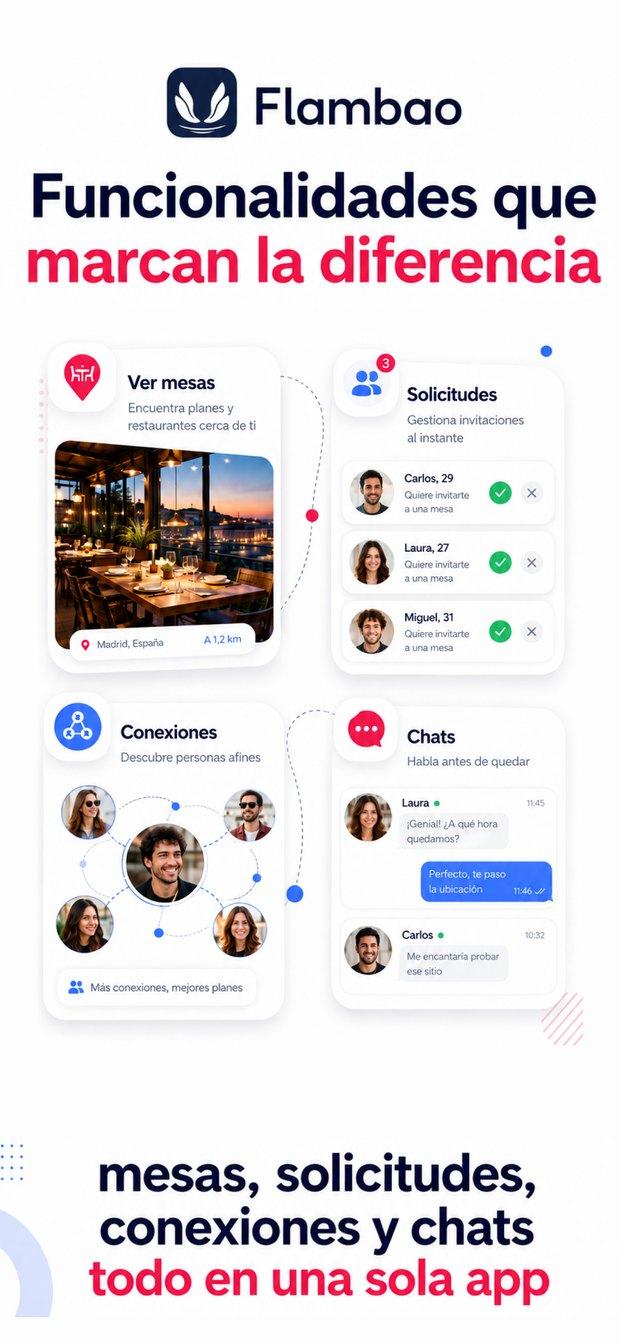
The promise and the four core features as presented in the app's store creatives: meet new people, unique moments around a table, authentic connections and a safe environment, alongside tables, requests, connections and chats. The interface is in Spanish, reflecting the app's home market.

Pick a topic, find your table: Flambao seats people around the conversations they actually want to have

The big idea: interest-led tables, where the conversation is the reason to come.

The idea that sets Flambao apart is easy to describe through one person. Imagine someone with a restless, curious mind who would happily spend an evening on how memory works or why people behave the way they do. In a normal restaurant, that conversation never happens. At a Flambao table built around science or psychology, it is the reason everyone is there.

That is the heart of the product. A person can look for a table that matches what they care about, join it, and spend the evening in conversation with people who share the same wavelength, the same intent and often the same curiosity. The app does not ask them to be someone else. It places them where their natural conversation already exists.

Why a shared interest changes the evening

It removes the small-talk tax

When everyone arrives with the same topic in mind, the first twenty minutes are not spent searching for common ground.

It makes rapport faster

Sociologists call the pattern : McPherson, Smith-Lovin and Cook's widely cited 2001 review describes how similarity between people breeds connection.

It builds confidence

Knowing why you belong at a table makes it easier to speak up, which matters most for people who find unstructured socialising hard.

It makes the next meeting more likely

People who enjoyed a topic together have something to continue.

What the profile cards show

The profile cards in the app carry a name, an age, a city and a short line of interests, such as films and series, sport, travel, culture and art, or gastronomy. Those interests are the raw material of matching. Combined with a table's category and the mutual connections shown on a card, they let a person judge in seconds whether a table is theirs.

A person who regularly sits with people who share their curiosity tends to build a wider and more varied circle, and to feel more at home in company. That is the social outcome the product is designed to serve: not more contacts, but better placed ones.

Eight tables, eight conversations: What interest-led evenings could look like

A closer look at the idea: sample tables that show how an interest becomes an evening.

An idea like interest-led tables is easiest to judge when it is concrete. The eight tables below are illustrative examples, built from the interests that appear on Flambao profile cards (films and series, sport, travel, culture and art, gastronomy) plus the science and psychology example. They are not a list of tables that exist.

Table ideaWho it drawsA conversation it might start
A table for people curious about the mindReaders of psychology, students, anyone who has wondered why people behave as they doWhy do we remember embarrassing moments so clearly?
A table for science loversEngineers, researchers and anyone who follows science newsWhat is the most surprising thing you have read this year?
Films and seriesPeople who watch with strong opinionsWhich ending would you rewrite, and how?
Travel storiesPeople who plan trips and people who have just come backWhen did a wrong turn become the best day of the trip?
Culture and artGallery-goers, museum members, concert regularsWhat did you last see that stayed with you?
Food and gastronomyPeople who plan evenings around restaurantsWhich dish would you send a stranger to try?
SportPlayers and supportersWhat is the best match you have ever been at?
A fresh startPeople new to a city or a chapterWhat did you leave behind, and what are you hoping to find?

A topic is a starting point, not a script. Nobody is expected to lecture, and the best tables drift from the stated subject into stories, jokes and tangents. What the topic guarantees is that the first question is easy to ask and the first answer is easy to enjoy.

The same person can also move between tables as their mood changes. The curious mind who joins a psychology table on Friday may take a travel table on Sunday. Interest-led matching does not box anyone in. It lets each evening be about whatever they feel like talking about that week.

Five moments in life, five kinds of table: Categories give every invitation a clear purpose

How the categories shape who joins and what the evening is for.

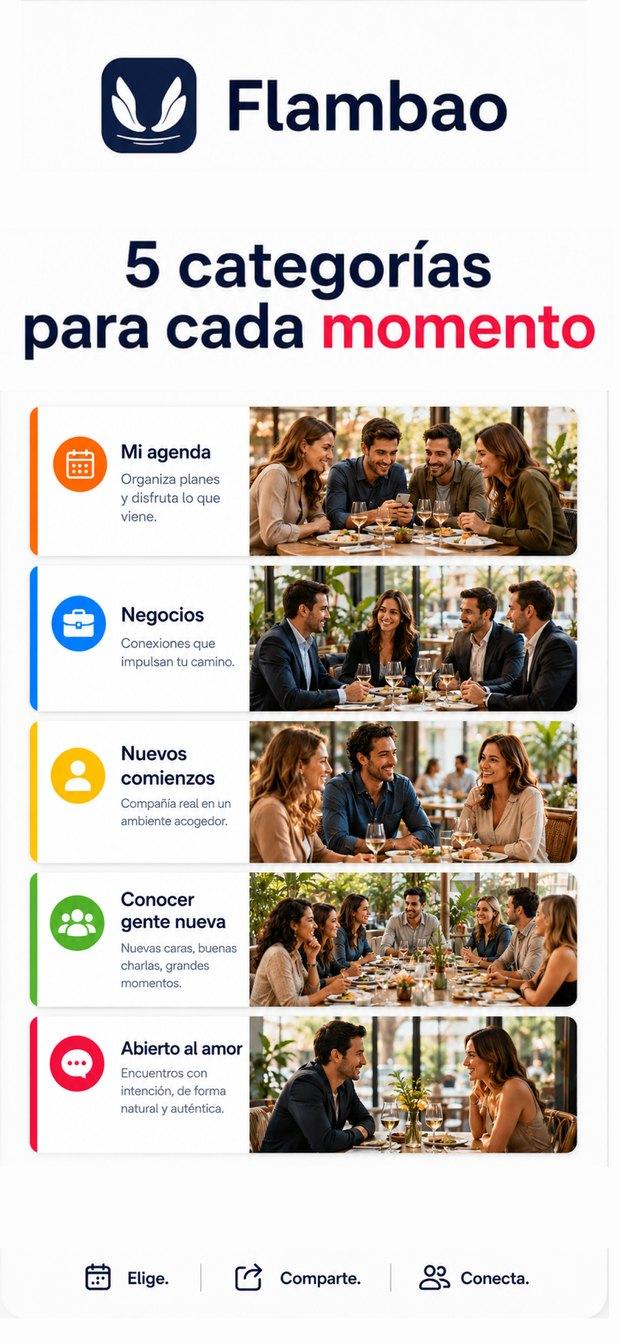
Every Flambao table declares its purpose before anyone sits down. The app presents five categories, each with its own colour, and the same colours echo through the map pins and filters so that a person can read the purpose at a glance.

My agenda
In plain English
Organise plans and enjoy what is coming
Who it suits
People who like to plan evenings in advance and make a regular habit of it
Business
In plain English
Connections that drive your path
Who it suits
Professionals who want conversation and contacts without a conference badge
New beginnings
In plain English
Real company in a welcoming setting
Who it suits
People who have moved, changed job or ended a chapter and want company
Meet new people
In plain English
New faces, good conversations, great moments
Who it suits
Anyone widening their circle, with no further agenda
Open to love
In plain English
Meetings with intent, natural and authentic
Who it suits
People open to romance who prefer meeting over a table to swiping

The store listing describes a wider set of dinner types as well, including afterwork tables, international dinners and unique dining experiences, which shows how far the model stretches.

Declaring purpose up front does three jobs. It sets expectations, so nobody arrives at a business table hoping for romance. It protects honesty, because "open to love" is named rather than implied. And it narrows the choice, so the person scanning the app sees tables that fit the evening they want.

Flambao app screen

Five categories for every moment, as shown in the app: each category has its own colour, icon and short description.

A table for eight is the whole product: Anatomy of one evening, from first filter to last course

The journey: the steps every Flambao evening follows.

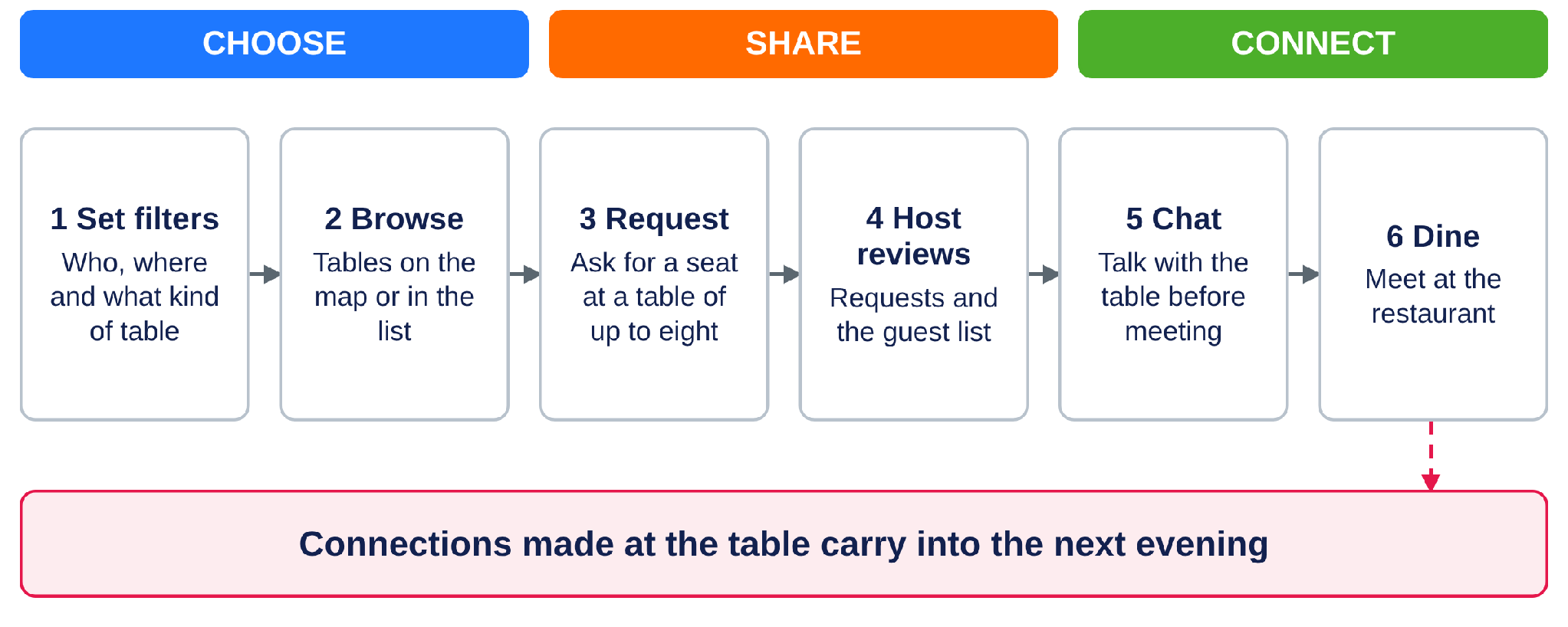
The app's motto is three short words: choose, share, connect. Each word maps to a stage of the evening, and each stage has a screen behind it.

Flambao diagram

From filter to dinner: the six steps every Flambao evening follows, grouped under the app's own motto of choose, share and connect.

Choose

The person sets who they want to meet, where and for what kind of occasion, then browses tables in a list or on the map.

Share

They send a request to join a table. The host reviews requests and the , and invitations can also flow the other way, from people who want to bring someone to their table.

Connect

Once seats are agreed, the group can talk, in direct messages or in a , before meeting at the restaurant.

Why the table is capped at eight

The store listing states that tables hold up to eight people. The design logic behind a cap like that is worth spelling out:

Large enough to survive a no-show

If one person drops out of a table of eight, the evening still works.

Small enough for real conversation

At eight, a table can hold one conversation or two, and nobody is stranded at the far end.

Compatible with how restaurants work

A party of eight is a booking a restaurant can plan for.

Easy to read

Eight seats are drawn as eight avatars, filled or empty, so a person sees at once how many places remain.

A table of eight is really two conversations of four: What group size does to talk

The evidence behind the cap: how many people can actually talk together.

Group size is not a cosmetic choice at a dinner table. Research by Robin Dunbar, Nicola Duncan and Daniel Nettle on freely forming conversational groups found an upper limit of about four people who can take part in a spontaneous conversation. The authors link that limit to the mechanisms of speech production and detection: how we speak, and how well we can follow several voices at once.

That finding changes how a table of eight should be read. Eight people rarely share a single conversation for a whole evening. They form two or three clusters that merge and re-form as people lean in, pass dishes and join each other's stories. A table of eight is, in practice, a small social ecosystem.

Several design consequences follow:

Eight is a good ceiling

It is large enough for variety and a shared moment, such as ordering or a toast, and small enough that nobody sits outside every conversation.

A shared interest keeps the clusters connected

When everyone came for the same topic, a split conversation is not a fragmented one. A thread that starts at one end of the table can travel to the other.

The table chat keeps everyone in touch

People who have already exchanged messages know each other's names and a little about each other, which makes it easier to move between clusters.

Smaller would be riskier

A table of four depends on every person and every personality fitting, and one absence is half the evening.

Larger would leave people out

Beyond eight, more clusters form and more people drift to the edges.

An honest note on evidence: the cap of eight is stated in the app's store listing, and the research above is an outside source. The link between them is design reasoning, not a published test of Flambao tables. It is the kind of reasoning a product team does well to make explicit, and then to check against what actually happens at real tables.

The map makes dinner local: Every F pin is a table waiting for one more person

Location: how the map turns an abstract idea into a real evening nearby.

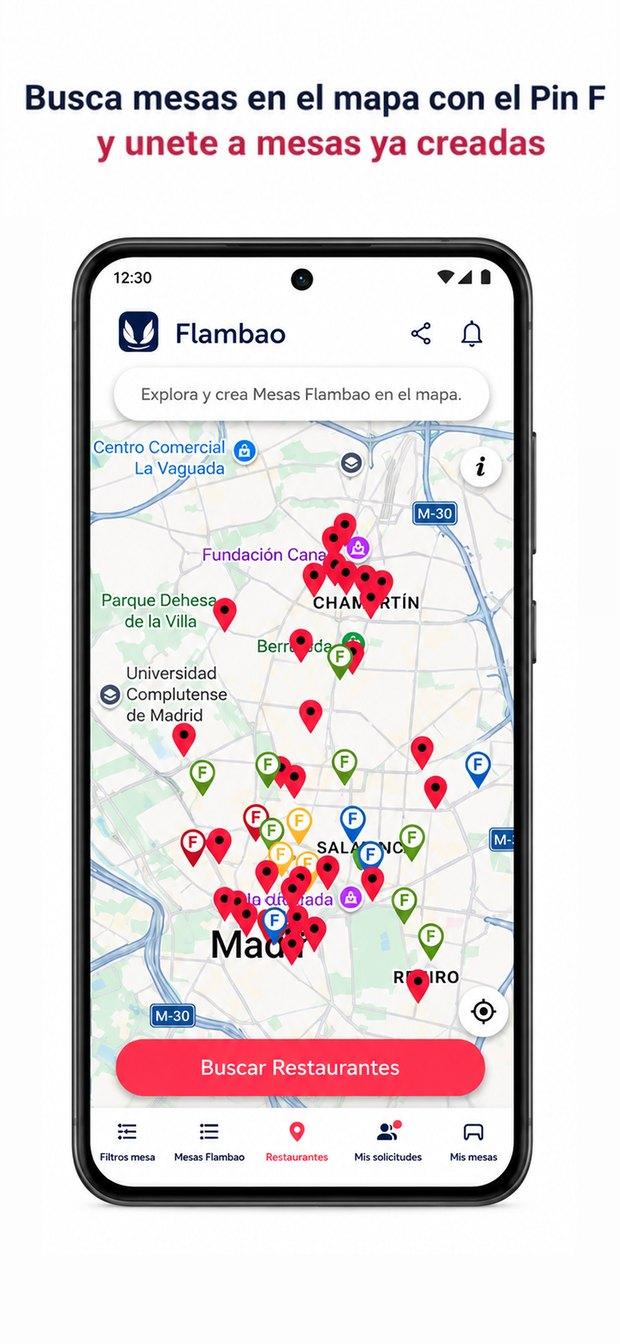
A dinner is always somewhere, and for most people the place decides whether they can go. The map in Flambao answers that directly. The app invites users to explore and create Flambao tables on the map, and the screen is covered in pins: a branded F marks a table that already exists, alongside plain pins for venues.

Search a neighbourhood and the picture is immediate. Clusters of pins show where the evening is busiest. A prominent button reads search restaurants, which lets a person start from the venue and build a table around it.

Distance is shown in plain terms, for example a table 1.2 kilometres away. That small detail carries a lot of weight. It tells a person that this is a short trip, not a project, which is often the difference between going and staying in.

The map also supports the creative side of the product. Anyone can host. A person who knows a good restaurant and wants conversation around a topic can create a table there and let the right people find it. The same mechanism serves both people looking for a seat and people looking to fill one.

Flambao app screen

The map view: tables and restaurants shown as pins around the city, with a search-restaurants button at the bottom. The interface is in Spanish.

Talking before meeting: Requests, chats and guest lists turn strangers into familiar faces

Coordination: the steps between wanting a seat and sitting in it.

Most of the anxiety in meeting strangers sits in the gap between agreeing to go and arriving. Flambao fills that gap with three tools.

Requests. A person asks to join a table with a single button. The requests screen collects everything pending, with a notification marker when something needs attention. Invitations also arrive in the other direction, in the form of a short line such as wants to invite you to a table, with an accept and a decline button beside it.

Guest lists. Hosts can see who has asked to join and who is already at the table. That visibility lets a host shape the evening and lets a guest see who they will be sitting with.

Chat. The app's headline for the chat feature is talk before you meet. The sample conversations show how ordinary the purpose is: agreeing what time to meet, sending a location, saying which dish looks good. Direct chats and a chat for the whole table both exist, according to the store listing.

The sequence is deliberate. A request creates a small commitment, the guest list creates transparency, and the chat creates familiarity. By the time someone walks into the restaurant, they have exchanged words with at least some of the people at the table. The first meeting is no longer the first contact.

A table about psychology in seven scenes: From a filter to a second dinner

The storyboard: one illustrative evening, told scene by scene.

The sequence below follows an invented person, Ana, who works in research and wants conversation, not small talk. It is a scenario, not a real user's story.

  1. 1. The itch
    It is Wednesday. Ana has no plans for Friday and wants an evening with ideas in it

    She opens the app instead of a feed

  2. 2. The filter
    She sets her area, picks the meet-new-people category and looks for people who share her interest in psychology

    Filters narrow the app to a short list

  3. 3. The table
    A table at a restaurant ten minutes away catches her eye: six seats, three taken

    Seat avatars show she has room

  4. 4. The request
    She sends a request to join

    The host sees it and the guest list

  5. 5. The chat
    Once accepted, the table chat fills with small talk: arrival time, a recommended dish

    Messaging builds familiarity

  6. 6. The dinner
    Friday night, five strangers become a conversation about memory, habit and why people tell themselves stories

    The restaurant supplies the setting

  7. 7. The second table
    Two people at the table become connections. Next week Ana is invited to a different table

    Connections carry the evening forward

Insert reference here (Storyboard visual: seven frames, one per scene, using real screens from the app)

ENGINEERING APPROACH

Every screen has to show the same truth, for many people at once

Six services keep tables, requests and chats in step behind the screens

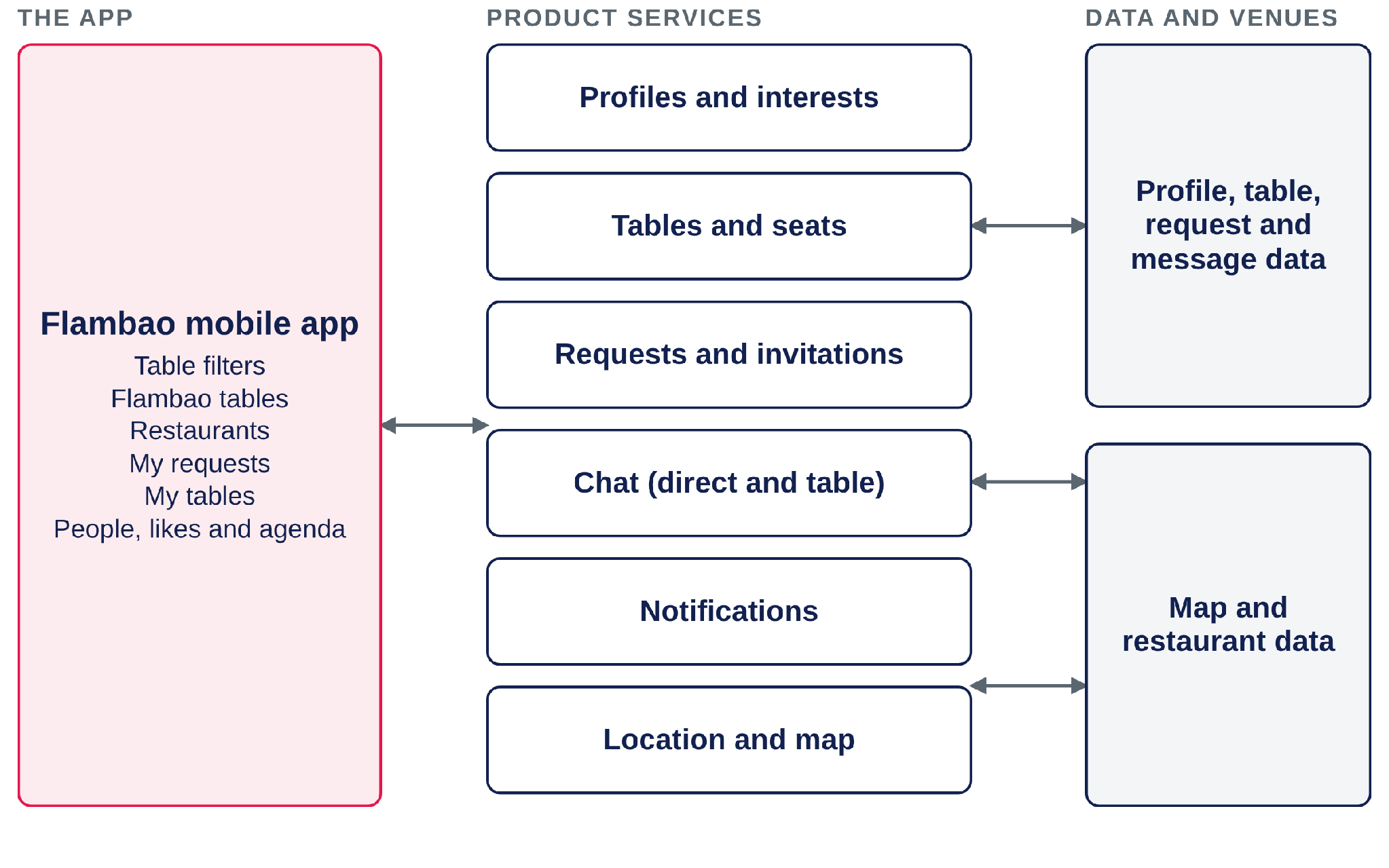
Engineering: how the product is organised so that every screen shows the same truth.

A social app is a set of promises that must stay consistent across many screens and many people at once. A seat taken by one person must disappear for the next. A request accepted by a host must reach the guest immediately. A message must arrive where the whole table can see it.

Flambao diagram

A logical view of how the product is organised. It shows capabilities, not technology choices.

Six services carry that work:

Profiles and interests hold what each person shares and what they are looking for.

Tables and seats hold each table's category, venue, date, time and the state of every seat.

Requests and invitations hold the lifecycle of every ask: sent, accepted or declined.

Chat supports direct conversations and table-wide ones.

Notifications tell people when something needs them, which is why the bell and the marker on requests matter.

Location and map turn addresses and restaurants into the pins and distances people use to choose.

What the engineering had to get right

Seat state

Tables fill quickly, so availability must be accurate everywhere at once.

Request flow

A request moves through clear states, and both sides must always see the same one.

Distance and search

Results must reflect where a person is and where they said they want to look.

Privacy

Personal information and location are sensitive, so what is shown, to whom and when is a product decision as well as a technical one.

Responsiveness

A person deciding on a Friday evening will not wait for a slow screen.

AI AND INTELLIGENCE

Three signals tell a person whether a table is right for them

Interests, intent and mutual connections replace the guesswork of sitting down with strangers

Matching: three signals that tell a person whether a table is right for them.

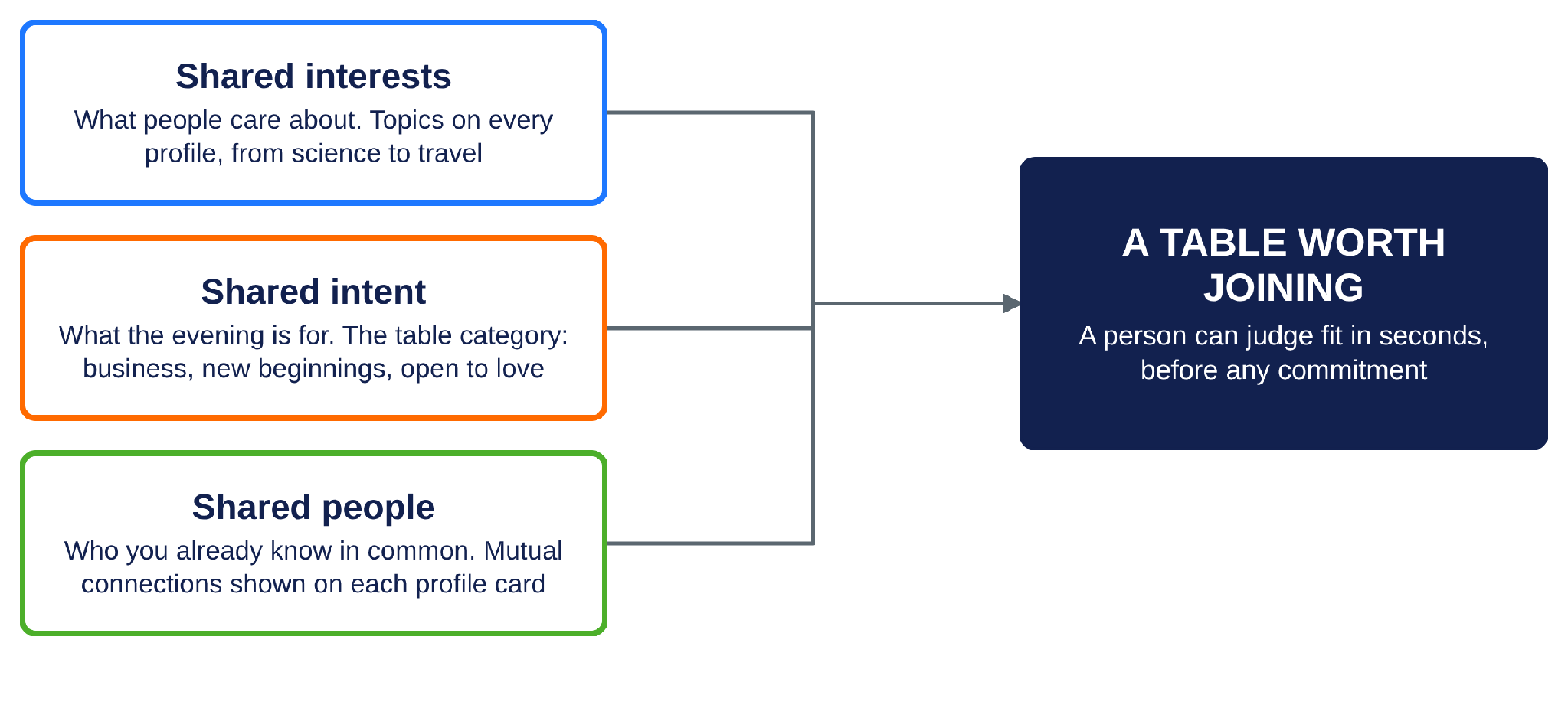
Flambao does not rely on a single measure of compatibility. It combines three signals, each visible on the screen where the decision is made.

Flambao diagram

Three signals of fit: what people care about, what the evening is for and who they already know in common.

Shared interests answer the question will we have something to talk about? They are listed on every profile and drive the conversation around the table.

Shared intent answers are we here for the same reason? The table category, from business to new beginnings to open to love, makes that explicit before anyone commits.

Shared people answer can I trust this? A badge on a profile card shows the number of mutual connections, for example two or five. A mutual connection is a quiet kind of reference: someone you know has been in a room with this person.

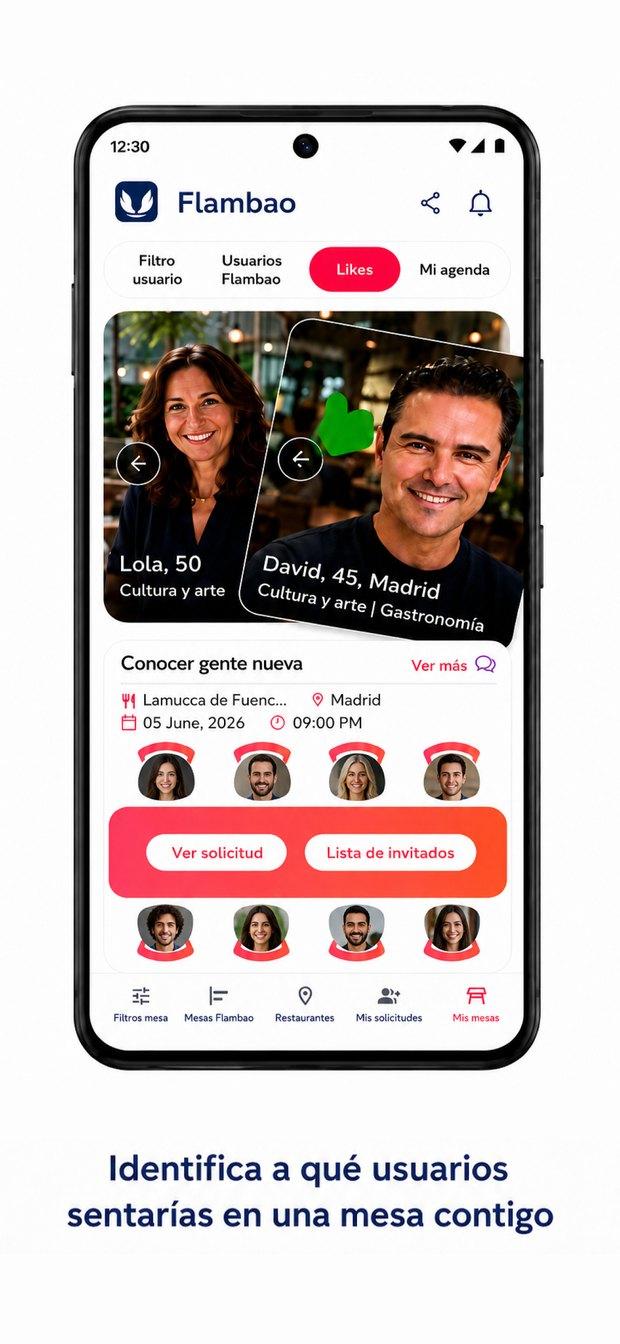
The "Likes" view adds a lighter layer. A person can show interest in other users, and the app's own headline for the feature is identify which users you would sit at a table with. That wording matters. It reframes liking as a seating decision, not a verdict on attractiveness, and it keeps the focus on the table.

Choosing beats scrolling: Filters turn a crowd of strangers into a short list of people worth meeting

Discovery: how people say who they want to meet, where and why.

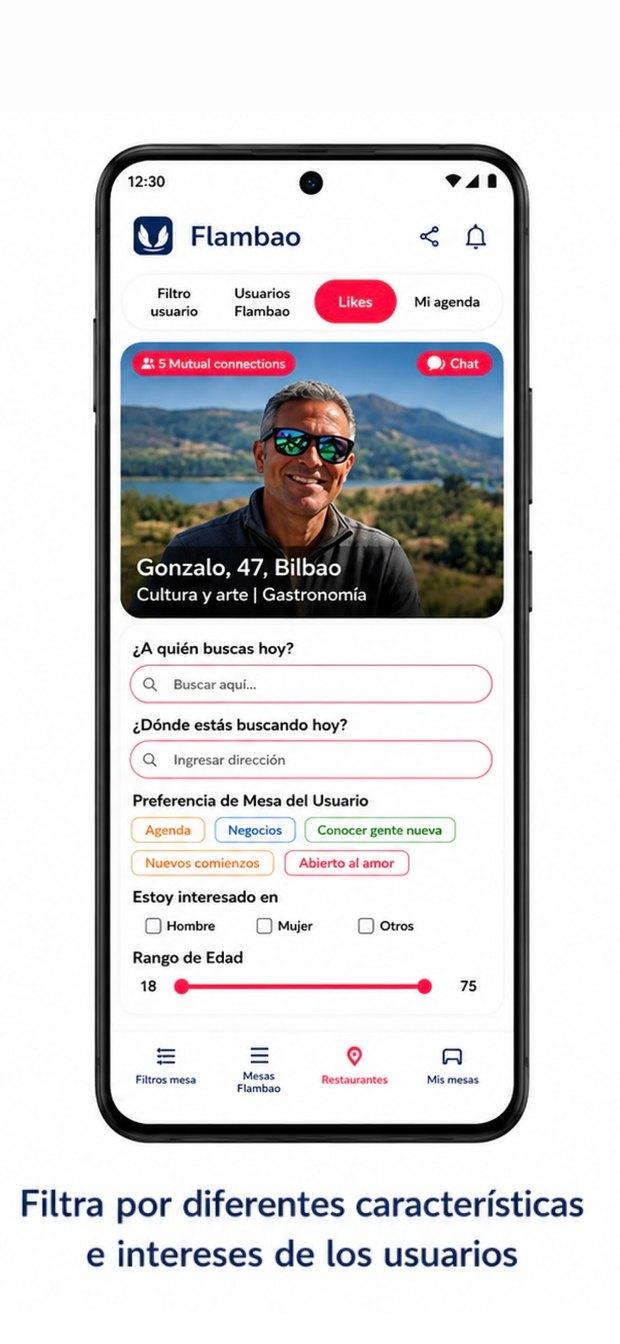
The filter screen opens with two plain questions: who are you looking for today, and where are you looking today? Two pieces of context come before any profile appears.

Beneath them sit the controls that give the product its precision:

Table preference: the five categories as selectable chips, so a person can say they want a business table or a new-beginnings table.

Who they are interested in: men, women or others.

Age range: a slider from 18 to 75.

Interests: the topics shown on each profile, which let the results lean toward the conversations a person cares about.

Filters matter more on a social app than on most products. A shopper who sees an irrelevant item scrolls past it. A person who is shown the wrong table may feel unwelcome, and may not come back. Good filtering is therefore a kindness as well as a convenience: it reduces mismatch before anyone is exposed to it.

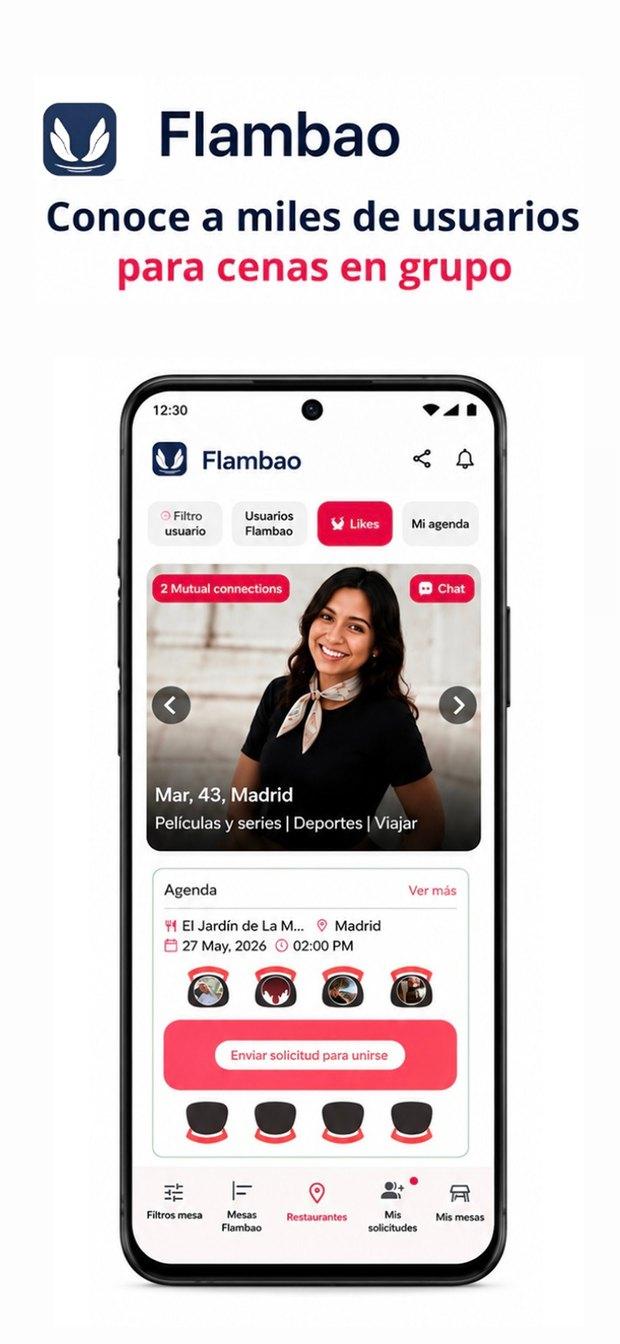
The profile cards are designed for fast judgment. A large photograph, a name, an age and a city, a line of interests, a badge counting mutual connections and a chat button all sit on a single card. A person can read it in a glance and act on it with one tap.

Flambao app screenFlambao app screenFlambao app screen

Discovery in the app: filters for people and tables, a profile card with mutual connections and an agenda card with a join button, and a likes view with a table card and request buttons. The interface is in Spanish.

SECURITY AND TRUST

Every stage of the evening is designed to lower the risk of meeting strangers

Public venues, small groups and a request before every seat do the quiet work

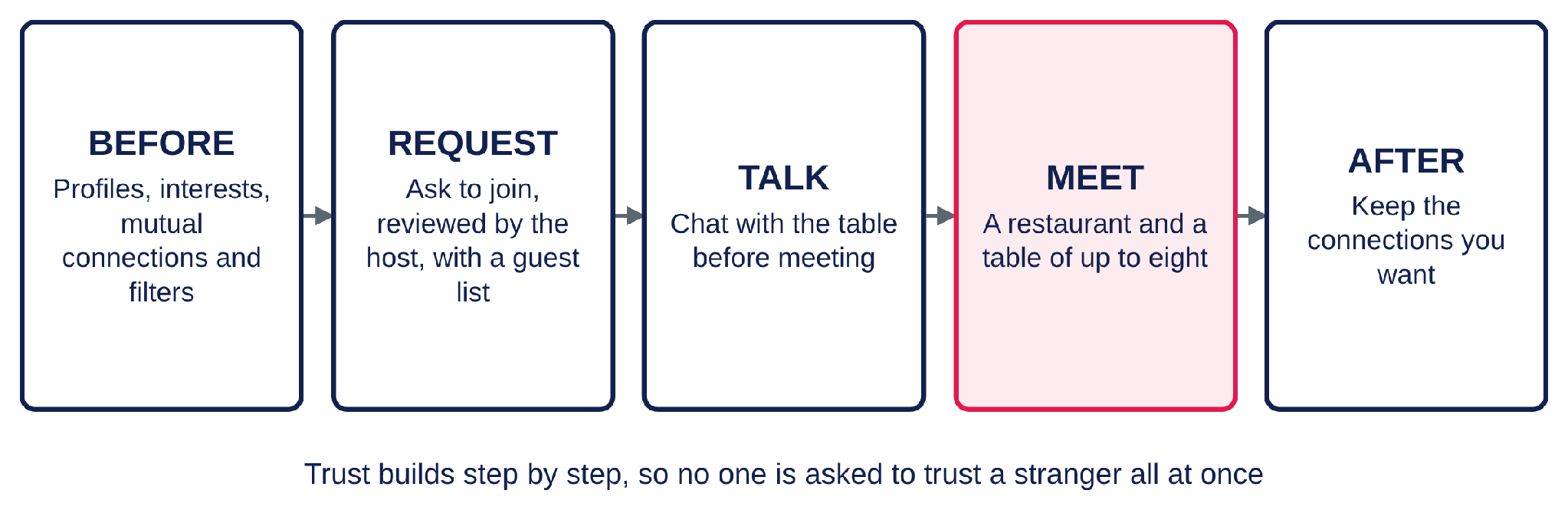
Meetings happen in public restaurants, in small groups of up to eight, with join requests reviewed by the host, a guest list and a chat before the meal. Mutual connections act as a quiet reference, and after a table each person chooses whom to see again.

Trust between strangers is built in layers, from the profile to the public restaurant

Safety by design: how the product reduces risk at every stage.

Meeting strangers is the product, so trust is not a feature added at the end. It runs through the whole journey, and the layers are visible in the app.

Flambao diagram

Five layers of trust, from knowing who you might meet to deciding who to see again.

Before
What the person can see or do
Profiles, interests, mutual connections and filters
Why it lowers risk
People judge fit before any commitment
Request
What the person can see or do
A request to join, reviewed by the host, with a guest list
Why it lowers risk
Nobody turns up unannounced
Talk
What the person can see or do
Direct chat and table chat
Why it lowers risk
Familiarity builds before the meeting
Meet
What the person can see or do
A restaurant, a small table of up to eight
Why it lowers risk
A public place with other people present
After
What the person can see or do
Connections the person can keep or let go
Why it lowers risk
The person chooses who to see again

The app presents itself, in its own store creative, as a safe and verified environment. The layers above are the parts of that promise a user can see for themselves in the interface. The structure of the product also does a lot of quiet work: the meeting happens in a restaurant, in a small group, with a record of who was invited.

DESIGN APPROACH

Designed to look like an invitation, and to welcome the people who find meeting strangers hardest

Six questions any social dining product must answer, and how Flambao answers them

Design thinking: the hard questions behind a deceptively simple idea.

Putting strangers around a table sounds simple until you list what can go wrong. Six questions shaped the product, and each has a visible answer in the interface.

QuestionWhy it is hardHow the product responds
How does someone know a table is right for them?Strangers share very little informationInterests, category and mutual connections sit on the card, and filters narrow the choice
What if a table is nearly empty or nearly full?Social products fail quietly when tables sit half filledSeats are drawn as avatars, so open places are visible before anyone asks
What if someone drops out?One empty chair can change the mood of an eveningA cap of eight absorbs a gap, and the table chat lets people coordinate
How does a shy person take the first step?Walking into a room of strangers is a high barrierRequest first, chat second, and a known size and purpose for the table
How does the app avoid becoming a dating app by default?Social apps drift toward romanceFive declared categories, with romance given its own named category
How do people stay safe?Meeting strangers carries real riskPublic restaurants, requests, guest lists, chat before meeting and mutual connections

None of these answers is dramatic. Each is a small decision about what to show, what to ask and in which order. Together they make the product feel safe enough to try and simple enough to repeat, which is what a social app needs before anything else.

The questions also explain why the product is built the way it is. A feed would have skipped most of them. A table forces every one.

Six people, six tables: One app serves very different evenings

Audiences: who uses Flambao and what each of them is looking for.

The same product serves very different needs. The six illustrative people below are composites, not real users, and show how the categories and filters adapt.

PersonWhat they wantThe table they look forWhat the app gives them
The curious mindLong conversation about ideas, such as science or psychologyA table with a stated topic and people who share the interestA room of people who want the same conversation
The newcomerCompany in a city where they know nobodyA new-beginnings or meet-new-people tableA way to meet several people at once, in public
The professionalContacts without a networking eventA business tableA small, seated conversation instead of a crowded room
The visitor or expatLocal company and local foodAn international-style dinnerA table in a real restaurant with people who live there
The person starting overGentle company after a changeA new-beginnings tableA low-pressure evening with no romantic expectation
The person open to loveMeeting people with intentAn open-to-love tableA shared dinner in place of a one-to-one gamble

What links the six is that none of them wants to be alone at a table, and none wants to be thrown into a room without a reason to talk. The categories supply the reason, and the filters supply the company.

An empty seat is the call to action: The design language behind Flambao

Visual design: how the look of the app expresses the idea of a shared table.

A social dining app has to feel warm without feeling casual about safety. The visual language of Flambao balances the two.

A confident palette

Deep navy carries the wordmark and text, giving the app a trustworthy, adult tone. A vivid crimson accent marks every action that matters: the active tab, the join button, the notification dot.

Real-life photography

Warm images of people at show the outcome the app promises, not a product interface.

Seats as avatars

The most distinctive idea sits on the table cards. Seats are drawn as small avatar shapes arranged around a central button, filled with a face where someone has joined and dark where a place is free. The join button sits between the rows like the table itself. An is the call to action.

Category colours as wayfinding

Orange, blue, yellow, green and red identify the five kinds of table in lists, filters and on the map, so the purpose of a table can be read before the text.

Rounded, generous cards

Large touch targets and soft corners keep screens friendly and quick to use with one hand.

A human voice

Short phrases such as talk before you meet and more connections, better plans keep the interface conversational.

The effect is a product that looks like an invitation. Every screen answers the question a hesitant person is asking: is there a place for me here?

Two rows of navigation cover the whole journey, so nobody has to wonder what to do next

Information architecture: how the screens are organised around what a person wants to do.

Flambao separates two ways of looking for company. The top of the home screen deals with people, and the bottom navigation deals with tables.

User filter

Set who you want to meet

Flambao users

Browse the people on the app

Likes

See who you have shown interest in and who has shown interest in you

My agenda

Keep track of the tables you are going to

Table filters

Set what kind of table, where and when

Flambao tables

Browse tables that already exist

Restaurants

Explore venues on the map and create a table

My requests

Follow every request you have sent or received, with a marker for anything new

My tables

Manage the tables you host or have joined

Splitting people from tables mirrors the way users think. Some arrive thinking I want to meet someone who loves psychology. Others arrive thinking I want to be somewhere on Friday. Both paths lead to the same place, a seat at a table, and neither forces the user through the other's route.

The bottom bar also follows the order of a real evening: set the filters, find a table, choose a restaurant, track requests, manage the plan.

Designed for the shy, the new and the wary: How the format lowers the cost of showing up

Inclusion: who the product is built to welcome, and how.

A product for meeting strangers has to be most welcoming to the people who find meeting strangers hardest. Several parts of Flambao work together to lower that cost.

Entry is a request, not an appearance

A person asks for a seat and waits for a reply. Nobody has to walk into a room cold.

There is always something to do and something to say

Eating gives people an activity, and the topic of the table gives them a first sentence.

The group is small

Eight people are easier to read than eighty, and the eight-seat cap means nobody disappears into a crowd.

There is time to warm up

The chat before dinner means the first words have already been exchanged by the time anyone sits down.

Purpose is declared

People can come for friendship, business or a new start without anyone assuming romance, and those who are open to love have a table of their own.

The audience is wide

The age filter runs from 18 to 75, and the interest options include a third choice beside men and women, so the product does not assume one kind of guest.

The interface is plain

Large buttons, short labels and familiar patterns keep the app easy for people who are not heavy users of social apps.

The measure of a social product's design is who feels able to use it. By that measure, small decisions such as the request flow and the chat-first step matter as much as any headline feature.

Nine words that explain the app: The Flambao vocabulary

A short glossary of the app's own terms, translated for readers.

The interface of the app shown in this case study is in Spanish. The terms below are the ones a reader needs to follow the screens.

Mesa

A table: one evening at one restaurant, with up to eight seats

Mesas Flambao

The tables created by users of the app

Pin F

The branded map marker that shows where a table exists

Mi agenda

My agenda: the tables a person is going to

Solicitudes

Requests: asks to join a table and invitations to one

Conexiones

Connections: like-minded people a person has met

Likes

A way to show interest in other users

Lista de invitados

The guest list for a table

Elige. Comparte. Conecta.

The app's motto: choose, share, connect

BUSINESS MODEL

One idea serves the three people who make an evening happen: a guest, a host and a restaurant

One product, three pitches: How Flambao sounds to a guest, a host and a restaurant

Positioning: the same idea, explained to the three people who make an evening happen.

An evening at a Flambao table depends on three kinds of people, and each cares about something different. The idea is the same. The pitch changes.

To a guest: Stop wondering who to have dinner with. Pick a table built around something you care about, ask for a seat, talk to the group first and arrive knowing you belong.

To a host: Bring people together around a topic you love, at a restaurant you trust. Set the purpose, see who wants to come and shape the evening with a guest list you can read.

To a restaurant: Receive a group that has already agreed to come, sits together and stays for conversation. Eight people arriving as one booking is the kind of table a restaurant wants.

What connects the three is the table. For the guest it is a place to belong, for the host it is a stage and for the restaurant it is a booking. A product that serves all three has a reason to exist for each, which is why the model is stronger than any single side of it.

Restaurants gain fuller tables, which makes the venue part of the story

The other side of the table: why restaurants are a natural beneficiary.

Every Flambao evening happens in a restaurant. That makes the venue more than a backdrop. A group of up to eight arrives together, eats together and stays for conversation, which is the kind of booking a restaurant is built to serve.

The model also opens a possibility for venues. Tables that might otherwise be taken by one or two diners can be filled by a group that has already agreed to come. The store listing notes that restaurants can be chosen worldwide, and the map lets hosts pick the place they know.

For a restaurant, the appeal is not a discount or a gimmick. It is a reliable way to meet new customers who arrive in company and in a mood to enjoy the evening. These are the directions the model supports, and they describe where a venue's interest could grow rather than results already achieved.

REVENUE MODEL

Flambao earns in two directions: from the restaurants it partners with and from a fee on every seat booked

Restaurants partner with Flambao

Flambao earns through partnerships with restaurants. Every evening happens in a restaurant, and a group of up to eight arriving as one booking is the kind of table a venue wants, which gives restaurants a reason to partner.

Guests pay a fee to book a seat

People pay a fee when they book a seat at a table. The per-seat fee is discussed with users.

One table feeds both streams

Each table brings seats booked by guests and a filled table for the restaurant, so the model earns from both sides of the same evening.

FINAL IMPACT

An app at the start of its story, built so that every table can seed the next

A live app, a public listing and a community taking shape: Where Flambao stands today

The current picture, taken from the app's public Google Play listing.

Flambao is live on Google Play, where it is listed in the Social category by Flambao S.L. The figures below come from the public listing, and show an app at the start of its story.

Content rating

12+, with the note that users interact

Downloads

500+

Table size

Up to 8 people

Chat

Direct chat and chat for the whole table

Table types

Afterwork, professional networking, international dinners, friends or small groups, unique dining experiences, open to love and new beginnings

A product like this grows by the density of its community. Tables need people nearby, and people need tables to join, which is why the first chapter of a social app is about building enough activity in a place for the next evening to be easy to organise.

From one-off dinners to lasting circles: Connections keep the community alive

Retention: how a single evening becomes a habit.

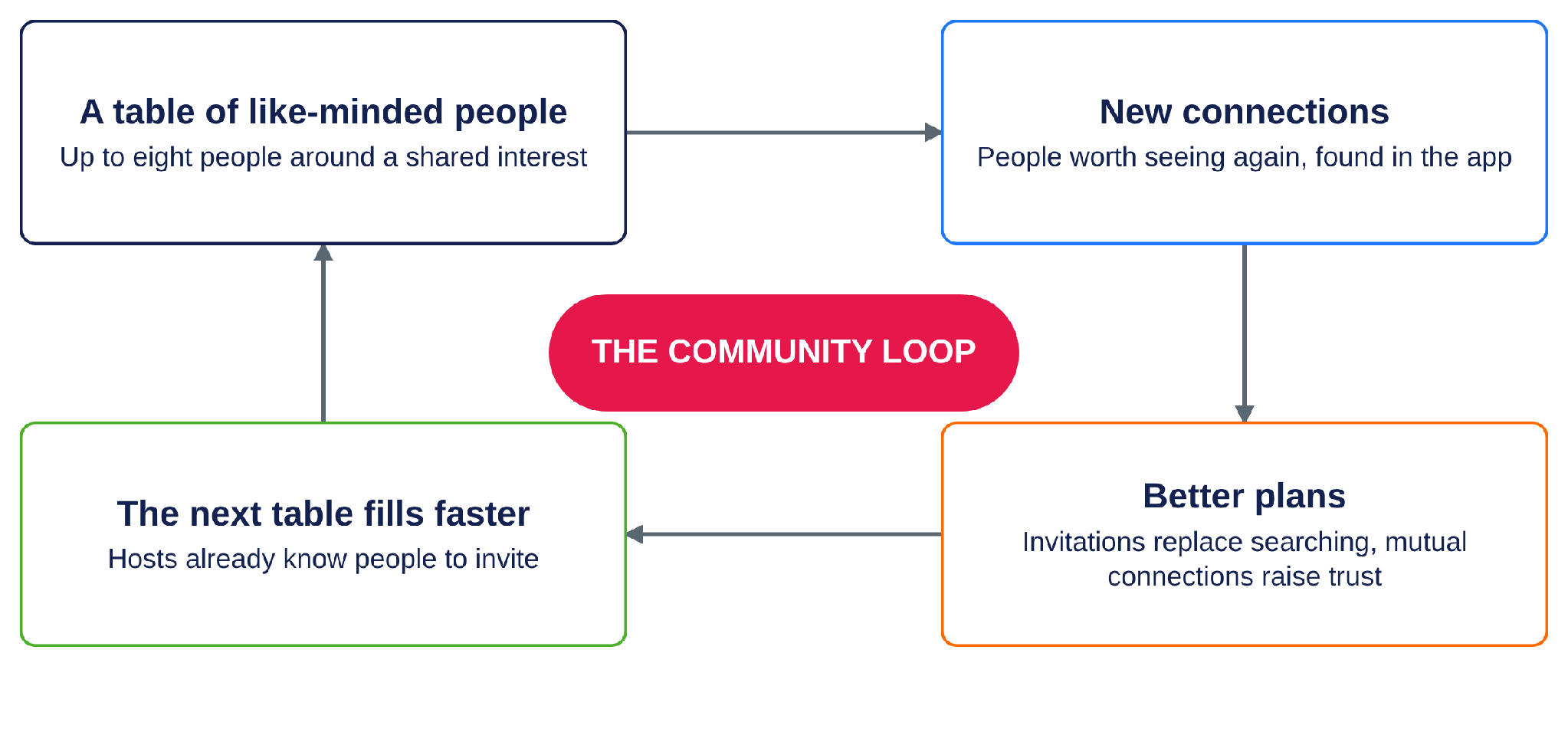
A dinner is an event. A community is what remains after it. Flambao is built so that every table can seed the next.

Flambao diagram

The community loop: each table creates connections, connections create better plans and better plans fill the next table.

The connections area of the app is described in its own words as a place to discover like-minded people, with the line more connections, better plans. The sample screen shows a person at the centre of a small network of faces, which is exactly the point. After a good evening, the people worth seeing again are already in the app.

The loop works in three ways:

Mutual connections raise trust

The more people someone meets, the more mutual connections show up on future profile cards, so each new table feels safer than the last.

Invitations replace searching

Once people know each other, they invite each other. A table is easier to fill when its host already has people to ask.

Interests deepen

A conversation that began at one table about science or film can continue at the next, with the same people and a better version of the topic.

This is also why a social product cannot be judged by downloads alone. What counts is whether the circle grows.

Five signals show whether strangers really became friends: Measuring a social product

Measurement: what to watch, and why downloads are not enough.

The success of a social product lives in what happens at the table, not on the home screen. The five signals below show whether the idea is working. They are the measures to track; this case study does not claim figures for them.

Table fill rate
What it shows
How many seats are taken on tables that are created
Why it matters
Whether the supply of tables matches demand
Request acceptance
What it shows
How often a request to join turns into a seat
Why it matters
Whether hosts and guests are well matched
Show-up rate
What it shows
How many confirmed guests actually attend
Why it matters
Whether the pre-meeting chat and commitment work
Repeat attendance
What it shows
How many people come to a second table
Why it matters
Whether the evening was good enough to repeat
Connections after a table
What it shows
How many people stay in touch afterwards
Why it matters
Whether strangers became part of each other's circle

Together, the five describe a funnel from interest to friendship. Each stage has a different owner: the filters shape fill, the host shapes acceptance, the chat shapes show-up, the evening shapes repeat attendance and the people shape connection.

Five lessons for anyone designing a product that gets people offline

What the project teaches: design principles that apply well beyond dining.

Building Flambao produced a handful of lessons that travel to other social and community products.

1. Make the purpose explicit before people meet. Categories, filters and interests do the work of an introduction. When everyone knows why the table exists, the evening starts further along.

2. Treat group size as a design decision. A cap of eight is not a technical limit. It shapes conversation, booking and the risk of a no-show.

3. Put conversation before chat. Messaging is useful only as a bridge. The product succeeds when it moves people from screens to a table.

4. Treat location as a feature. On an offline product, distance decides participation. The map is not an add-on; it is how the idea becomes reachable.

5. Design for the empty seat. A seat waiting to be filled is the most persuasive thing a screen can show, because it turns an abstract invitation into a specific place for a specific person.

Video thumbnail goes here (16:9)
Video

Watch the Flambao video

See the platform in action on our video page.

Watch the video

[Client quote goes here.]

Flambao founder
INDUSTRIES IT SERVES

One table-based model that serves several industries

Every one of these reuses the same four building blocks: a table, a purpose, a place and a group of people who chose to be there.

Social and community products

Turns online interest into an in-person gathering with a clear purpose, a small group, a place, a request flow and a chat.

Hospitality and restaurants

Sends groups of up to eight who arrive as one booking and stay for conversation, with hosts choosing the venue from the map.

Professional networking

Business tables give contacts through a small, seated conversation instead of a crowded room.

Travel and expat communities

International-style dinners give visitors and expats a table in a real restaurant with people who live there.

Employers, alumni and community groups

Private tables for their own people, a direction the model supports rather than an announced plan.

WHAT'S NEXT FOR FLAMBAO

The structure leaves room to grow without redesigning it

Built to grow: New cities, new table types and new reasons to gather already fit the model

What comes next: the directions the product structure supports.

The structure of Flambao leaves room to grow without redesigning it. The possibilities below are directions the model supports, not announced plans.

New cities

A table, a restaurant and a map work anywhere people eat. The store listing already notes that restaurants can be chosen worldwide.

Themed series

A recurring table around a topic, such as a monthly science night or a book table, could turn one-off evenings into a habit.

Host tools

Hosts who run tables regularly could be given ways to manage guest lists, repeat bookings and build a following.

Venue partnerships

Restaurants that value fuller tables could become regular homes for particular types of evening.

Community and company tables

Alumni groups, expat communities and employers could run private tables for their own people.

More ways to build trust

Further verification and feedback tools could strengthen the safe environment the app already promises.

Each of these reuses the same four building blocks: a table, a purpose, a place and a group of people who chose to be there.

FAQ

Frequently asked questions about Flambao and the project

Quick answers for readers who want the essentials.

What is Flambao?

A social dining app that lets people find, create and join tables of up to eight people at restaurants, so they can meet like-minded people over a meal.

How do tables work?

A host creates a table at a restaurant with a category, date and time. Others send a request to join, the host reviews requests and the guest list, and the group can chat before the meal.

Can I join a table about a topic I care about?

Yes. Profiles show interests, tables carry a category and filters narrow the results, so a person interested in science or psychology can look for tables where that conversation is the point.

Is it a dating app?

No. Romance is one of five categories, called open to love. The others cover planning evenings, business, new beginnings and meeting new people.

How does the app help people feel safe?

Meetings happen in restaurants, in small groups, with join requests, guest lists, mutual connections and a chat before the meal.

Why a mobile app and not a website?

Choosing a table is a decision made on the move, with a map, a notification and a chat close at hand. A phone is the natural place for it.

Can this approach work for other community products?

Yes. Any idea that turns online interest into an in-person gathering can use the same ingredients: a clear purpose, a small group, a place, a request flow and a chat. Talk to our team about adapting it.

SOURCES

The research referenced in this case study

  • World Health Organization, Social connection linked to improved health and reduced risk of early death, 30 June 2025, WHO Commission on Social Connection.
  • Hall, J. A., How many hours does it take to make a friend?, Journal of Social and Personal Relationships, University of Kansas, 2018.
  • Dunbar, R. I. M., Breaking Bread: The Functions of Social Eating, Adaptive Human Behavior and Physiology, University of Oxford.
  • Dunbar, R. I. M., Duncan, N. D. C. and Nettle, D., Size and structure of freely forming conversational groups, 1995.
  • McPherson, M., Smith-Lovin, L. and Cook, J. M., Birds of a Feather: Homophily in Social Networks, Annual Review of Sociology, 2001.
  • Flambao listing on Google Play, for table size, categories, content rating and download count.