Metaverse Infrastructure Needs: How AR VR App Development Companies Can Prepare for the Next Digital Frontier
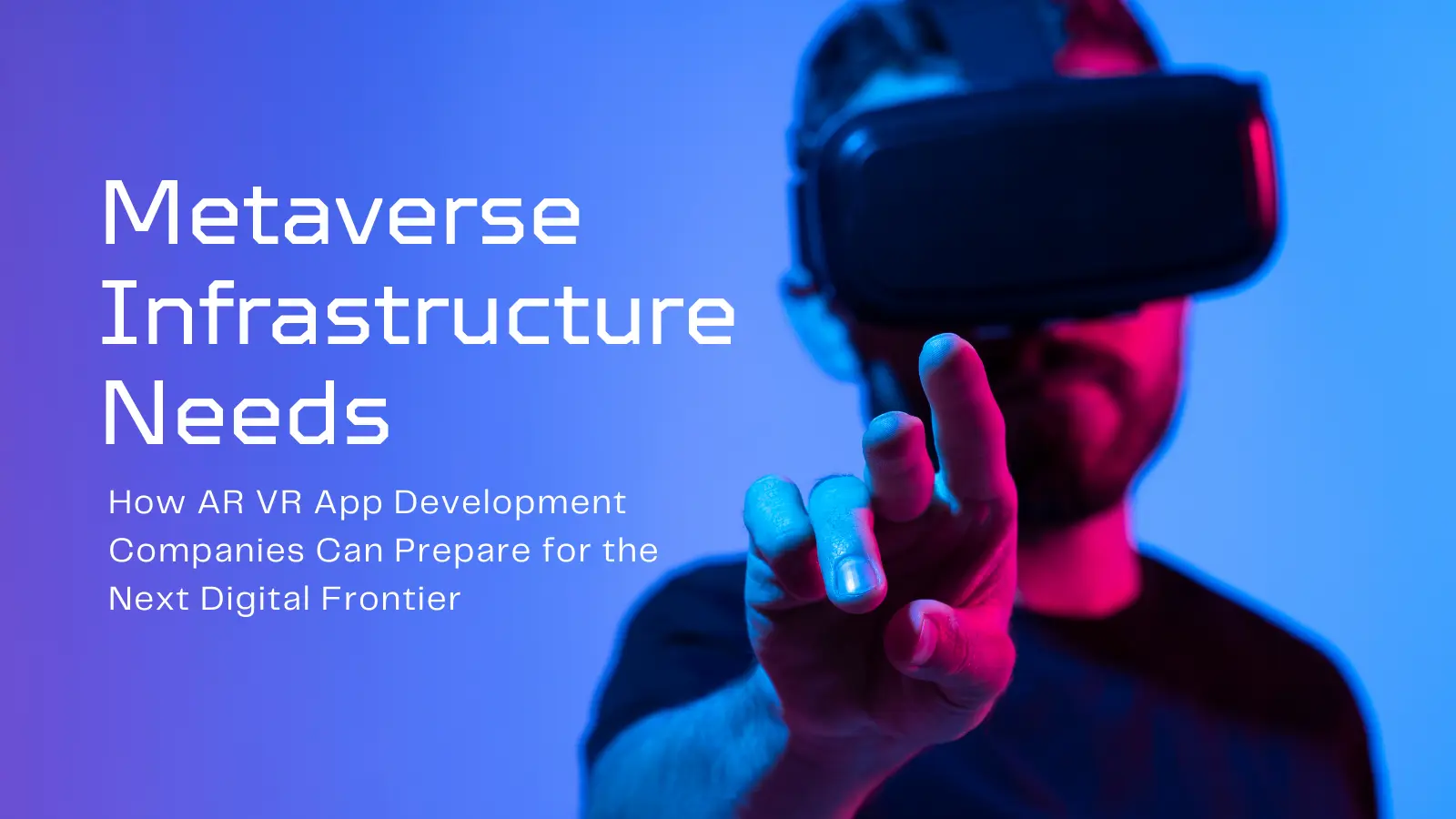
Comprehending the Metaverse and Its Infrastructure Fundamentals
The Role of AR VR App Development Companies in Building the Metaverse
The metaverse's success rests in the hands of AR VR app development firms, who are the architects of immersive digital experiences. Theirs is more than coding and app designing; they are responsible for building realistic simulations, interactive virtual bazaars, and dynamic collaborative spaces. Such firms have to embed tools such as motion capture, 3D rendering, and real-time user tracking within their offerings. A professional AR VR application development firm is well-placed to offer customers innovative solutions that not just entertain but also yield quantifiable business returns. Be it a virtual real estate display suite, a VR school, or an AR retailing experience, the technical expertise of development firms guarantees these spaces work flawlessly. Additionally, through providing varied AR VR app development services, they enable businesses in all industries—healthcare, education, e-commerce, and more—to claim their space in the metaverse. This foundational contribution places them at the forefront of the digital frontier.
Connectivity and Cloud: The Digital Backbone of the Metaverse
Underlying every metaverse experience is connectivity. Without a high-speed internet connection, real-time collaboration and immersive experiences are not feasible. The advent of 5G networks and edge computing has changed the way users consume AR and VR applications, with reduced latency and loading times. Cloud platforms like AWS, Azure, and Google Cloud play a crucial role in hosting large metaverse worlds, offering the scale needed for millions of users. It is imperative for an AR VR app development company to create applications that leverage the capability of cloud services. Providing AR VR app development services that incorporate cloud-based functionalities such as multiplayer syncing, virtual asset storage, and device compatibility guarantees smooth user interaction. Edge computing also enables local processing of data, which minimizes delay while interacting in real-time. Development firms that keep pace with cloud and connectivity innovation will better be able to provide metaverse-ready apps that satisfy the needs of enterprises and end-users alike.
Hardware and Device Ecologies Facilitating Metaverse Takeoff
Hardware is just as crucial for the success of the metaverse as is software. Devices like VR headsets, AR glasses, haptic gloves, and motion trackers serve as portals to rich digital worlds. In the absence of good, affordable hardware, users are not able to realize the potential of AR VR. AR VR app development firms need to develop applications that are tailored for a variety of devices, ranging from Meta's Quest headsets to Microsoft's HoloLens and Apple's Vision Pro. A visionary AR VR app development firm also ensures their apps are accessible on mobile devices, making experiences more accessible. Providing AR VR app development service that accommodates the changing device environment means these firms can serve a variety of audiences. As the hardware gets more sophisticated—with lighter weight, enhanced graphics, and enhanced comfort—the need for optimized AR VR applications will increase. Companies developing these applications that know these trends in hardware are able to create experiences that are not only aesthetically pleasing but also run flawlessly across platforms.
Security and Privacy Issues in the Metaverse
As the metaverse grows, issues around data privacy and user security escalate exponentially. Virtual spaces gather sensitive data like biometric information, behavioral patterns, and financial transactions. Therefore, AR VR application development firms need to incorporate strong security features into their apps. Encryption standards, multi-factor authentication, and blockchain-based identity verification are the key elements of secure AR VR platforms. A veteran AR VR app development firm understands that users' trust comes first and designs apps with inherent protection from breaches and misuse. Offering AR VR app development services that ensure compliance with international data protection regulations such as GDPR and CCPA will differentiate firms. Transparent data collection and use policies also build brand trustworthiness. As users and businesses commit more resources and time to the metaverse, demand will naturally follow for secure and privacy-focused solutions. Development firms that innovate solutions to meet these requirements first will be the pioneers of the next digital dimension.
Blockchain and Digital Ownership in the Metaverse
The metaverse brings a new age of blockchain-enabled digital ownership. From virtual land NFTs to decentralized finance networks for facilitating in-world transactions, blockchain is the backbone of ownership and trust. AR VR app development firms are required to embed blockchain technologies into their offerings in order to make seamless ecosystems for consumers. By offering AR VR app development services that include features such as tokenized assets, smart contracts, and safe wallets, companies allow brands and individuals to engage in this digital economy. An AR VR app development firm that knows about the integration of blockchain can develop virtual marketplaces, decentralized applications, and interactive economies that drive user experiences. The future of the metaverse depends almost entirely on transparent and verifiable ownership models, and blockchain provides accountability at all levels. Businesses that harmonize AR VR applications with blockchain will not only grow the capabilities of virtual spaces but also drive their adoption among mainstream audiences
AI and Automation Driving AR VR App Development Services
Artificial Intelligence (AI) is a game-changing influence revolutionizing the future of AR VR apps. From creating photorealistic avatars to driving smart NPCs (non-player characters) and delivering personalized suggestions, AI adds richness to virtual worlds. AR VR app development firms have to integrate AI algorithms into their work to provide next-generation features. An innovative AR VR app development firm utilizes machine learning for real-time environment adaptation, voice recognition, and predictive analytics. Providing AR VR app development services integrating AI with immersive technologies enables businesses to create apps that become alive, responsive, and interactive. For instance, AI can monitor user activity and modify virtual spaces to improve learning in edutainment apps or drive sales in shopping apps by presenting targeted product recommendations. Automation also simplifies development procedures, saving on costs and time-to-market. By embracing AI-powered solutions, development firms can keep their services at par and engaging within the changing metaverse environment.
Getting AR VR App Development Companies Ready for Industry-Specific Solutions
Various industries will incorporate the metaverse differently, and AR VR app development firms need to be ready to adapt their services in response. In medicine, AR VR apps can transform surgery training and therapy. In e-commerce, immersive virtual stores will change shopping experiences. In property, home buyers can view properties in virtual reality before they buy. A company specializing in AR VR app development for such industries will have a competitive advantage. Sector-specific application development needs profound knowledge of industry opportunities and challenges. For example, educational sites require user-friendly designs so that students are interested in using them, whereas enterprise collaboration software needs to focus on data security and real-time synchronization. Firms that diversify their services into different industries not only increase their customer base but also become more resilient in an ever-changing landscape of technology. Customized solutions will be the hallmark of effective AR VR development in the metaverse age.
Challenges AR VR App Development Firms Need to Overcome
Though the potential in the metaverse is enormous, AR VR app development firms have various challenges to overcome. High development expense, device constraints, and divergent standards may retard adoption. Moreover, to produce truly immersive and interactive experiences, one needs competency in several fields, from 3D design to user experience engineering. A visionary AR VR app development firm has to invest in talent building, research, and alliances to remain ahead. Providing end-to-end AR VR app development service packages that respond to client issues—like cost savings, scalability, and compatibility—overcomes these challenges. The other key challenge is persuading old-school businesses to invest in metaverse solutions, as the ROI is uncertain. In order to be successful, development firms need to prove actual business benefits, like more customer interaction, lowered training expenses, or increased sales conversions. Through overcoming these challenges, AR VR app development services will be integral to the creation of the digital frontier's infrastructure.
Conclusion: The Future of AR VR App Development Services in the Metaverse
The metaverse is a revolutionary change in the way we live, work, and socialize. It calls for a solid infrastructure that includes connectivity, hardware, security, blockchain, and AI. AR VR app development organizations are at the vanguard of this transformation, crafting the applications and experiences that will shape the digital frontier. With innovative AR VR app development services, organizations can enable businesses in diverse industries to adopt immersive technologies and build enduring customer value. Along the way, the process demands adaptability, creativity, and vision. Those businesses that invest in scalable infrastructure, user security first, and new technologies will be the leaders. A company that develops an AR VR app today for these demands is going to define tomorrow's metaverse. For brands wanting to succeed with a hyper-digital economy, working with seasoned development companies is no longer necessary—it is the solution to tapping the infinite potential of the future digital world.
More Blogs
Expert AR VR App Development Company Crafting Next-Level Immersive Applications
No longer science fiction buzzwords, Augmented Reality (AR) and Virtual Reality (VR) are becoming defining technologies across industries from gaming and education to healthcare and enterprise training. The biggest challenge, though, h...
The Role of Blockchain & Web3 in Transforming Services Offered by Metaverse Development Services
The metaverse has rapidly become more than simply a catchphrase of the future—it is a new model for digital connection, commerce, and imagination. Although virtual reality and 3D spaces bring the metaverse to life, the true shift...

From Vision Pro to Niche Apps: AR/VR Trends Powering 2025 and Beyond
2025 is poised to become a watershed year for virtual reality (VR) and augmented reality (AR). What was futuristic technology is now deeply ingrained in mainstream dialogue, not only among technology aficionados but also within busines...

 Awards & Recognition